JUST WHAT HE WANTED
Reading edition
A Restless Seeker After Excitement, the War Filled the Bill for Lieutenant Roberts
Few young men enlisted for the war more frankly in the spirit of adventure than did Lieutenant E. M. Roberts, an American boy, born in Duluth, and seemingly born with the unrest of the winds of the Northwest in his blood. When he was but ten years old he ran away from home in obedience to the restless longing to fare for himself, go whither he listed, and taste the ruggedness of nature in experience. He tried lumbering in the Northwest. He crossed the border into Canada and successively turned his hand to many things—mining, automobile repair, railroad construction, cow-punching, sheep-raising, etc.—getting a liberal education in the “University of Hard Knocks,” as he expressed it, but never finding just the excitement he vaguely yearned for.
He was in Calgary in October, 1914, and by chance learned from a newspaper in which he had wrapped a purchase, that there was war doing in Europe. It struck him that the thing sought, the desired excitement, was now ready to hand. He met an old friend and talked the news with him. The friend told him that there had been a call that morning for men for service in Europe. “Let’s join!” Both were of the same mind; both were ready for adventure. Next morning he enlisted as a member of the 10th Canadian Infantry Battalion. But the officer in charge of the barracks knew Roberts, and recalling that he was familiar with mechanics, transferred him to a mechanical transport section, not at all to his liking, mechanics being but a tame affair.
In time he went with the battalion to France as driver of a lorry. He got a dose of gas at Ypres and was sent back to England for hospital treatment. On recovery he was returned to France as Section Sergeant, his duty being to scout the roads ahead on a motor cycle. He found that he was getting very little out of the war but hard work, plodding knee deep in mud much of the time while up there the flyers were having a jolly, enviable time. Ambition to get into the Royal Flying Corps seized him and never let go of him, but it was long before the opportunity to join came to him. Much experience of many kinds came his way, despatch riding among the rest, before the happy day when he was attached to an air squadron as gunner on probation, the getting of which position was in itself an adventure, as is duly set forth in A Flying Fighter, the intensely interesting story of his career told by Roberts himself.
Though on the way he was yet far from his goal. He had first to go into the trenches to learn what infantrymen had to go through. He got a thorough lesson, which included prowls in No Man’s Land, charging enemy trenches and plunging in to prod with the bayonet and fling hand grenades and much like matter rather adapted, one would imagine, to disqualify an aspirant for service in the air, for rising above ground. But he arrived in due time at the dignity of an accepted aviator, and made his first flight. Then came the excitement of shooting down his first Hun, but we pass that and many other arresting incidents and exploits of his apprenticeship to come to his account of an exceptional sort of encounter with hostile planes that has in it all the elements of dramatic surprise.
He was assigned to pilot duty with a scout and fighting squadron doing service in France, and his first turn of service consisted of patrol duty for three days running. It was an uneventful start, nothing occurring in the three days. On the fourth day he went up again on patrol to 20,000 feet. He was looking for Huns up there but found none. As it was very cold he decided to go down a way, and shut off power. He says:
“At the level of 18,000 feet, I found myself sweeping along a very large peak of cloud. Intending to spoil its pretty formation I dived into it, and coming out on the other side, found myself along side of a Hun plane of the Albatross type. [Roberts was in a Spad.] I had no intimation at all that a Hun was present, and I guess he was in the same position.
“THE HUN WAVED AT ME AND I WAVED AT HIM”
“I suppose he was as much surprised as I was when he saw me emerging from the cloud. Neither of us could shoot at the other for the reason that the guns of the machines we were flying were fixed to the machine so that the machine itself has to be pointed.
“We were so close together that this could not be done without our ramming one another, which both of us had to avoid if we did not wish to crash to the earth together.
“The Hun waved at me and I waved at him.
“We found ourselves in a very peculiar situation. I was so close to him that I could see with the naked eye every detail of his machine. His face also I could see quite clearly, even to the wrinkles around his mouth.
“There was something odd in our position. I had to smile at the thought that we were so close together and yet dared not harm one another. The Hun also smiled. Then I reached down to feel the handle on my pressure reservoir to make sure that it was in its proper place, for I knew that one of us would soon have to make a break.
“I had never before met a Hun at such close quarters in the air and though we flew parallel to one another for only a few minutes, the time seemed like a week. I remembered some of the tactics told me by some of the older and best fighters in the corps, and was wondering how I could employ them. Finally a thought occurred to me. Two machines flying at the same height are not necessarily on exactly the same level, as they keep going up and down for about 20 feet.
“I was flying between the Hun and his own lines and I had fuel for another hour and a quarter anyway. I wanted to make sure of this bird, but decided to play a waiting game. We continued our flight side by side.
“After a while, however, much sooner than I expected, the Hun began to get restless and started to maneuver for position; like myself he was utilizing the veriest fraction of every little opportunity in his endeavor to out-maneuver the antagonist. Finally, the Hun thought he had gotten the lead.
“I noticed that he was trying to side-slip, go down a little, evidently for the purpose of shooting me from underneath, but not far enough for me to get a dive on him. I was not quite sure as yet that such was really his intention, but the man was quick. Before I knew what had happened he had managed to put five shots into my machine, but all of them missed me.
THE HUN SPINS EARTHWARD
“I maneuvered into an offensive position as quickly as I could, and before the Hun could fire again I had my machine gun pelting him. My judgment must have been fairly good.
“The Hun began to spin earthward. I followed to finish him, keeping in mind, meanwhile, that it is an old game in flying to let the other man think you are hit. This bit of strategy will often give an opportunity to get into a position that will give you the drop on your antagonist. The ruse is also sometimes used to get out of a fight when in trouble with gun jam, or when bothered by a defective motor.
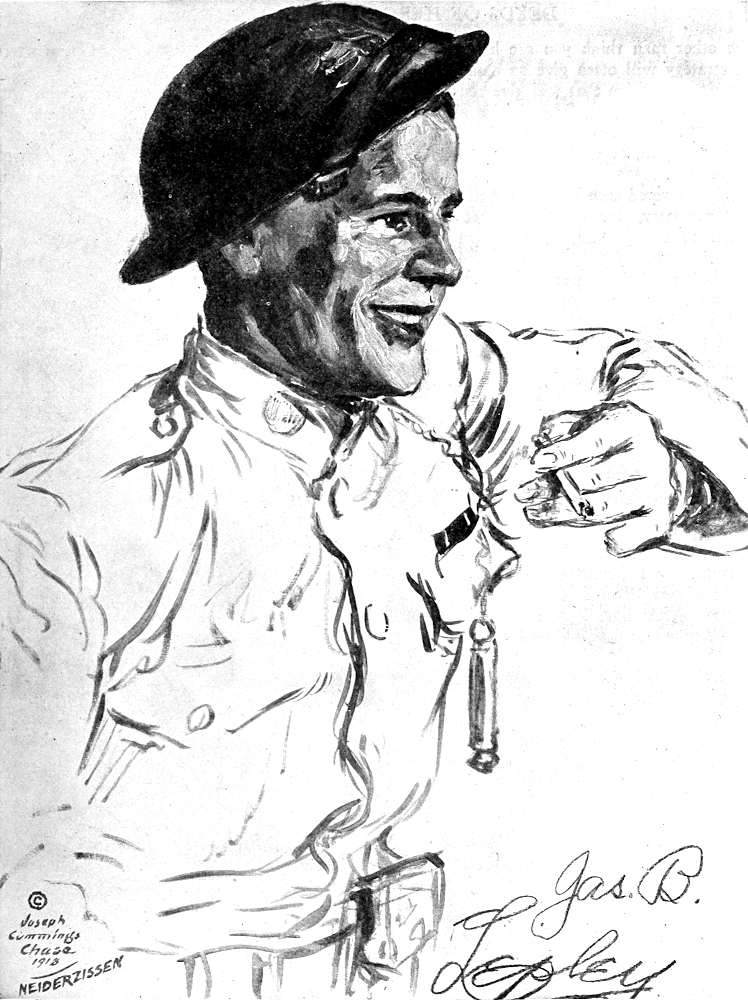
Drawn by Joseph Cummings Chase.
Sergeant James B. Lepley
42nd Division, 168th Infantry, Company “M”
On the night of July 14 and 15, 1918, to the northeast of Châlons-sur-Marne, near Souain, Lepley left his trench in a dense gas attack, and made his way to a wood through a rain of shrapnel. He went in search of two men lost from his platoon. He found them and guided them back to the trenches. A few days later, near Sergy, he led his platoon in a charge upon six machine-gun emplacements, which they captured, together with over thirteen prisoners of the Prussian Guards.
“I discovered soon that this precaution was not necessary, for the Hun kept spinning down to the ground. He landed with a crash.
“A few minutes later I landed two fields away from the wreck and ran over to see the kill I had made.
“I had hit the Hun about fifty times and had nearly cut off both his legs at the hips.
“There was nothing left in the line of souvenirs, as the Tommies had gotten to the wreck before I did. I carried off a piece of his props and had a stick made of it. That night we had a celebration over the first Hun I had brought down behind our own line since I became a pilot.
“Next day I went out to get another Hun to add to my collection. I was in the act of crossing the Hun lines when, bang! to the right of me came a thud, and my engine stopped. Revenge, I thought. I volplaned to the ground, made a good landing in a field just behind our lines, and, ’phoning up the squad, I then had another engine brought out to replace mine.
AVIATOR PRICE DOWNS THREE PLANES
“On my way to the squadron I witnessed one of the greatest air fights I have ever seen. It took place above the cemetery of P——.
“Three Huns were aloft behind their own lines, and back of them was one of our patrolling scouts.
“The Hun does not believe in coming over our lines if he can possibly help it, and generally he will maneuver so that any engagement will have to be waged over German territory.
“One of our men named Price, who was coming in from patrol, was pilot of the scout, which was flying at the same height as the Hun aircraft, about 12,000 feet. Price was well behind the Hun lines when they saw him, and all three of them made for him at once. I happened to be at an artillery observation post, which I had to pass on my way home, and so was able to get a good view of the combat.
“The foremost of the Huns made straight for Price, and for a minute it looked as though he intended ramming him. The combatants separated again and began to fire upon one another, as the tut-tut-tut of the machine guns told me. Of a sudden one Hun volplaned, while another made straight for Price. I wondered what Price would do, but saw the next moment that he had ‘zoomed’ over the second Hun machine, which just then swooped down upon him. While Price was ‘zooming’ I noticed that the first Hun was falling to the ground, having either been disabled or killed by Price’s machine gun.
“Yet within a few moments the second Hun also crashed to earth, and the third was now making for home as fast as his motor would carry him; but Price chased and quickly caught up with him. It was an exciting race. Price was working his machine gun for all the thing was worth, and before long the third Hun went down.
“Just five minutes had been required for the fight. When I met Price later I congratulated him. I remember wishing him all the good luck a fellow could have. But that did not help, for within a month he, too, came down in a heap.”
Roberts won his lieutenant’s commission and achieved the distinction of Ace before he returned home. He was four times wounded in mid-air.
In April, 1918, the American forces just going into active sectors had three squadrons, two for observation and one for pursuit. Their strength totaled 35 planes. In May, 1918, the squadrons were increased to nine. The most rapid growth occurred after July, 1918, when American De Haviland planes were becoming available in quantity for observation and day bombing service, and by November, 1918, the number of squadrons increased to 45, with a total of 740 planes in action.