BETTER WRECKER THAN SPY
Reading edition
Scion of a Noble Prussian Family Who Failed to Deliver the Goods
Though he may not have been a conspicuous success as a spy, Gustav Constantin Alvo von Alvensleben had a very decided record as a wrecker. Through his directive genius many concerns, industrial and financial, went to utter smash, involving the loss of an unknown but huge number of millions of dollars and causing a suicide or two. In the brief span of years between 1904 and 1911 Alvo rose from the precarious state of a hobo to the lofty plane of millionairedom. That is a performance that requires some doing, and indicates a mental aptitude for the peculiar office of “playing your fellow man” considerably above the ordinary.
And Gustav, or, as he was more commonly named, Alvo, played with no mean counters. Among his clients was Kaiser Wilhelm himself, who, through Alvo, invested two and a half million dollars in British Columbia timber. Other clients were the ex-Chancellor Bethmann-Hollweg, Gen. von Mackensen, the conqueror of Rumania; Emma von Mumm, the champagne queen; Bertha Krupp, the gun woman, and others of equal prominence in Germany. The companies he organized or coupled up with his enterprises—nearly all of which collapsed when the shadow of war blighted Alvo’s golden prospects—included the Alvensleben Canadian Finance and General Investment Company, the Standard Fish and Fertilizer Co., the Vancouver Timber and Trading Co., the Piercite Powder Co., the German-Canadian Trust Co., etc. Also with these went several of the Pacific Coast’s largest financial and industrial concerns, including the Bank of Vancouver, the Issaquah and Superior Coal Mining Company of Seattle, and the Dominion Trust Company, whose failure following the alleged suicide of its managing director, W. R. Arnold, was one of the greatest scandals in the history of the Dominion of Canada.
Two private banks of Seattle closed their doors as a result of their connection with the I. and S. Coal Company, one of the projects of the gambler-financier. The final liquidation of his original real estate and financial company in Vancouver disclosed liabilities of over one and a half millions, with assets of about $3,000, insufficient to satisfy the liquidator’s fees.
NOT A NONDESCRIPT
It is assumed that Alvo would have been able to extricate himself from his difficulties and avert the bankruptcy into which he was forced but for the outbreak of war. The fatality lay in the fact that all his investments were in countries with which the Kaiser was or was about to be at war.
But to begin at the beginning, as we find it in an issue of the Canadian Courier of October, 1917, when Alvo’s career came to a conclusion, temporarily at least, by his internment as a spy.
© National Service.
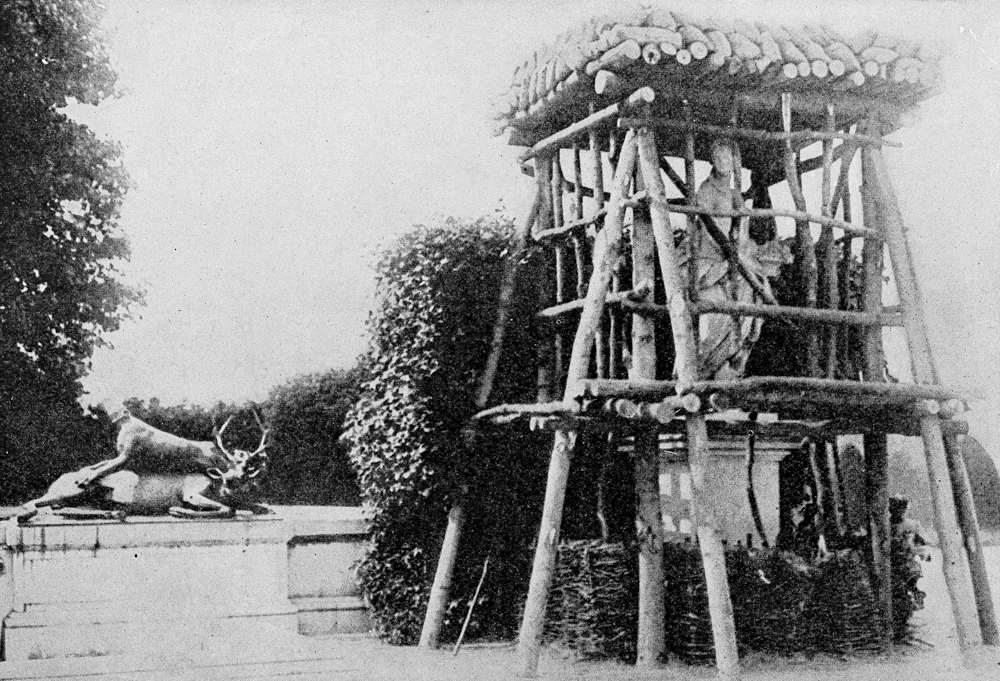
Protecting French Works of Art
A scaffolding built around the statue of “Flore” at Versailles to protect it from enemy air raids.
He was not a mere nondescript adventurer. He was the youngest son of Count Werner Alvo von Alvensleben, erstwhile German Ambassador to Russia, when Nicholas was Czar. The young man had a taste for the livelier side of life, gaily dissipated his allowance and seemed to regard college life not so much as an educational purpose as a convenience to the sowing of wild oats. This was not at all to the liking of Papa von Alvensleben and in an hour of unsuppressed wrath and resentment he cast the young man off and bade him shift for himself. This was an unexpected climax to his pleasure quest, and rather shocked Alvo. He remembered that the Kaiser was an intimate friend of his father’s, of the family indeed, and it jarred his pride to be an outcast from a circle of such distinction. He felt under obligation to reëstablish himself in the good graces of his father and the august personage whom he had so often familiarly hoched. So he set out to subdue some fraction of the world to his service and credit. He did not immediately find a field of action.
It was in the rôle of a hobo that he drifted into Western America and began casting about for the horn of plenty from which he hoped to shake substantial advantage. Two inches above six feet in stature, two years under forty years of age, he was typically Prussian, stubborn, unreasonable, of violent temper. But he was a good talker and not without imagination. Behold him arrived in Seattle. The Canadian Courier says:
HOBO TO MILLIONAIRE
“He was practically dead broke. An employment office extracted from him the usual $2 fee—all he had—and sent him to a job in a lumber-mill some distance from the city. Alvo tramped many miles to the mill only to be refused employment upon his ticket. He could scarcely speak any English, but he knew how to use his fists. Walking all the way back to Seattle, he proceeded to beat up the employment agent in thorough and picturesque fashion. Afterward he secured temporary rough work at various mills along Puget Sound.
“His first job in British Columbia was the whitewashing of a salmon-cannery at the little village of Ladner, near the mouth of the Fraser River. His wardrobe included overalls and a dozen dress-shirts—the latter relics of his grander days—but he had no socks. From wielding the whitewash-brush to hauling the nets was the next step, and it was not long before the Prussian Junker’s son was engaged in partnership with a rough-neck fisherman making nightly trips out into the Gulf of Georgia, and doing his share in one of the hardest and most dangerous callings in the world, that of a deep-sea salmon-fisher.
“In two months, with the money obtained from his salmon fishing, he was enabled to purchase an ancient mare and a light wagon. Over night he blossomed out as a produce-dealer, buying poultry and dairy products from the farmers in the vicinity of Ladner. These he brought to the city of Vancouver and sold them from house to house in opposition to the Chinamen. Business increased, and the staid old Vancouver Club, a hoary and the most exclusive institution, in which only the most elect held membership, became his best customer.
“But Alvo did not stay long in the business; but went up by leaps and bounds. Real-estate clerk, then curb-broker, then large independent dealer were some of his upward steps, until two years after he had sold his last load of produce to the Vancouver Club he was himself a member.”
There was one little incident of the club life which pleasantly reminds us that Alvo was not an upstart and therefore not a snob. He was entertaining a German baron soon after having become a member, and he noticed that the waiter eyed him very curiously. Presently divining the reason, Alvo suddenly looked up at the waiter and said: “Yes, by jingo, I’m the man who used to deliver chickens at the back door. Now go on serving dinner, and stop staring.”
PLAYS THE GAME WELL
“When the real-estate boom struck Vancouver in 1905,” continues the Courier, “Alvensleben was quick to see the opportunities in land. The old wild gambling spirit of his youthful days was still strong upon him. He was the man for the moment, reckless, willing to take chances, and a born mixer. He cabled relatives in Berlin, who had heard of his early successes, and induced them to invest large sums of money. His first investment yielded enormous and quick profit, and thus established his prestige in Germany, for he promptly repaid the investors with a 1,000 per cent. on their money. In the next three years he made several visits to Germany, brought men of royal blood to the Pacific coast, and was given several audiences with the Kaiser, whose accredited representative he became. In all probability, at a very conservative estimate, Alvensleben caused $20,000,000 of German capital to be invested in British Columbia and Washington State.
“In 1908, after a very romantic courtship, he married Edith Mary Westcott, a popular Vancouver girl, daughter of one of the leading society matrons. Following the marriage the financier purchased the largest private estate in Vancouver’s most select residential district, Point Grey, where he erected a magnificent home. His name, high foreign connections, and expenditure on entertainment that set a hitherto unknown high mark in the very British city of Vancouver, quickly brought him valuable social connections.
“His business ventures broadened with astounding rapidity, but most of his purchases for himself and clients were made on ‘agreements,’ with the expectations of making big margins in the prevalent boom. A good salesman himself, he was also the easiest mark for wildcat schemes who ever came out of Europe, owing to his gambling mania. Soon his companies became loaded up with timberlands, bought at inflated prices, wild lands, doubtful mining leases, Alberta oil shares, and other unproductive assets. Some of his wealthy clients thrust upon him their useless sons, whom he was forced to maintain in his office at high salaries.
SHY ON DIVIDENDS
“In 1912 the first trouble arose over dividends not being forthcoming from his investments. He was still strong in Berlin and went there and raised fresh capital with which he succeeded in placating some of his investors. Then he was attacked in a Vancouver German paper which charged him with unscrupulous methods in handling foreign capital. Copies of this were mailed to Berlin to members of the Reichstag by the Vancouver editors, and the matter was brought up for discussion by that body. Alvo was game. He sued the local paper and secured judgment in a criminal action against the editors. But the fat was in the fire as far as his German clients were concerned, though he managed to keep his affairs afloat.
“In the early part of 1914 the financier’s creditors, both in Europe and Canada, were pressing him. He was tied up in such a mass of deals, counter-deals, and trades of property with Arnold and the Dominion Trust Company that an army of auditors has never as yet succeeded in untangling them. He owed over $10,000 to one of Vancouver’s chartered banks on some Victoria Island timber deals, which he had anticipated selling to the British Columbia government for a park reserve. The Vancouver manager and a dozen of the staff were dismissed through their connection with this loan.”
He doubtless had advance notice of the outbreak of war, for he suddenly left Canada.
Later interviewed by a New York paper he said he could “best serve his country and his clients by returning to the Pacific Coast,” and from the outbreak of the war until his arrest on the suspicion that he was implicated in a plot to steal the plans of the Puget Sound Navy Yard of Bremerton, he remained in Seattle and other American Pacific Coast cities.
THE WIND-UP
“Rumors were afloat several times that he had visited Vancouver in disguise. After one of these reports appearing in the local papers, Alvensleben wrote to a friend in Vancouver, saying: ‘You can tell the good people of Vancouver I have something better to do than visit their city in the disguise of a Hindu or any other of their numerous allies.’
© Underwood and Underwood.
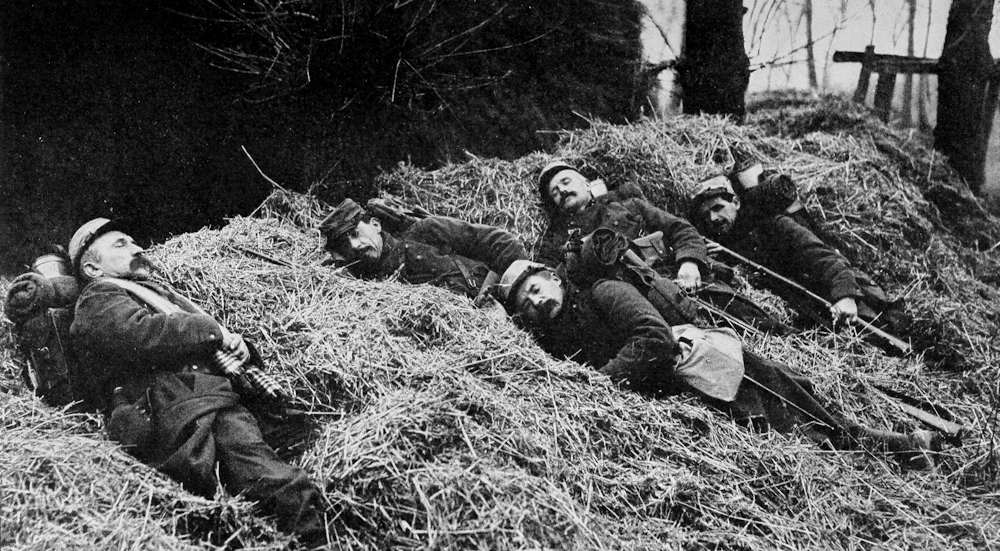
Exhausted French Soldiers Resting in a Farmyard
A pile of straw was a welcome couch to men who had been for days in the trenches near the Yser. Men under artillery fire were often unable to get any sleep for several days. Sometimes their nerves were so shattered that they were unable to sleep after they were relieved. Deafness from the concussion of their own heavy artillery was also a frequent occurrence.
“Alvensleben’s brother, Bodo, who was in charge of the Victoria branch of the Alvensleben Canadian Finance and General Investment Company, left hurriedly a few days before the outbreak of war to join his unit. The wildest rumors were circulated as to the spying operations of the brothers. It was said that Bodo had been taken off a ship by a British man-of-war, and when searched had in his possession the plans of the Canadian navy-yard at Esquimalt, and for this he was shot. Alvo denied the report, but whatever happened to this escaping brother, British censorship has never let out. Joachim von Alvensleben, an elder brother, well known from his various visits to Vancouver, was killed early in the war.”
The third and most brilliant of the brothers, the gambler-financier Alvo, was arrested at Portland and taken to Seattle, where he was interned “till the end of the war.” Concerning his subsequent proceedings there is no important information; at all events his meteoric career made a chapter of life which Vancouverites will never tire of discussing.