COLORED TROOPS REACH THE RHINE
Reading edition
Though They Had More Than Their Share of Trouble to Get to France
Everybody knows what a record the 15th New York Colored Regiment made in the war, how splendidly it fought, the heroism it displayed and the honors it received, but not everyone knows what adversities it had to contend with before it could get to France. The Colonel of that remarkable regiment (which revived the memory of the Civil War military reports that “the colored troops fought nobly”), Col. William D. Hayward, has given a humorous account of those difficulties. This was in one of the many talks Hayward—who has put off the title of Colonel and returned to the civilian simplicity of “Mister”—has been compelled to make in response to public requests. He said, broadly smiling:
“The first thing I ever did in my life that anybody approved of was getting up that regiment. After I gathered my crowd of Harlem waiters, bellhops, indoor chauffeurs, and elevator boys I thought I’d never get them across. When the minute finally came for sailing I think every elevator on Riverside Drive stopped automatically.
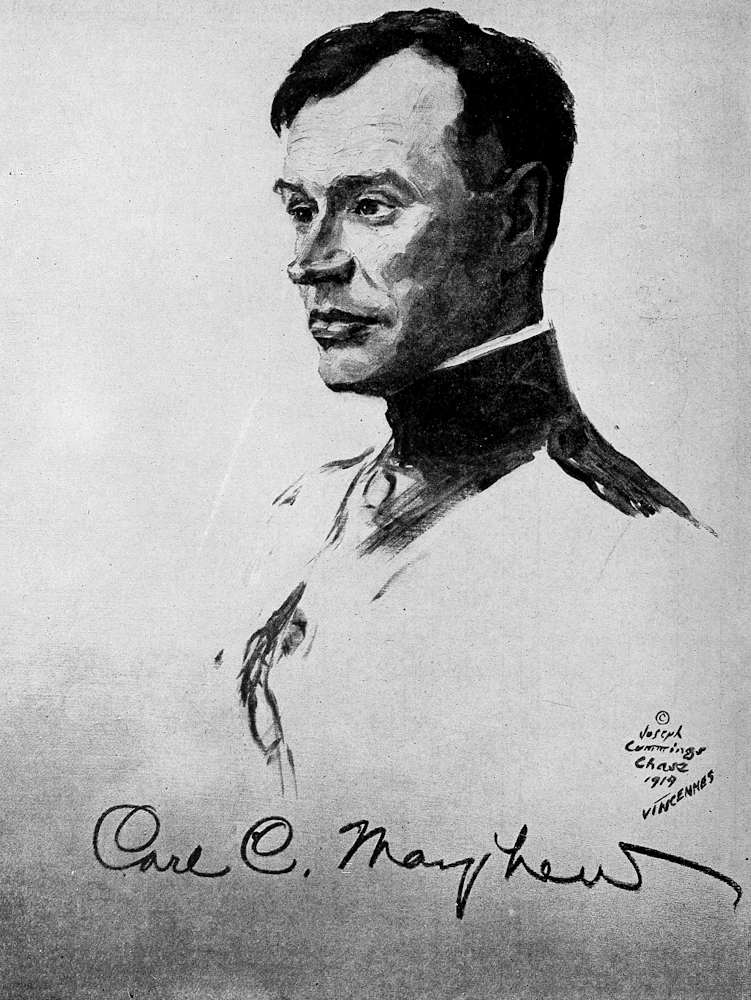
Drawn by Joseph Cummings Chase.
Second Lieutenant Carl C. Mayhew
26th Division, 101st Infantry.
Cited for skill and courage displayed May 8, 1918, while making a daring patrol in the enemy’s front line trenches resulting in the death of 2 German officers and the gathering of valuable information. He participated in 44 raids, receiving 3 citations.
“When our ship left in 1917 we sailed a little way, then broke down, came back, and tied up at Hoboken with our cargo of Thanksgiving turkeys and black troops. We got fixed up and started again. We didn’t get quite as far as before when the ship caught fire. I sneaked back and reported the mishap to General Shanks at the port of embarkation. Our ship was overhauled and a third time we set out full of hope, but the machinery broke down again. When I reported to General Shanks this time, he said: ‘Goodness gracious, Colonel, are you ever going to get those coons and turkeys to France?’
“When at last we reached the French front in the Argonne Forest I reported to the French officer in command that I had arrived with the 15th New York Infantry and would place myself and men at his disposal. ‘It is impossible!’ exclaimed the officer. ‘There’s no such American unit due here.’ Finally he said in surprise, ‘Are you the 369th Infantry Regiment of the United States?’ and I replied, ‘I are.’
GAVE THEM BOLOS
“Then they took all our American ordnance away and gave us bolos, which are knives modeled after those used by the Cubans. I was glad afterward, although I think my boys would have done better with razors. When we were leaving France I was told that the regiment would be presented with three thousand razors by the French. When we received the gift we found they were safety-razors. The regiment was insulted.
“From March, 1918, until the following January we were with the Fourth French Army, under General Gouraud. On July 15 I wrote Governor Whitman that the German Army was licked. They were at maximum strength and we at minimum, but ten American divisions were arriving monthly.
“My boys had a sublime faith that they would win. The idea of defeat never entered their heads. No private or officer had any doubt about our ability to break through. One day I found a number of the men buying German money that had been taken from the dead. I asked why they wanted it, and they answered, ‘We’ll be needin’ this here money soon.’ In five months they were spending it in the Rhine towns and talking Harlem German with a Yiddish accent. They were the advance guard of the Allied armies. The French gave them the honor of carrying the Stars and Stripes to the Rhine. And I was the first man to scoop water from the river. Can you beat that for Allied generosity?
“The boys all had a keen sense of humor. When we docked at Hoboken they were eager to get ashore. One of them said to me: ‘Colonel, the Generals is goin’ over the gangplank and the rats is goin’ over the hawsers. We hope you’ll tell us when it’s time for the regiment to go ashore!’
“I remember one little negro on the other side who was carrying shells from an ammunition-dump to a train. He was so loaded down with 3-inch shells that he was sunk ankle-deep in the mud. He said to his officer, ‘How you got my name on dat sheet?’
“‘Your name is Simpson,’ replied the officer.
“‘Yas, sir, dass right; only I thought maybe you had “Sampson” by mistake.’”
He jested about them freely, did Colonel Hayward, but the jests were of a kind to betray the intense pride he felt in the soldierly character and spirited daring of the men under him. The Hun learned to regard with wholesome fear a charge of Hayward’s “bellhops and waiters,” as he styled them.
At the beginning of the war there were only 750 officers, 393 nurses, and 3,619 enlisted men belonging to the Medical Department of the American Army. In November, 1918, the corresponding figures were 39,363 officers, 21,344 nurses, and 245,652 enlisted men.
In the 19 months elapsing from the declaration of the war to the signing of the armistice the American Army created an embarkation service which succeeded in shipping overseas 2,075,834 men, and 5,153,000 tons of cargo.
During the whole period of active hostilities the American Army lost at sea only 200,000 deadweight tons of transports. Of this total, 142,000 tons were sunk by torpedoes. No American transport was lost on its eastward voyage.