IT WAS UP TO BILL
Reading edition
And in Spite of Regulations and Red Tape the Old Sergeant Got to France and Into the Front Lines
Let no one dare deny the heroism of Bill Davidson. His name may not be found among those cited for distinguished service, but that is because distinguished services are not enumerated in the military code. If there is an instance of more determined valor or of more successful triumph over the impossible it does not appear in the chronicles. Nevertheless it is necessary to introduce Bill Davidson, and the greatest distinction that can be conferred upon him in the estimation of Bill Davidson himself is to say he was orderly to Lieutenant Colonel John C. Greenway, First Division, A. E. F. He hailed from out Arizona way. In the days when the United States was engaged with Spain in the discussion of matters more or less serious, Jack Greenway was a Captain of Rough Riders, and Bill was his Sergeant, and by the testimony of that Captain, now Lieutenant-Colonel, Bill was the best first Sergeant in Cuba. There Bill took into his spiritual system an affection of devotion to Greenway that time and circumstances can never diminish.
Therefore, when the United States declared war against Germany, Bill, who was in the employ of the New Cornelia at Ajo, straightway thought of Jack Greenway. He said to himself, “All hell can’t keep Jack Greenway from going to the front, and it’s me for Jack Greenway.” He foresaw a great experience “over there,” the doing of extraordinary things, and he wanted to be with Greenway in the performance.
Greenway, of course, tendered his services to the Government at once and was given a commission as Major of Engineers. Now let the Bisbee Review continue the story as it got it direct from Colonel Greenway in Bisbee town.
One day Bill walked into the Captain’s office in Warren just as he was preparing to close his desk and quit the office.
“Well, Captain, I’ve quit over yonder,” Bill remarked, after the salutations.
“What did you quit for, Bill?”
“I’m going into the army with you.”
“Have you enlisted?”
“Hell, no. I’m no fool. If I enlisted over here I might not go to France for months, perhaps not at all. I’m going with you, and shall enlist in your regiment after I get to France,” was the way Bill figured it out.
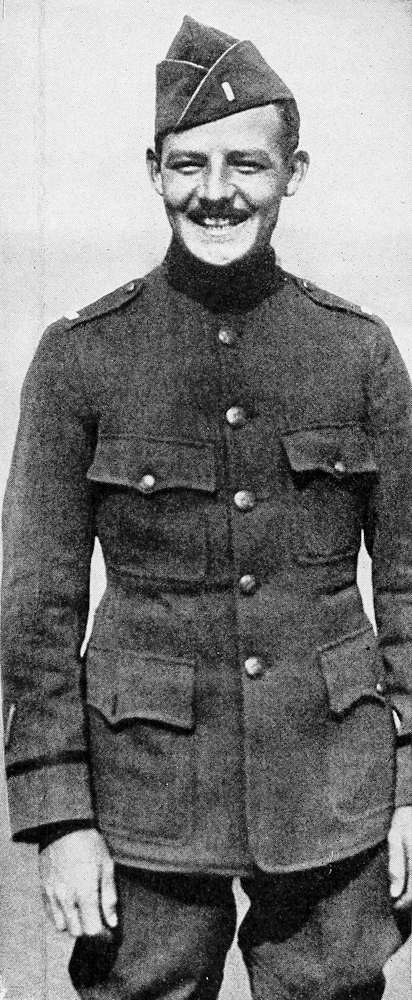
Courtesy of Munseys.
Lieutenant Arthur McKeogh
He brought relief to a battalion by making a daring journey through the German lines with two other men. On the way to the American lines he killed one German officer, fell into a trench with two others and killed them, and was under fire all the time.
Greenway couldn’t make Bill see the futility of the idea of getting over to France without enlisting in the service, so there was nothing to do but let Bill come along. They took the train together at Osborn, Bill carrying his bed rolled up in a slicker, and together they made the trip to New York.
Bill met some of his old comrades of the Cuban campaign and confided to them his plans. They told him how impossible it was, and that he could not even get on the dock at Hoboken without a pass. Bill’s urbane confidence may have been a little shaken but not his determination. He went to Washington to see Senator Ashurst, and the Senator tried to get Bill a passport but without success, as there was no way for the War Department to act in the circumstances. Bill came back to New York with more determination than ever.
“I got my sailing orders,” said Greenway, “and with my sister, sister-in-law and Bill went to the Hoboken pier and found that I was to sail on the Agamemnon, which was formerly the German steamship Kaiser Wilhelm II. I went aboard and found that I had a large and comfortable stateroom and came ashore and told Bill.
“Bill declared that he was going to get aboard of that boat, although I pointed out the guards to him and told him how impossible it was. Bill was not disconcerted in the least. After sizing up the situation to his own satisfaction he said:
“‘Just you get somebody to talk to that guard over there to distract his attention while you are going through the gate.’
“I got an officer friend of mine to talk to the guard, and Bill picked up my bags and followed me. To my surprise he got through the gate without being seen by the guard, and we proceeded to the gangplank. There we ran into a snag. The captain called out to stop that civilian, and Bill was held up. It was only momentarily, however. I stepped up and told the captain that he was a friend of mine, carrying my bags aboard for me, and the captain permitted him to pass.
“When Bill got into that stateroom of mine he was the happiest man I ever saw. ‘If you get me off this boat they will have to throw me and hog-tie me and carry me off,’ was the way Bill put it as he sank into a chair and wiped his forehead.
“We sailed that night at high tide, and Bill stayed secreted in my room. I would smuggle food from the dining-room to him, but after two days of this Bill rebelled at having to live on cold food and declared that he intended having regular meals like the others on board. I told him that if he were discovered the chances were that he would find himself in the brig, but he said he would risk it, and out of my stateroom he went.
ON THE WAY TO FRANCE
“Bill had just one chance. There were 150 civilians on board, going over for employment on government work in France. It was possible, but not at all probable, for Bill to mingle with them and get by. I went on to dinner in the first cabin, and after dinner concluded that I would look about for Bill. I expected to find him in the brig, but he was not there. I made my way to the dining-saloon where the civilian passengers had their meals and looked in.
“At the extreme end of a very long table I saw Bill. He was engrossed in a menu and was ordering the most delectable things to be found on it. Everybody on the vessel got to know Bill and he was in his element. He needed no further guidance by me while on board. Arguments were referred to Bill for settlement and he was looked to among the civilian passengers as a general source of information, being consulted as to when we would arrive in the submarine zone, when we would land, and about everything else that came up.
“How to get Bill ashore at Brest was a problem that loomed large before me, but it did not worry Bill to any great extent. Power Conway was on board and I enlisted his services, and between us we managed to smuggle Bill aboard the tug and get him ashore. Now the question was to get Bill to Paris, and in this I was assisted by General Harbord, U. S. M. C.
BILL ACCEPTED FOR SERVICE
“We arrived in Paris, where I was kept for several weeks at headquarters. One night I returned home in Paris and informed Bill that I had been assigned to the First Division and ordered up to the front. Bill was delighted and ready to put off at once, and, although it seemed impossible to me, it never feazed him.
“It never occurred to Bill that he was a civilian in France, with no military connection whatever, and that it would be impossible for a civilian to accompany me to the front. In this dilemma I placed the situation before Colonel Malin Craig. He is a general now, and it made a strong appeal to him. He wanted to make Bill a captain of military police, but Bill would have none of that. He wanted to get to the front, and to the front we started.
“Together we arrived within seven miles of the front line before Bill was finally held up. He had come 7,000 miles on his own responsibility, without one line of authority from any one, and was now actually at the front and in the face of the enemy, and was still a civilian. And it was there in the Toul sector that Bill enlisted and became officially what he had been at heart and in fact for many weeks—one of the American Expeditionary Force.
“From then on Bill and I were together without danger of being separated by army regulations. He became my orderly and remained so throughout. The only time we were separated was when Bill was in the hospital recovering from shell-wounds. We came back together and Bill went with me to Hot Springs, Ark., where we both took baths. We separated at Fort Worth, Bill going on to Ajo by another route, while I came on to Bisbee.”
And that is the story of Bill Davidson, whose devotion to his chief is unlimited. It causes him to “do the impossible” and to override all of the regulations of the War Department. It is a story in the telling of which Colonel Greenway takes the greatest pride and in which a spirit of affection is dominant.
Bill quit his job to go to war with Jack Greenway, and he did.
The original Selective Service Law of May 18, 1917, with its subsequent amendments, mobilized the man-power of the United States, between the ages of 18 and 45 inclusive. Under the original and later acts, approximately 23,709,000 men were registered and slightly over 2,800,000 were inducted into the military service.