GIRLS OF THE “BATTALION”
Reading edition
Russian Women Who Gave Splendid Proof That Soldierly Valor Knows No Sex
When first reports of the Battalion of Death—the regiment of Russian women—were read in the western world they were regarded as the fiction of correspondents hard pressed for material. Fighting Amazons belonged to the legendary past. But the authentic confirmations of the story and the official recognition of the battalion’s services presently roused a curious interest in these women doing heroes’ work, and there was demand for information concerning the redoubtable “Madam Butchkareff” and the circumstances leading to the organization of the regiment of which she was given command.
The story when told more than gratified the expectant interest. The London Daily Telegraph was the first to give the particulars as they are here presented.
“Vera Butchkareff, or simply Yashka, as she has been christened by the men of the regiment to which she belonged, got much of her war-like spirit from her father, who fought through the whole of the Turkish war and was left a cripple for life. Her mother was a hard-working woman, with five children, of whom Yashka was the eldest, and she had to go out washing and cooking to earn enough to clothe and feed this flock.
© Underwood & Underwood.
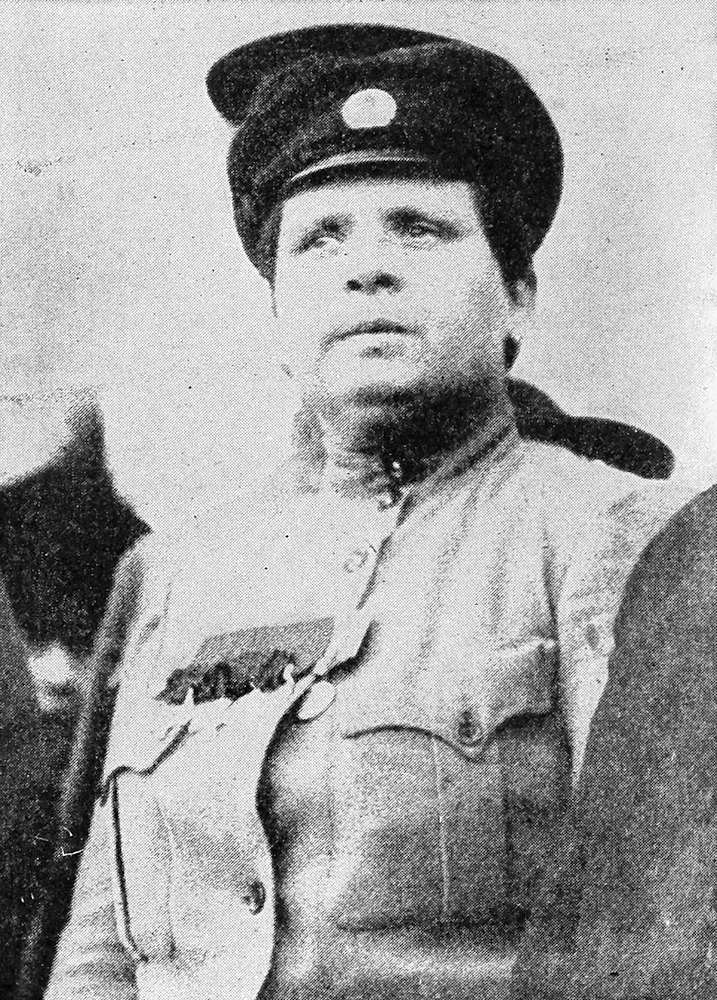
Marie Botchkareva,
Commander of the Battalion of Death
“At the age of five Yashka was sent out as nurse to a baby of three. And from that time she has never stopped working. She looks none the worse for it. Finely yet strongly built, with broad shoulders and healthy complexion, she can lift 200 pounds with the greatest of ease. She has never known what fear is.
“Not long ago she remarked that during the last two years she had lived through so much that there remained but one danger yet to experience, that of flying. Just as she was saying that an aviator came up and offered to take her for a flight, and before the day was out she had exhausted her list of perils.
MARRIED AN UNKNOWN
“When she was sixteen years old her parents seized the first opportunity of getting her married. She never knew the man, but luckily as time wore on they grew very fond of each other, and were very happy. At first they both served in a shop, and thanks to their perseverance and frugality they were soon able to open a small shop of their own. But just as they began to prosper the war broke out, and he was one of the first to be called up.
“She was very keen on accompanying him as a soldier, but he begged her to stay behind and work for her parents, whom they had been keeping.
“She was always ready for any daring venture, and it was with great reluctance that she stayed at home in compliance with her husband’s wish. Time passed, and after long waiting she got the news that he had been killed in action in May, 1915. At once she went to her parents and said: ‘I have decided to go to the front, and you will either hear of my death or I shall return to you in honor and glory. I trust in God.’ And no persuasions were of any use.
“For two years she lived in the trenches and fought like a man. She was wounded three times—in her arm, leg, and back. In the Lake Naroch battles there was a time when all the officers were killed and the men lost courage and lay down, too frightened to attack. Then she rose up and dashed forward calling on them to follow her. Every one obeyed her command, and the trench was captured. She has received two St. George’s medals and two St. George’s crosses for various feats of bravery. At the end of the two years she was legally admitted into the 28th Polozk Regiment.
RAISES HER BATTALION
“She was presented to Mr. Kerensky for her bravery, and after hearing all her experiences, the Minister of War asked what wish she would like to have granted. She straightway said: ‘I want to form a woman’s volunteer battalion, which is to lead men into battle if they will not go of themselves.’ The idea was approved by Kerensky, and, with the sanction of the commander-in-chief, the battalion was formed.”
There were 300 girls, most of them being recruits from the higher educational academies and secondary schools, with a few peasants, factory girls and servants. There were a few married women, but none with children were accepted. They ranged from 18 to 28 years in age and were of good physique, most of them pretty and of refined appearance. They wore their hair short, or their heads entirely shaved. They wore as uniform a soldier’s khaki blouse, short breeches, stockings, heavy soled shoes and forage cap. It was a mixed battalion in the matter of class; with the peasant and the factory girl marched the daughters of noble families, society women, writers, etc., for it was in the universities and schools that the Russian revolution found its most earnest advocates.
These were the women who in action near Vilna that terrible July day exhibited great courage and coolness, and did such heroic service in the midst of a wavering and weakening, cowardly, panic-stricken body of troops that they have hardly a parallel in all history. Marie Golokbyova, a member of the battalion but eighteen years old, who enlisted from the high school, has told of the first engagement of the fighting girls.
THEIR FIRST ENGAGEMENT
“We went into action a fortnight after our arrival at the front under heavy German cannon fire. Given the order to advance, we rushed out of our trench. Feeling no sense of danger, we dashed toward the enemy in the wood. The machine guns began knocking over my companions. We were ordered to lie down. I noticed those at the front with me were all women. The men were further back.
“I began shooting, the gun kicking my shoulder so hard that it is still blue and stiff. I was glad when we were ordered to charge the machine guns in the woods. We paid dearly, but we held on, and by night our scouts discovered the machine gunners and we shelled them out.
“After the first attack I was attached to a machine gun, carrying ammunition to an advanced position under the fire of hidden German machine guns. We were advancing and constantly in danger of capture by the Germans. On one trip over newly captured ground I saw what I considered a wounded German officer lying on the ground. I went to help him with my gun in my right hand and the machine gun ammunition in my left.
“Seeing me, he jumped to his knees and pulled out his revolver, but before he could shoot I dropped the ammunition and killed him.
“How did I feel on taking a human life? I had no sensation except to rid my country of an enemy. There was no sentimentality. We were trying to kill them and they were trying to kill us—that is all. Any Russian girl or any American girl in the same position would have the same feeling.”
Mme. Butchkareff—Commander Butchkareff—the peasant born leader of the heroic girls, was not only endowed with the highest quality of courage but she seemed to have an instinct for military command. She was, as her soldiers testified, “here, there, everywhere,” directing the action, adding the fire of her own spirit to the enthusiasm of the members of the battalion, urging them to “fight like real Russian soldiers,” and they met the demand. Said one of them:
“None of us was afraid once we got started. We were in the midst of a great fusillade of shots. Then terrific big shells began bursting around us. We were again frightened a little when we first saw the dead about, but before very long we were jumping over the dead and quickly forgot all about them. We just forgot ourselves entirely. We were simply Russia fighting for her life.
“As we ran forward we suddenly came upon a bunch of Germans immediately ahead of us. It was only a second until we were all around them.
“They saw they were caught and threw down their rifles, holding up their hands. They were terribly frightened.
“‘Good God! Women!’ they exclaimed.”
It might have been better for Russia had all her soldiers been women.