THE BALD FACTS
Reading edition
A Story of the Trenches by One Who Knew Them at Their Worst
He has a very illusory view of life who knows only its sunny phases; and his is worse than a deceptive impression of war—especially the monstrous war of 1914-18—who has vision only of its valorous deeds and heroisms, its thrilling tales of daring and achievement, of splendid adventure and fearless sacrifices.
Here is a revelation of the side of war seldom more than glanced at by those who tell of the moving exploits. It wears none of the trappings of romance; it is without allure; but it is terribly true. The New York Times History of the War made certain of that before publishing what it rightly described as one of the most thrilling human documents produced during that awful four years. The grim record of the young soldier’s experience is necessarily curtailed here, enough being given, however, to picture the grisly reality of war as millions of youths encountered it. It is not the stirring tale of a hero.
Roméo Houle, French parentage, was born in New Bedford, Mass., in 1893. He was the son of a local barber, Zacharie Houle. In 1912 he removed to Montreal, where he was employed as a barber, having followed his father’s calling. He had a grammar school education. He enlisted in the Sixty-first Regiment, First Canadian Division, Aug. 1, 1914, eager to serve in the war. He went with the Division to France, and was soon in the front trenches. During his service he made notes of his experiences. With the assistance of the editor of a French paper in New Haven, these notes were put into narrative form after young Houle, through the efforts of his father, was discharged from the army in 1916.
The narrative begins: “The true story of the trenches has never been told. I know, because for many months I lived in trenches. I have slept daily in dread of bullet, shrapnel, mine and deadly gas; and nightly in fear of mine and gas—and the man-eating rats. I am one of the few soldiers living who entered the front trenches at the opening of the war and lived to fight the Germans in the front trenches in February, 1916. Of my original company (the Fourth of the Fourteenth Battalion, Third Brigade, First Canadian Division) which so gayly marched away to that hell at Laventie and Ypres—500 brave boys—I am one of the sixteen who survived. And returning unexpectedly, snatched by the American Government (as an American citizen who had enlisted under age) out of the very jaws of death, with the mud of the trenches still upon my clothing, I discovered how much American people have been talking of the trenches and how little, after all, they know about them.”
AGONIES OF BODY AND MIND
And during that trench existence, there was, he thinks, no conceivable agony of body or mind which he did not see and experience. There was the gas—“a crawling yellow cloud that pours in upon you, that gets you by the throat, and shakes you as a huge mastiff might shake a kitten, and leaves you burning in every nerve and vein of your body with pain unthinkable, your eyes starting from their sockets, your face turned yellow green.” There were the rats—“I see them still, slinking from new meals on corpses, from Belgium to the Swiss Alps. Rats, rats, rats, tens of thousands of them, crunching between battle lines while the rapid fire guns mow the trench edge, crunching their hellish feasts. Full fed, slipping and sliding down into the wet trenches they swarm at night—and more than one poor wretch has had his face eaten off by them attacking him in his sleep.”
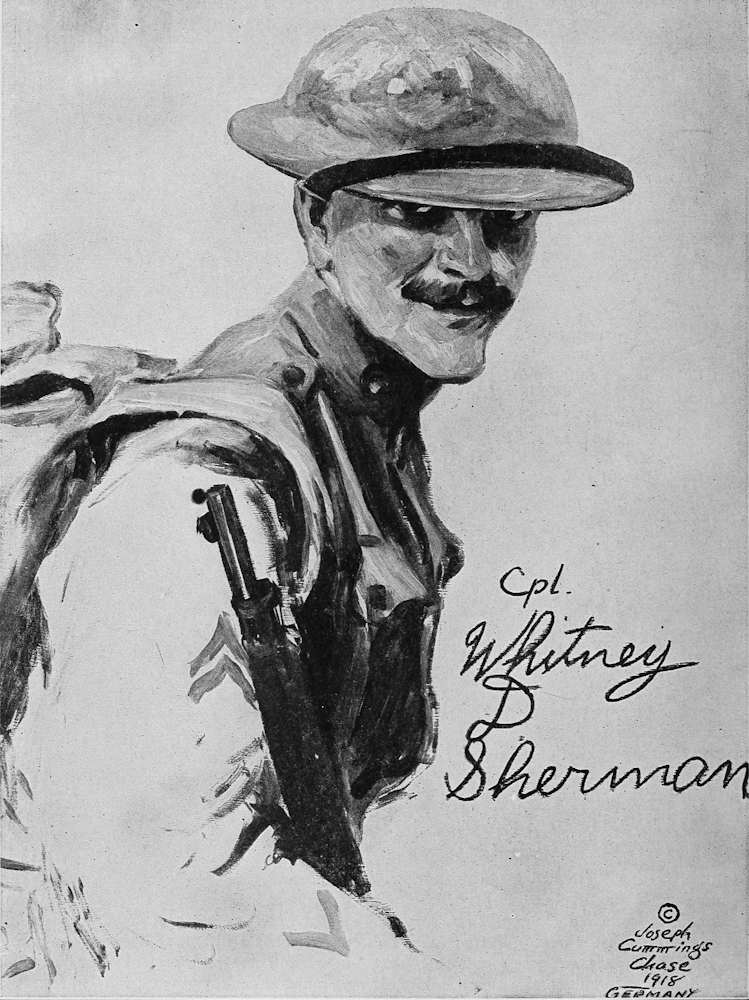
Drawn by Joseph Cummings Chase.
Corporal Whitney D. Sherman
2nd Division, 5th Regiment, 18th Company, U. S. M. C.
This soldier is a fine type of Marine and showed himself to be a brave and valiant soldier at the Battle of Belleau Woods, now known as the Bois de la Brigade de Marine. He was wounded in action June 10, 1918, in this engagement.
There was the stink from decaying bodies, the filth of days and weeks of unmarked accumulation. “Ah! you would say ‘Roméo, Houle, you are lying’ were I to tell you some unbelievable things that I have really lived through. We go mad over there. My God! I am sick of adventure, for the adventures I have had will plague my sleep until I die.”
His first acquaintance with the trench under fire was at Richebourg. “There Charles Lapointe, the first of our company to die, looked over the edge of the trench. That is death. Machine guns all the day sweep the trench edges. If you raise your hand your fingers will be cut off as by a knife. Well, Lapointe looked over the trench; and nobody knows what he saw. His brother was there to lay him down. He buried him (as we ever must the dead) in a hollow pit in our trench. And the brother had for a time the agony of having to fight and feel the earth over Charley’s breast give under his feet.”
He fought in the first line again at Laventie, and there got his first taste of gas. It came while he was trying for a little rest after a turn at guard duty. Some one having stolen the two empty sandbags he had been using for bedding, he spread his overcoat on the ground and pulled a blanket over him. “The sun meantime was shining hotly on the heaps of dead bodies which lay not far outside the trench, and I was glad to cover my head with the blanket to shut out some of the awful stink. And that is how the smell of decaying bodies saved my life. Arthur Robillard, a car conductor back in Montreal, was on guard duty. I was roused by his falling over me. As I sat up something got me by the throat and I began to strangle for my life. The air was rent with awful cries. Many of my comrades lay dying and dead about me. I hurled myself in semi-madness into a huge crater near by in which there was a little water, and I fell in it face down.
BLOWN FROM THE TRENCH
“The water relieved me a little and I wet my handkerchief in it and covered my face. I crawled out and half blindly sought my chum, who was unconscious, and dragged him to the crater where the water was. I laid him there face downward, and he, too, revived a little, and then we lay waiting for death.”
Ten minutes later there was a shouting that announced the approach of the Germans on a charge. Houle, followed by Robillard, ran back into the trench, got his gun and began firing. When the rifle became so hot that it burned his hands he threw it down and began hurling bombs. They were ordered to retreat to the next trench and the Germans began pouring into the vacated one. Houle and his fellows got hold of two machine guns, good for from 560 to 700 shots a minute.
“I shall never forget those Germans. When our guns suddenly spoke their front line melted; their second crumpled before this destruction; but on, on, on they came, unflinching, marching with even steps into certain death. We were like lions at bay. It was our lives or the Germans’. Then, as fourteen of us fought together, a bomb dropped amid us, and killed eleven. I came to consciousness, lying in the bottom of a trench, with Roy leaning over me.
“‘Are you living yet, Roméo!’ he exclaimed in amazement. I rose dizzily. He and I and one other stood alone among our eleven dead friends.
“Then Roy told me that I had been blown clear of the trench, twenty feet from where I stood, and that he had braved death to secure, as he supposed, my dead body. A careful examination showed that my only injury was a terrible bruise on the calf of my leg, where the round surface of a flying shard had struck me, but without breaking the skin. Miracles are but small matters when you fight in the presence of death.
“‘I’m not afraid now,’ I told Roy. And from then on I and all my soldier friends believed my life was charmed and that the Germans could not kill me.”
The defenders were driven back to the fourth trench which they were almost immediately ordered to leave, which they did with all speed as it had been mined by the engineers and was ready to give the Germans a warm reception as they came surging in. Houle describes the explosion. “The whole earth seemed to leap skyward, and through and through the black mountain of earth and stones shot heads and arms and legs, torn fragments of what were once heroic men. Next to the gas which they gave us, I think our blowing them up was surely the worst thing men could do to men.”
He describes mining operations, which are a big part of trench warfare, as one of the most dismaying features of trench life. Apparently the mines were more feared than anything else. “It was more terrible than gas poisoning to think that at any moment you would be thrown a thousand ways at once.... The soldier in the trench never knows when he may be blown into small pieces,—and that is why we are always prepared to risk uncertain dangers between the lines at night, instead of lying down in the wet trench hopelessly waiting for death.
FELT SAFEST WHEN ON GUARD
“I never felt so secure, indeed, as when I was on guard between the trenches. Through all the night I could hear the bullets go over me. Men go crazy there. And the insane are sent to England. Sometimes men go mad and become a menace to their own comrades and officers. They sometimes have to be killed. And there have been times when I crouched in some first line trench, where no communication trench joined us to the second or third line, where no doctor could reach us. And I have seen men so terribly wounded, enduring such agonies, and screaming so heart-breakingly for somebody to kill them, that our boys have done what they asked, to save them the unnecessary horror of living dismembered. And I have seen men of good health grow so weary of the trenches that they have simply stood up at noonday. Some machine guns swiftly ended them. And others, as I have written, simply stick their hands above the trench top and bullets trim off their fingers.”
Fingerless hands are unprofitable in the trenches, and not very useful elsewhere in the activities of war. Getting rid of one’s fingers is a comparatively cheap exchange for release from the dangers and maddening anguish of long periods in the trenches. Houle did not think these men were cowards. “But only men who have lived in the trenches can understand.” Though he makes no claim to heroism for himself, Houle’s record shows that he was a resolute soldier doing valiant things that he sets down in his story quite as matters of routine experience—such as going out under fire to bring in the wounded.
He names Ypres the “graveyard of the old Sixty-first.” They were carried to within six miles of the place in London buses, twenty-five men to a bus. The remaining distance they tramped. At Ypres they first met “the gallant French troops,” and his company of French-Canadians being at the left of the English line acted as interpreters. Here the trenches were but forty yards from the Germans and in bad condition; they were raked terribly by German machine guns on a height. There were dead bodies of Germans and French lying between that had been there three months, neither side having the chance to bury its dead. These were to be seen through the periscopes—but one did not need to see to know they were there. The Battle of Ypres was one of the greatest of the war, one of the most desperate, one of the most deadly in human toll, but out of it all comes the memory of the gas attacks to which the men were then so helplessly exposed.
“There comes a sudden stinging in your nose. Your eyes water. You breathe fire. You suffocate. You burn alive. There are razors and needles in your throat. It is as if you drank boiling hot tea. Your lungs flame. You want to tear your body. You become half wild. Your head aches beyond description. You vomit, you drop exhausted, you die. It is a frightful thing to see your friends like that. Every other man seemed to fall. As I fought I marveled that I was spared. Again and again came to me the belief that my life was charmed. An ecstatic confidence bore me up. I was brave because I was so sure of life, while all my companions seemed groveling in death.”
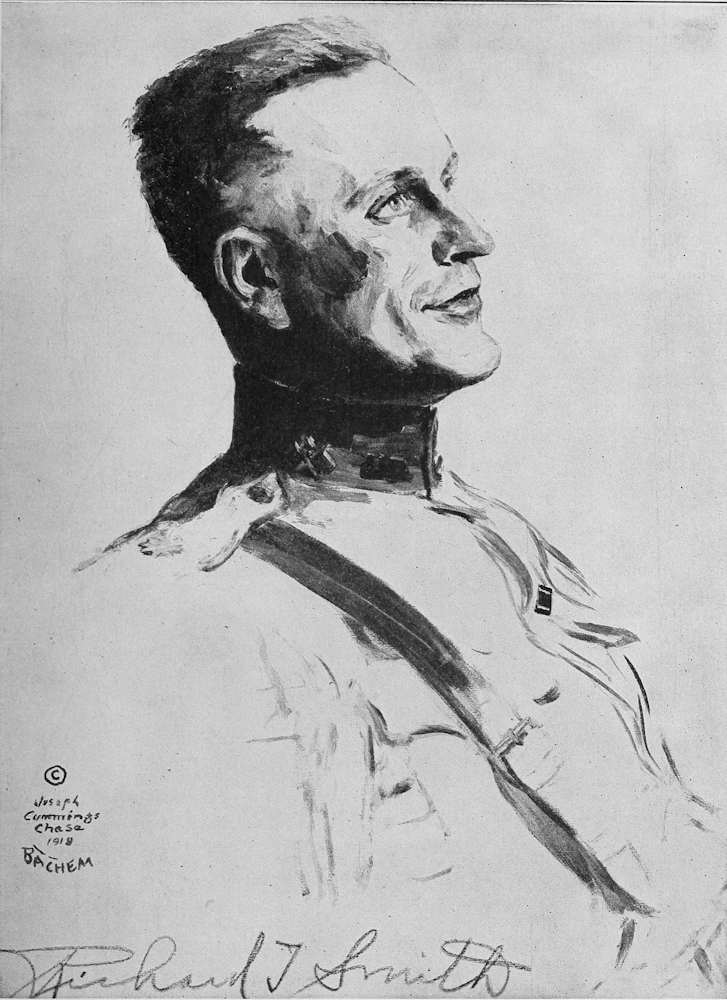
Drawn by Joseph Cummings Chase.
Captain Richard T. Smith
42nd Division, 117th Field Battalion, Signal Corps
Before daylight on the morning of March 17, 1918, while constructing communication lines in the vicinity of Fort de Manonviller, France, Captain Smith conducted his men to a place of safety, and while the fire was still intense returned and carried a wounded soldier to the dugout, where he fell exhausted.
They left the trench for a charge, under a withering fire, but they pressed forward, and came to the enemy’s trench and leaped in. He saw four Germans trying to escape on the further side. “I did not fire, intending to make them prisoners. But the only thing I took was a great blow on the side of my head, and away went my prisoners.” That night he was one of twenty of his comrades who volunteered to attempt the recovery of four field guns the English had lost. They joined men from the Tenth and Sixteenth Battalions. They were to storm the wood where the guns were. There were forty yards of open ground to traverse. The Germans worked havoc among them, but the remnant made the wood. In the darkness it was almost impossible to distinguish foe from friend.
“I ran in and out among the trees and asked every one I met who he was. I came upon one big fellow. My mouth opened to ask him who he was, when his fist shot out and took me between the eyes. I went down for the count, but I knew who he was—he was a German. I got up as quickly as I could, you may be sure, and swung my rifle to hit him in the head, but the stock struck a tree and splintered. I thought I had broken all my fingers.
“I found three wounded men, French, I thought they were, in that gloom. So I carried them into our trench. As I brought in the last one, the officer said, ‘You are doing good work, Houle.’ I asked him why he thought so, and he answered: ‘You have brought in three wounded men and when we put the light on them we found they were Germans.’ Well, I am glad I saved them. I would have done so anyhow, had I known their nationality. For we were all trained to give a wounded man help, whether he were friend or foe.
NOT SAFE TO HELP THE HUN
“Yet it is dangerous work, helping a wounded German. I never helped another, after the experience I had. It was one of the two occasions when I knew with certainty that I killed a man. He was a wounded German soldier. We found him suffering and weak. But we knew we could save his life and were dressing his wound. My back was turned. He took a revolver out of his tunic pocket and fired pointblank at me.
“I do not know how I escaped death. Perhaps it was because his hand shook from weakness; perhaps my guardian saint turned aside that death bullet. Anyhow, he had his revolver in his hand. We had to act quickly. My officer spoke a quick word, and I made sure that he would never fire another shot.
“Well, we got our machine guns. But the Germans had blown them up, and all our sacrifice of men was in vain.”
The Battle of Ypres was a twenty-one day affair, and the toll exacted was appalling. Of the 500 boys of Houle’s company who left Canada only 20 survived. Then came other engagements until in May, 1915, he was again in Richebourg, and the next day an assault was made on the German first line trenches. The first two lines of trenches were taken without difficulty, but there was a counter attack at the third and out of Houle’s company (now reinforced to 365 men) 75 were killed, 100 wounded and 20 taken prisoners.
“We were obliged to leave our wounded in the trench with the dead. I lay until night in the German second line trench among the dead and wounded,” for of course there were no communications and no means of getting medical help for the men “writhing in agony all around us.” At night Highlanders from the 13th and 14th Battalions came to the relief. Three days later there was an attack at a point near Lacouture, where the Germans were entrenched in a hilly vantage. The French Canadians had been reinforced again, this time to 420. The Scots Grays and the Cold Stream Guards engaged in the assault. The artillery cleared the way for the charge. “On the third tussle we got into the German trenches. It was a close fight. We used even our fists. My bayonet was broken, and I used my gun as a club. There we remained until we got reinforcements. Out of 420 men my company was reduced to eighty. No, I could not be killed.”
Then the French Canadians fought at Cuinchy and at La Basse—repetitions of the same story. He had fought in the front lines from almost the very opening of the war, “until all the bed I knew was wet earth, and all the rest I knew was snatches of sleep obtained during lulls in the roaring tumult. And long since I had had my fill of the fighting.”
Then Jan. 10, 1916, he was summoned to headquarters to receive his discharge. He frankly rejoiced in the fact that he was free, free from the trenches, their fevers, their wounded and dead, their noxious odors, their deadly gases, their man-eating rats; free to go home to relatives and friends neither maimed nor wounded. Not that he had gone unscathed. There was a dent in his skull made by a spent bullet, and a very bad bruise on the leg made by a piece of shell, but these were trifles.
NO WORDS TO DESCRIBE IT
“I take no credit for any special courage in the field. If I was brave it was because I had to be so. We were all brave who kept our senses. We became accustomed to a large degree to the incessant intimacy with dangers and death. We could look at frightful things without wincing.”
He knows no word with which to describe war as he saw it. Hell is far too weak a word. “It is more horrible than the slaughter house, because the forms of death planned are more cruel, more mad, more devilish. We fight underground and under sea. We fight with fire, with steel, with lead, with poison, with burning oil, with gases. We are lower than the brutes, lower than the most degraded forms of life.... I am only Roméo Houle, a barber. But I have lived—God! I have lived. All the slaughter of heroes by the Meuse and on the Belgian border and in Northern France has passed before my eyes. And I, Roméo Houle, am forced to write this: ‘We cannot make ourselves better nor the world more worth while by killing each other like beasts gone mad.... I hope never to fight again.’”
And here is a final reflection of the soldier who confesses “I do not know why we fought.”
“No Archduke’s little life was worth the titanic butchery of the world war. The beginning was petty and small. And I, looking back at horror, horror, horror, cannot forget the extraordinary friendships we made with the men in the enemy’s trenches. We were both only human beings, after all, Fritz and I. We had no wish to kill each other. We had much rather sit at the same table, with our wives and children around us, and talk of gardens, of fair pictures, and of great books. But for our officers and the nations which they represented peace would have been declared right there in the trenches—and that by the soldiers themselves.”