“THE RED BATTLE FLYER”
Reading edition
Von Richthofen’s Brilliant Career in the Air an Offset to His Failure as a Uhlan
The cheery egotism of a man fully assured within himself that he merits his own good opinion is the dominant note of Captain Baron Manfred Freiherr von Richthofen’s account of his experiences as a flyer. It is not an offensive egotism; you do not resent it; though you may smile, wondering that a spirit so entirely valiant could so lock arms with that quality of juvenile vanity commonly described as “cockiness.” Von Richthofen was a remarkable fellow, the most debonair as well as the most redoubtable of the German aviators and really entitled to exemption from the opprobrious terms of “Hun” and “Boche.” Though a resolute foe he did not forget that he was a gentleman, an aristocrat, and he played the game on that level. He was easily the foremost of aviators—as far as official recognition can determine priority—at the time of his death, April 21, 1918. He then had a record of 80 downs—70 aeroplanes and 10 observation balloons. His nearest rival at that time was Major Raymond Collishaw, the British Ace, with a record of 77.
Von Richthofen was shot down on the Amiens front, over the Somme, April 21st, and his machine, a new and elaborate triplane of the Fokker type, recently presented to him—its speed was 140 miles an hour and it could climb 15,000 feet in 17 minutes—fell in the British lines. The esteem in which he was held by those who had so often sought to shoot him down was attested in his burial with full military honors and the tributes of genuine admiration heaped on his grave. In the fifteen months of his active flying he became the favorite of the Kaiser and the idol of the Germany Army. Some one has said, perhaps not too extravagantly, that the fall of Amiens, then besieged, would not have compensated Germany for the loss she sustained in the death of the greatest and most beloved of her heroes of the air.
Von Richthofen belonged to the country gentry, of noble family. He entered the Cadet Corps when he was eleven years old. In 1911 he entered the Army. At the outbreak of the war he was a lieutenant of Uhlans. He went to the Western front with his regiment. His first experience with whistling bullets was when he and his company of Uhlans, out to ascertain the strength of the enemy in the forest near Virton, were caught in a trap. They fled in wild disorder, not without casualties. He was in the trenches before Verdun and found it “boresome.” When off duty he sought amusement shooting game in the forest of La Chaussée. So passed several months. Then one day he rebelled against inactivity. It was not the thing for which he went to war. He made his plea to the higher powers. With much grumbling his prayer was granted. He joined the Flying Service in May, 1915. He made his first flight the next day as an observer. Of that experience he wrote in his book:
HIS FIRST FLIGHT
“The draft from the propeller was a beastly nuisance. I found it quite impossible to make myself understood by the pilot. Everything was carried away by the wind. If I took up a piece of paper it disappeared. My safety helmet slid off. My muffler dropped off. My jacket was not sufficiently buttoned. In short, I felt very uncomfortable. Before I knew what was happening, the pilot went ahead at full speed and the machine started rolling. We went faster and faster. I clutched the sides of the car. Suddenly, the shaking was over, the machine was in the air and the earth dropped away from under me.
“I had been told the name of the place to which we were to fly. I was to direct my pilot. At first we flew right ahead, then my pilot turned to the right, then to the left, but I had lost all sense of direction above our own aerodrome. I had not the slightest notion where I was!”
He continued—with steadily increasing knowledge of aircraft—to serve as an observer until October 10, 1915, when, having passed his examination and been accepted as a pilot, he had the ecstasy of his first solo-flight. In his book (The Red Battle Flyer, translated by T. Ellis Barker, published by Robert M. McBride & Company), he describes that flight:
“I started the machine. The aeroplane went at the prescribed speed and I could not help noticing that I was actually flying. After all I did not feel timorous but rather elated. I did not care for anything. I should not have been frightened no matter what happened. With contempt of death I made a large curve to the left, stopped the machine near a tree, exactly where I had been ordered to, and looked forward to see what would happen. Now came the most difficult thing, the landing. I remembered exactly what movements I had to make. I acted mechanically and the machine moved quite differently from what I had expected. I lost my balance, made some wrong movements, stood on my head and I succeeded in converting my aeroplane into a battered school ’bus. I was very sad, looked at the damage which I had done to the machine, which after all was not very great, and had to suffer from other people’s jokes.
“Two days later I went with passion at the flying and suddenly I could handle the apparatus.”
THE BOELCKE CIRCUS
It was not, however, until September 17, 1915, when he was a member of the newly organized Boelcke flying squadron that came to be known as the Circus, that he scored his “first English victim.” It was “a gloriously fine day, and therefore only to be expected that the English would be very active,” so under the leadership of Boelcke the squadron took the air. As they approached the front, Boelcke discovered an Allied squadron going in the direction of Cambrai. There were seven of the Allies to five of the Germans. They came within range. Here is a sample of that “cockiness” with which von Richthofen described his various and manifold encounters:
“The Englishman nearest to me was traveling in a large boat painted with dark colors. I did not reflect very long but took my aim and shot. He also fired and so did I, and both of us missed our aim. A struggle began and the great point for me was to get to the rear of the fellow because I could only shoot forward with my gun. He was differently placed, for his machine gun was movable. It could fire in all directions.
“Apparently he was no beginner, for he knew exactly that his last hour had arrived at the moment when I get at the back of him. At that time I had not yet the conviction ‘He must fall!’ which I have now on such occasions, but, on the contrary, I was curious to see whether he would fall. There is a great difference between the two feelings. When one has shot down one’s first, second or third opponent, then one begins to find out how the trick is done.
“My Englishman twisted and turned, going criss-cross. I did not think for a moment that the hostile squadron contained other Englishmen who conceivably might come to the aid of their comrade. I was animated by a single thought: ‘The man in front of me must come down, whatever happens.’ At last a favorable moment arrived. My opponent had apparently lost sight of me. Instead of twisting and turning he flew straight along. In a fraction of a second I was at his back with my excellent machine. I gave a short series of shots with my machine gun. I had gone so close that I was afraid I might dash into the Englishman. Suddenly, I nearly yelled with joy, for the propeller of the enemy machine had stopped turning. I had shot his engine to pieces; the enemy was compelled to land, for it was impossible for him to reach his own lines. The English machine was curiously swinging to and fro. Probably something had happened to the pilot. The observer was no longer visible. His machine gun was apparently deserted. Obviously I had hit the observer and he had fallen from his seat.
HIS FIRST VICTIMS
“The Englishman landed close to the flying ground of one of our squadrons. I was so excited that I landed also and my eagerness was so great that I nearly smashed up my machine. The English flying machine and my own stood close together. I rushed to the English machine and saw that a lot of soldiers were running towards my enemy. When I arrived I discovered that my assumption had been correct. I had shot the engine to pieces and both the pilot and observer were severely wounded. The observer died at once and the pilot while being transported to the nearest dressing station. I honored the fallen enemy by placing a stone on his beautiful grave.
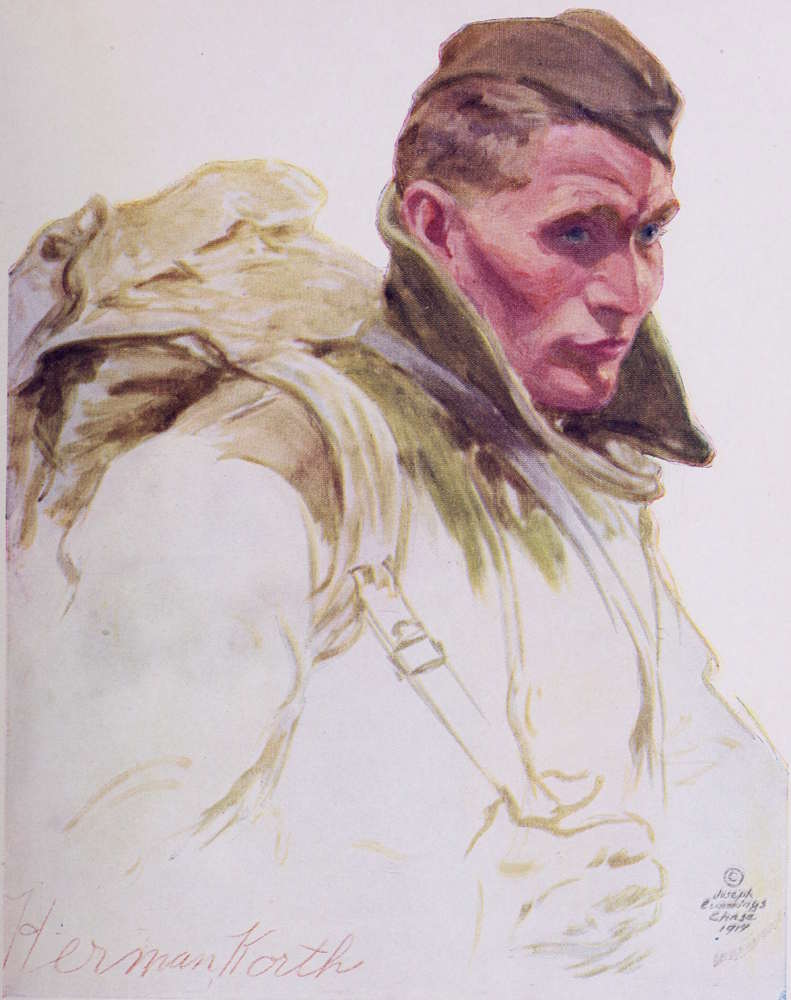
Painting by Joseph Cummings Chase.
Sergeant Herman Korth
32nd Division, 121st Machine Gun Battalion, Company D
Under heavy fire from machine guns and artillery. Sergeant Korth crawled to the crest of a hill, near Juvigny, north of Soissons, August 31, 1918, setting stakes to line the American artillery on enemy machine-gun emplacements. He remained in observation in this perilous position for half an hour, signaling back when American troops were endangered by the fire of the batteries.
“When I came home Boelcke and my other comrades were already at breakfast. They were surprised that I had not turned up. I reported proudly that I had shot down an Englishman. All were full of joy, for I was not the only victor. As usual, Boelcke had shot down an opponent for breakfast and every one of the other men also had downed an enemy for the first time.
“I would mention that since that time no English squadron ventured as far as Cambrai as long as Boelcke’s squadron was there.”
“Still,” said von Richthofen, in his airily patronizing way, “the Englishman is a smart fellow. That we must allow. Sometimes the English came down to the very low altitude and visited Boelcke in his quarters upon which they threw bombs. They absolutely challenged us to battle and never refused fighting.”
BOELCKE’S FINISH
But October 28, 1916 (when the squadron had 40 downs to its credit), Boelcke, von Richthofen and four others flying in formation saw at a distance “two impertinent Englishmen in the air who actually seemed to be enjoying the terrible weather.” The struggle began. “Boelcke tackled one, I the other. I had to let go because one of the German machines got in my way.” All that seems to have interested him further in the fight was the fact that Boelcke’s machine suffered a sort of collision with one of the other German machines, a part of his planes was broken off, his machine was no longer steerable and it fell. Boelcke was killed.
Some little time after he had brought down his sixteenth victim von Richthofen was given the Ordre pour le Mérite and appointed commander of the Eleventh Chasing Squadron. It was then that the idea seized him to paint his machine a flaming red, which became afterward the personal identification of the Captain, who became famous through the adventures and success he had with his machine—Le Petit Rouge, as “everyone got to know my red bird.”
French, English, and American airmen who gained wisdom at the front may find an amusing flavor in a sage remark of von Richthofen about the time he became captain of the squadron. “In my opinion, the aggressive spirit is everything and that spirit is very strong in us Germans. Hence we shall always retain the domination of the air.” Events did not altogether sustain the boast.
But it is not necessary to object strongly to the complacency of a man who fought with undiminished valor throughout his flying career, accounted for 80 enemy machines, and died at last, shot down over the enemy’s lines. If he was self-confident to the degree of vanity, his audacity was truly admirable. He lacked just ten days of attaining his twenty-sixth birthday when he fell. The English grudged him no honors.
THE WORLD’S GREATEST LAUNCHING
American shipbuilders established a world’s record on July 4, 1918, by launching 92 ships of 450,000 deadweight tonnage—one third more than the tonnage produced during the fiscal year, 1915-16. The previous year’s record of total tonnage was 398,000 tons in 1901. American Labor’s answer to Germany’s unrestricted warfare was the launching on one day of 54,000 tons more shipping than had been constructed in any previous year.
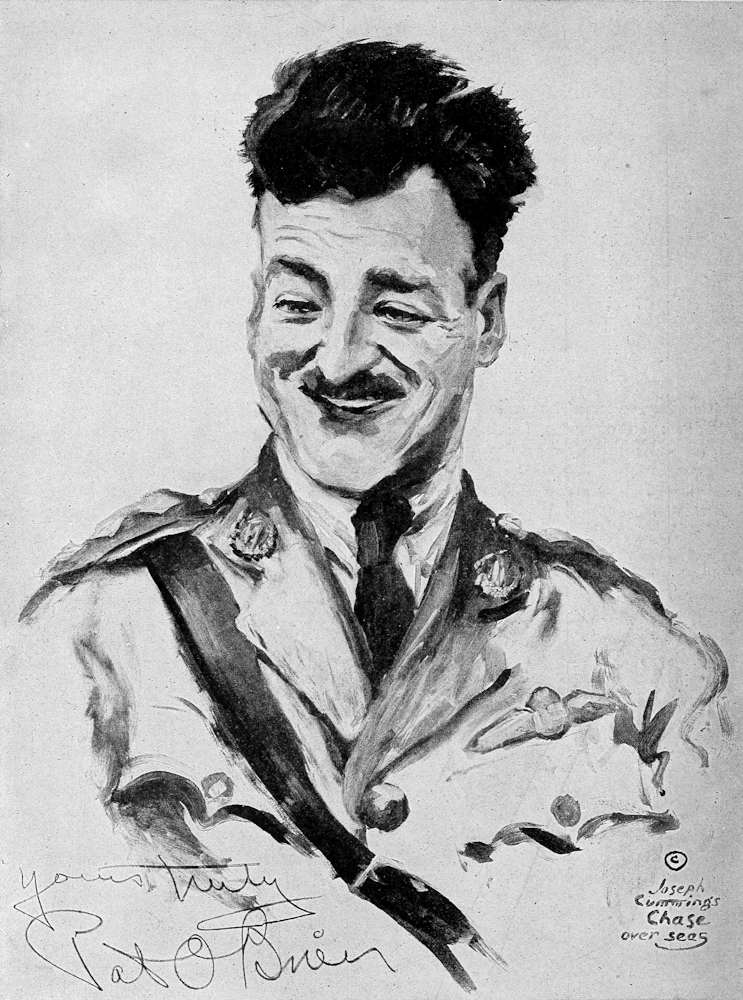
Drawn by Joseph Cummings Chase.
Lieutenant Pat O’Brien
An American youth who, in the early part of the war, joined the Canadian Royal Flying Corps. Shot down from a height of 8,000 feet, he was captured by the Germans. Afterwards making his escape, he passed through 72 days of harrowing ordeal leading finally to safety.