MISTRESS “RAZZLE DAZZLE”
Reading edition
A Rampageous, Self-Willed Old Thing Fondly Remembered by Her Non-Commander
Captain David Fallon is a young Irishman, but an old soldier. Before 1914 he had fought against the hillmen in India, and had won the Indian Field Medal. At the opening of the war he was physical instructor and bayonet drill master at the Royal Military College. So expert a teacher was he that the authorities decided to keep him at his post training new officers. Dave Fallon couldn’t “see it” that way. He remonstrated strenuously. There were other men—older men—professional soldiers, he insisted, just as capable of training men as he was. Anyway he couldn’t stay out of the “big fight.” He pointed to his long service record, his Frontier Medal. He would be more valuable at the front. The authorities finally gave in.
Fallon had no wild dreams of glory and distinction. “It is your amateur soldier,” he says, “who is most filled with such aspirations. Not that he hasn’t a right to entertain them, and try to act on them, for they have led many new-made soldiers into great and brave accomplishments. I don’t mean that such dreams are bad for a man. They are distinctly good. I only mean that with regulars soldiering is a cold, hard business and one isn’t given to enhancing it with romantic imaginings.”
Little did Fallon think when he was urging himself on the military authorities for active duty that when the war was over there would be few soldiers with adventures more thrilling and perilous than fell to his lot.
He went through the entire terrible campaign at Gallipoli. He was in numerous fierce trench battles. He served as an aerial observer, and fought enemy planes. On the road to Thiepval he had a shoulder smashed by shrapnel, but he remained in command of his men behind barricades made of the dead bodies around them in “No Man’s Land.” For twenty-two hours they kept the Germans off. Then reinforcements came. On scout duty he frequently penetrated German trenches and gun positions in the night. At last he was detected in the enemy trenches. A bomb duel ensued. He was frightfully injured but managed to escape.
Photo, by International Film Service
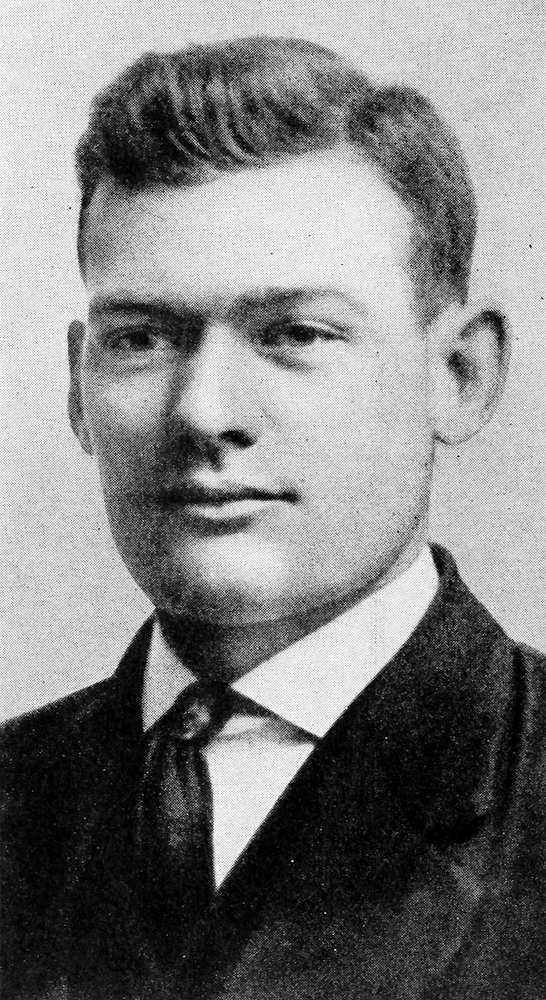
Sergeant Clyde Graham
In company with an American officer he manned a tank and charged two towns under heavy German fire. The tank scattered a German battery and accumulated seventy prisoners. In peace time he is a college professor.
These incidents and many others Captain Fallon relates in his book The Big Fight (W. J. Watt & Company). One of his most interesting chapters is devoted to his experience in command of a tank. It was an amazing adventure.
The Captain has fond memories of that good, old tank. “The dear girl was named ‘Razzle Dazzle,’” he says.
“She was very young, having been in service only three months, but rather portly. She weighed something over thirty tons. And in no way could you call the dear little woman pretty. She was a pallid gray and mud splashed when I got her and there was no grace in the bulging curves of her steel shape; or of her conical top; or her ponderous wheels.
“She showed every aspect of being a bad, scrappy, old dearie. The minute I saw her in her lovely ugliness I knew she would like trouble and lots of it. She carried a six hundred horsepower motor. And out of her gray steel hoods protruded eight guns.
SHE GOES INTO ACTION
“The order had come to me about one in the morning, and it was nearly three when we started lumbering out toward the enemy trenches. We had about six hundred yards to cover. I knew little or nothing of her motor power or speed. My concern was with the efficiency of the guns. She pumped and swayed across ‘No Man’s Land’ at about four miles an hour. She groaned and tossed a great deal. And in fact, made such poor progress that my regiment, the Oxfords and Bucks, beat the old dearie to the enemy lines. Our men were among the barbed wire of the first line, fighting it, cutting it, knocking it down before the old ‘Razzle Dazzle’ got into action.
“But she ‘carried on’ just the same. And when she smote the barbed-wire obstacles, she murdered them. She crushed those barriers to what looked like messes of steel spaghetti.
Drawn by Joseph Cummings Chase.
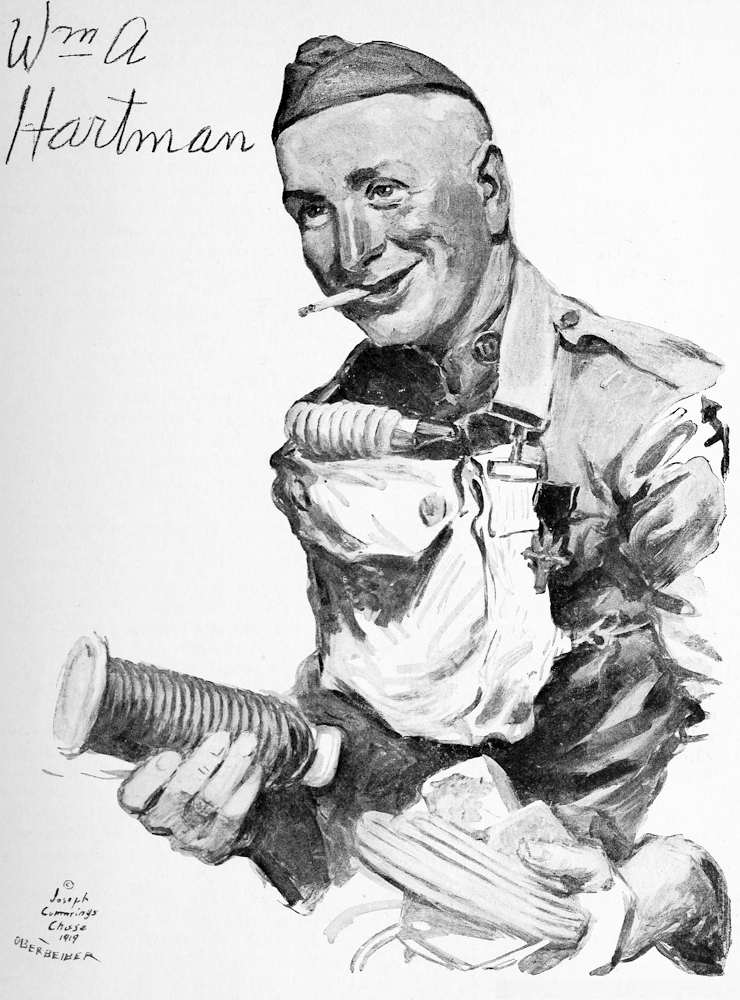
Sergeant William A. Hartman
32nd Division, 107th Engineers, Company “F”
He was a member of a patrol sent out from the battalion post of command August 4, 1918, to reconnoiter the Vesle River front near Fismes for the location of possible sites for pontoon bridges. The patrol separated, but he continued to work alone, starting the construction of the bridges without orders.
“Instead of sinking into trenches as I feared she would, she crushed them and continued to move forward. Of course, we were letting go everything we had, and from my observation hole, I could see the Germans didn’t like it. They had put up something of a stand against the infantry. But against the tank they were quick to make their farewells. It was a still black night, but under the star-shells we could see them scurrying out of our way.
“This was very sensible of them because we were certainly making a clean sweep of everything in sight and had the earth ahead throwing up chocolate showers of spray as if the ground we rode was an angry sea of mud.
“Every man in the tank was shouting and yelling with the excitement of the thing and we were tossed up against each other like loosened peas in a pod.
“Suddenly out of a very clever camouflage of tree branches and shrubbery a German machine gun emplacement was revealed. The bullets stormed and rattled upon the tank. But they did themselves a bad turn by revealing their whereabouts, for we made straight for the camouflage and went over that battery of machine guns, crunching its concrete foundation as if it were chalk.
“Then we turned about and from our new position put the Germans under an enfilade fire that we kept up until every evidence was at hand that the Oxfords and Bucks and supporting battalions were holding the trenches.
“But this was only preliminary work cut out for the tank to do. I had special instructions and a main objective. This was a sugar refinery. It was a one-storied building of brick and wood with a tiled roof. It had been established as a sugar refinery by the Germans before the war and when this occasion arose blossomed as a fortress with a gun aimed out of every window.
“To allow it to remain standing in hostile hands would mean that the trenches we had won could be constantly battered. Its removal was most desirable. To send infantry against it would have involved huge losses in life. The tank was deemed the right weapon.
“It was.
“And largely because ‘Razzle Dazzle’ took matters into her own hands. The truth is she ran away.
“We rocked and ploughed out of the trenches and went swaying toward the refinery. I ordered the round-top sealed. And we beat the refinery to the attack with our guns. But they had seen us coming and every window facing our way developed a working gun. There were about sixteen such windows. They all blazed at us.
“My notion had been to circle the ‘sugar mill’ with ‘Razzle Dazzle’ and shoot it up from all sides. We were getting frightfully rapped by the enemy fire, but there was apparently nothing heavy enough to split the skin of the wild, old girl. Our own fire was effective. We knocked out all the windows and the red-tiled roof was sagging. As I say, my notion was to circle the ‘mill’ and I gave orders accordingly. But the ‘Razzle Dazzle’s’ chauffeur looked at me in distress.
“‘The steering gear’s off, sir,’ said he.
“‘Stop her then and we’ll let them have it from here,’ I ordered.
“He made several frantic motions with the mechanism and said:
“‘I can’t stop her, either.’
“And the ‘Razzle Dazzle’ carried out her own idea of attack. She banged head-on into the ‘mill.’ She went right through a wide doorway, making splinters of the door; she knocked against concrete pillars, supports and walls, smashing everything in her way and bowled out of the other side just as the roof crashed in and apparently crushed and smothered all the artillery men beneath it.
“On the way through, the big, powerful old girl bucked and rocked and reared until we men and the black cat inside her were thrown again and again into a jumble, the cat scratching us like a devil in her frenzy of fear.
“Closed up in the tank as we were, we could hear the roar and crash of the falling ‘mill,’ and from my observation port-hole I could observe that it was most complete. The place had been reduced to a mere heap. Not a shot came out of it at us.
SHE DEFIES CONTROL
“But still the ‘Razzle Dazzle’ was having her own way. Her motorist was signaling me that he had no control of her. This was cheerful intelligence because right ahead was a huge shell crater. She might slide into it and climb up the other side and out. I hoped so. But she didn’t. She hit the bottom of the pit, tried to push her way up and out, fell back, panted, pushed up again, fell back and then just stuck at the bottom of the well, throbbing and moaning and maybe penitent for her recklessness.
“Penitence wasn’t to do her any good. It wasn’t five minutes later when the Germans had the range of her and began smashing us with big shells. I ordered my men to abandon her and led them in a rush out of the crater and into small shell holes until the storm of fire was past.
“When it was, ‘Razzle Dazzle’ was a wreck. She was cracked, distorted and shapeless. But the runaway engine was still plainly to be heard throbbing. Finally a last big shell sailed into the doughty tank and there was a loud bang and a flare. Her oil reservoir shot up in an enormous blaze.
“‘Razzle Dazzle’ was no more. But she had accounted for the ‘refinery.’ And our infantry had done the rest. The German position was ours.
“I was all enthusiasm for fighting ‘tanks.’ But my superiors squelched it. For when I asked for command of a sister of ‘Razzle Dazzle’ next day, a cold-eyed aide said to me:
“‘One tank, worth ten thousand pounds, is as much as any bally young officer may expect to be given to destroy during his lifetime. Good afternoon.’”