ONE OF THE GREAT “ACES”
Reading edition
Raoul Lufbery, the Connecticut Boy Who Roamed the World to Die a Hero in France
The Great War brought into bold relief no more romantic figure or daring spirit than that of Major Raoul Lufbery, from Wallingford, Conn. The bare facts of his life have the flavor of incidents taken from the adventure story of a highly imaginative fiction writer. There is no need of invention or added color to make his history a thrilling tale. No presentation of it, however bald and commonplace the narrative, can cheat it of its romance and heroism. That he was one of the chief of the American “Aces” is in itself an epitome of adventure that might easily be elaborated into a volume.
Lufbery was an adventurer in the dashing sense of the word. His blood was filled with the essence of unrest, the energy of motion that would not let him stay fixed to place. When he was seventeen years old Wallingford held him too much cabined and confined. He ran away from home as an explorer of the unknown world. Drawn, perhaps, by the spell of ancestral affinities, he made his way to France and wandered from place to place in the land of legend and romance, working at any job that would provide his keep and supply him with funds for his next excursion.
From France he sailed to Algiers, where he remained till he had satisfied his interest, when he set off for other scenes—Egypt, the Balkans, Germany, South America and then back to Wallingford for a peep at the home folks. He chuckled appreciatively on learning that his father was off doing a bit of globe-vagabonding on his own account.
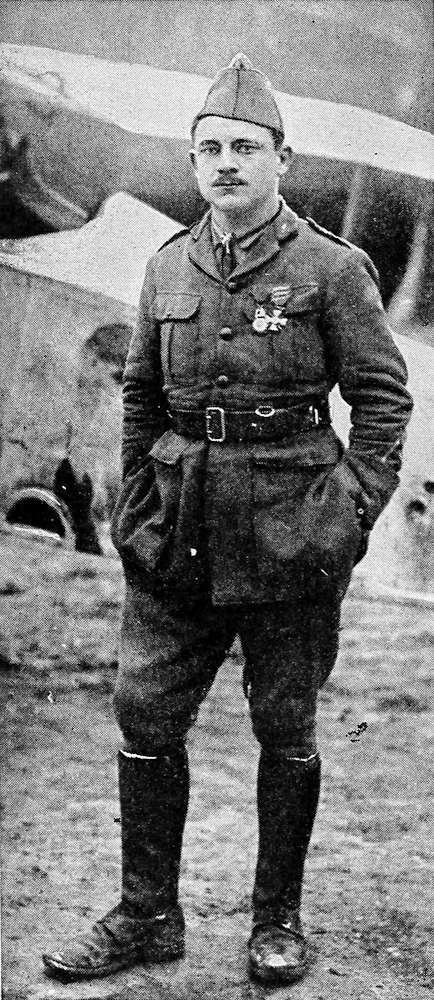
© Press Illustrating Service.
Major Raoul Lufbery, an American, Who Was Loved by Fellow-Flyers
He stopped at home for a year, when the wander-bubbles of his blood got into ferment again, and trotting down to New Orleans he was tempted by military possibilities and enlisted in the Regular Army. He was sent to the Philippines, where he displayed such proficiency as rifleman that he won all the regimental prizes for the best marksmanship. That skill in getting bullets into the right spot was one of his great assets when he came to battling in the air over the fields of France.
But even the Army waxed tame for Lufbery, and when his term of enlistment expired he was ready and eager to nose out what the still strange parts of the world had to offer him. He sailed for Japan, sampled the beauties and novelties of that country and then dipped into China. From China he went into India. A characteristic anecdote is told of him as ticket-seller in one of the railway stations of India. It has been said that he sustained himself with any kind of odd job as he roamed the world, and ticket-selling was one of the tedious sort of occupations least to his liking. A pompous type of native one day stood at the wicket.
“Want a ticket?” Lufbery asked.
“Say ‘Sir’ when you speak to me,” said the native, loftily.
THE PRICE OF A JOB
With never a wink, Lufbery left his place, approached the offended person, took him by the back of the neck and with neatness and dispatch ejected him from the station. Under English civil law one is promptly summoned for assault, and as the person Lufbery had treated so summarily in accord with his own ideas of fitness chanced to be the richest and most influential merchant of Bombay, the summons cost the ticket-seller his place. Cochin-China was his resort, Saigon his haven, and there, if you please, he viewed with envious admiration the aerial antics of Marc Pourpe, the famous trick flyer.
There came a day when Pourpe lost his mechanic, and his exhibitions came to a stop while he made vain quest among the natives for a substitute. None cared for the office, preferring infinitely the understood foundation of Mother Earth to antics in the air. Quite right—Lufbery applied for the job. Was he a mechanic? No. Did he know anything about an aeroplane motor? Not a thing.
“Why the deuce, then, do you come bothering me?” demanded the irritated Pourpe.
“I don’t know the job now,” Lufbery said, “but I can learn. You only have to show me once. Take me on. You won’t regret it. I’m not afraid of work.”
Marc Pourpe is quoted as saying to some friends later in relating the incident:
“His reasoning was full of logic. His method was original. I agreed, and I will say that never have I seen a person more devoted, more intelligent and more useful. He is already better informed about a motor than most of the so-called mechanics of Paris. Moreover, this boy has hung his hat in every country in the world. He is not a man, he is an encyclopedia. He can tell you what the weather is in a given season in Japan, in Egypt, in America, or in France. He observes everything and once he has noticed it, it is engraved on his memory.
“He told me that in all his travels he had never been more than a week without working. He was hospital interne at Cairo, a stevedore in Calcutta, station master in India, a soldier in America. I am glad he is now a mechanic.
“If he likes it, I will take him back with me at the end of my tour and will keep him with me. It is rare to find a good mechanic. His name is Raoul Lafberg, and he spent his childhood in the vicinity of Bourges. If I return with him, you will see what a sympathetic character chance has thrown in my way. So once more in my life everything goes well.”
This shift of name on the sudden from Lufbery to Lafberg was due to a hope that the Frenchified turn would the more favorably determine Pourpe to engage his services, especially as Lufbery spoke French fluently, having learned it in his three years’ stay in France.
JOINS THE FOREIGN LEGION
So it was that Lufbery, as Pourpe’s mechanic, found himself in France when the war storm burst. Pourpe, who had a new type of plane, promptly enlisted as a flyer for his beloved France. As an American Lufbery could not be accepted except as a member of the Foreign Legion, which he hastened to join in the expectation that he could be transferred thence to service with his friend, which was done. But they were not long together at the front. Pourpe was killed the first or second of December, 1914.
Thereupon Lufbery applied for admission to the regular French air service, which was granted and in a short time he was on the front with the Escadrille of bombardment, V. 102.
But it was not until he joined the newly organized Escadrille Lafayette that his career of distinction began. His first victim was brought down, over Etain, July 30, 1916, the second five days later. He was cited by the French Government thus:
“A model of address, of coolness, of courage. He has distinguished himself by numerous long distance bombardments and by the daily combats he has had with enemy aeroplanes. On July 30 he unhesitatingly attacked at close range four enemy machines. He shot one of them down near our own lines. He successfully brought down a second on the 4th of August, 1916.”
His record grew apace. He got his third August 8, his fourth August 12, his fifth October 12, and became an “Ace.” In December he brought down two in one day after a fight that nearly cost him his life as his jacket was torn with bullets. That victory gained him the award of the Legion of Honor. Incidentally, he was the first American to receive from England the British Military Cross which was conferred on him June 12, 1917, when his record had mounted to ten enemy planes.
That tenth plane exploit, by the way, was memorable. Lufbery was alone at an altitude of 18,000 feet when, at a distance, he saw a formation of seven Boche machines. Two of them were two-seater observation machines, the others were the protective escort. He flew into the sun to wait for a chance to attack. Soon one of the seven cut loose from the others, and immediately Lufbery dived for it and began firing, taking the enemy by surprise. After thirty shots or so his gun jammed, but no more shots were necessary. The enemy machine wobbled, shifted and began its downward plunge, and as Lufbery volplaned away he saw the wrecked machine crash into the German trenches.
In an article written for the French publication La Guerre Aérienne, Lufbery describes an encounter he had one day when he was sent scouting over the Vosges, the panoramic beauty of which had so enthralled him he flew in sheer delight of the vision, nevertheless “all the time on guard.”
Suddenly an enemy appeared a little below and behind him. He wrote:
“It is a little one-seater biplane of the Fokker or Halberstadt type. A glance around assures me that he is alone. I am surprised at this, for it is certainly the first time that a machine of this sort has deliberately placed itself in a position so disadvantageous for fighting. Perhaps it is a trap. One never knows! If it only may prove to be a beginner, lacking experience, who listens to nothing but his courage in his purpose to become one of the great Aces of his country.”
ATTACKS A MASTER OF HIS ART
“However that may be, the wind keeps blowing from the west and carries me farther and farther into the lines. It will not do to allow the Boche to have this advantage too long: I decide to begin the attack without losing another second.
“An about face, followed by a sudden double spin, carries me a little behind my adversary. Profiting by this advantage I dive upon him, but with a remarkable skill he gets out of range of my machine gun. He has anticipated my maneuver and parried the blow before it was struck. I am now aware that I have to do with a master of his art. This first encounter has proved it to me.
“Making my machine tango from right to left, I saw him again below me but much nearer than before by at least forty yards.
“Suddenly he noses up as if to begin a looping, and in this awkward position fires a volley at me which I dodge by a half turn to the right. A second time I attack but with no more success. The wind carries us to the north of Mulhouse, and I begin to ask myself if I am not playing my adversary’s game for him in delaying longer.
“At this moment I chanced to glance in the direction of Belfort, which was about twelve miles within our lines. I perceived in the air little white flakes. Evidence of the presence of a Boche.
“A lucky chance! I had now an excuse for abandoning without loss of honor the match, which I confess I am not at all sorry to leave. Only before leaving my adversary I feel that I must show him that I appreciate that he is a valiant foe and respect him as such. Drawing my left arm out of the fuselage I wave him a sign of adieu. He understands and desires to show courtesy on his part, for he returns my farewell.
“All my attention is turned toward him whom I already consider as my new prey, a big white two-seater of very substantial appearance.
“I draw nearer and nearer to him. Good luck! For the first time since I have been a chaser I am going to have the good fortune to battle within our lines. Also this increases my confidence until it makes me disregard measures of caution, even the science of tactics.
“Another motive impels me to take more than ordinary risks. I am determined that he shall not escape me, and I make up my mind to shoot at him until I have won the victory.
“What joy if I can only lodge a ball in his motor, or in his gasoline tank, which would oblige him to make a landing on French soil! Then I should be able to speak with the conquered and ask them their impressions of the aerial duel in which they had just taken part. But there is an old French proverb which says ‘You must not sell the skin of the bear before you have killed him.’ I had occasion that day to prove the wisdom of this as you shall soon see.”
“POOR COUCOU”
“Enough of dreaming! The moment for action has arrived. Quickly I place myself in the rear and on the tail of my enemy from whom I am separated by a distance of about fifty yards. Then I open fire with my machine gun, and continue firing up to the moment when my plane, his superior in speed, arrives so near the big two-seater that a collision seems inevitable.
“Quickly I pull up, leap over the obstacle, and fall in a glide on the right wing. Increasing my speed I re-establish my equilibrium and prepare to tempt fortune a second time.
“Curse the luck! It is of no use. The motor, the soul of my aeroplane, has received a mortal wound and is about to draw its last breath.
“Turning my head I discover that the ailerons are also seriously injured. My enemy fortunately does not seem to wish to profit by the situation. He continues his flight in the direction of his own lines. Perhaps I have wounded him very seriously. I hope so. Anyway, his flight leaves me master of the field. But that is a very small consolation. And also of short duration; for I am coming down faster and faster. At last I safely take the ground on the nearest flying field within gliding distance.
“Pilots, observers, mechanics surround me and besiege me with questions. They have seen the fight and want the details. For the moment I do not explain much but that I have encountered a Boche who does not understand joking! Besides, I was in a hurry to examine the wounds of my little aeroplane. It is very ill, poor thing! Three bullets in the motor, the gasoline tank ruined, a strut out of commission, many holes in the hood, finally the left aileron was cut and broken off by the bullets. It had made its last flight! Poor Coucou!”
An admirable story of Lufbery in Heroes of Aviation says in conclusion:
“To recount all the aerial successes of this American champion is but to repeat the usual details of his sober inspection of his aeroplane and his arms before dawn; his calm scrutiny of the skies for the black crosses of the enemy planes; his adroit maneuvering for the best position from which to surprise the foe; his determined and patient attack; his exactness in machine gun marksmanship; his jubilant return to his comrades with another certain victory on his score.
“During months of his service in France Lufbery suffered from acute seizures of rheumatism which frequently necessitated his return to the hospital. Quiet and unassuming in his conversation, Lufbery won universal respect from the mechanics and affectionate loyalty from his comrades. Every one who met him felt as Marc Pourpe wrote, ‘He is not a man, he is an encyclopedia.’
“When America entered the war and began her preparations for her own Air Service in France, certain of the experienced fighting pilots who had been fighting for France were given charge of the new American escadrilles. Lufbery and William Thaw, both original members of N. 124, the Escadrille Lafayette, were commissioned Majors. To them fell the task of organizing the eager youths who were to assist in clearing from the skies of France the invading Huns.
“Possessed of all the honors that his army could bestow upon a noble Soldier, and wracked with physical pains that were daily increased by inclement weather, an ordinary man would have been satisfied to seek his ease and fill his required duties with the instructions to his pilots. But Major Lufbery instructed by example, not by speech. Not unmindful of his value to his comrades as their mentor and commander and impelled by an ardor that knew no rest, Lufbery continued his active patrolling, exposed himself to every risk.”
THE LAST FLIGHT
“On Sunday, May 19th, the American Ace went aloft over Toul with his fighting squadron. Enemy fighting machines were flying over the American line. The latest designed Fokker aeroplane, a single-seater triplane, appeared deep enough within our territory to be cut off before he could escape. Lufbery darted swiftly to the attack.
“Exact details of any air combat are known only to the combatants. Fighting machines of to-day move with a speed of 140 miles per hour. Approaching each other they lessen the distance between them at the rate of over 400 feet each second. Let some one calculate the fraction of an instant given to the pilot in which he plans his maneuver, alters his position, takes his aim, and presses the trigger!
“Lufbery’s machine fell in flames. He was seen to jump from the blazing mass when 2,000 feet from the ground. A parachute attachment might have saved his life as his body was found to be uninjured from the enemy’s fire. A non-inflammable fuel tank might have permitted him to continue his attack until the Fokker triplane dropped as his nineteenth victory.
“Deprived of these improvements, Lufbery died. With his lamented loss the title of the American Ace of Aces passed to Sergeant Frank L. Baylies, of New Bedford, Massachusetts, who after eight months at the front, had amassed a total of twelve enemy machines. Upon the gallant death of Baylies, Lieutenant Putnam of Brookline, Massachusetts, with ten official victories, headed the American list of Aces.”
Though officially credited with only eighteen planes brought down in single combat, Lufbery was, in fact, the victor over twice that number of enemy planes. The rule for official recognition requires that a fall must be attested by eye-witnesses in addition to the flyer. Many of Lufbery’s “downs” were inside the enemy lines beyond the observation of any of his comrades, and others fell in such a way that it could not be said positively that they were destroyed.