WEDDIGEN’S WONDER FEAT
Reading edition
The Dramatic Sinking of Three British Cruisers by U-boat in the Early Days of the War
Early on the morning of September 22, 1914, three 12,000-ton armored cruisers of the British Navy—the Aboukir, the Cressy, and the Hogue—were torpedoed in the North Sea and sunk by a German submarine, with a loss of 1,433 men. The news startled the whole world. It was as if three Goliaths, imposing, formidable, on parade in panoply, challenging the stoutest, had succumbed impotently to the assault of the diminutive David—for it was a solitary submarine that sank the naval giants in less than an hour. So adroit, rapid and precise had been the maneuvers of the submarine that the officers of the attacked warships were of the belief that there were several of the invisible devil-boats, and that the guns of the Cressy sank one of them. Nor did they become the wiser until Captain Lieutenant Otto Weddigen, commander of U-9, made report of his exploit on his return to Wilhelmshaven, whence he had set forth for the enterprise. Conditions, be it said, were entirely favorable to him, for the sea was calm, and the weather clear. The three cruisers, unsuspicious, were steaming along in close formation, patrolling the silent sea, and they gave him a famous victory—the destruction of the first warships by the U-boat.
There follow three separate accounts of the event as related by three different sources, the first being that of an officer of the Cressy, published in the Manchester Guardian.
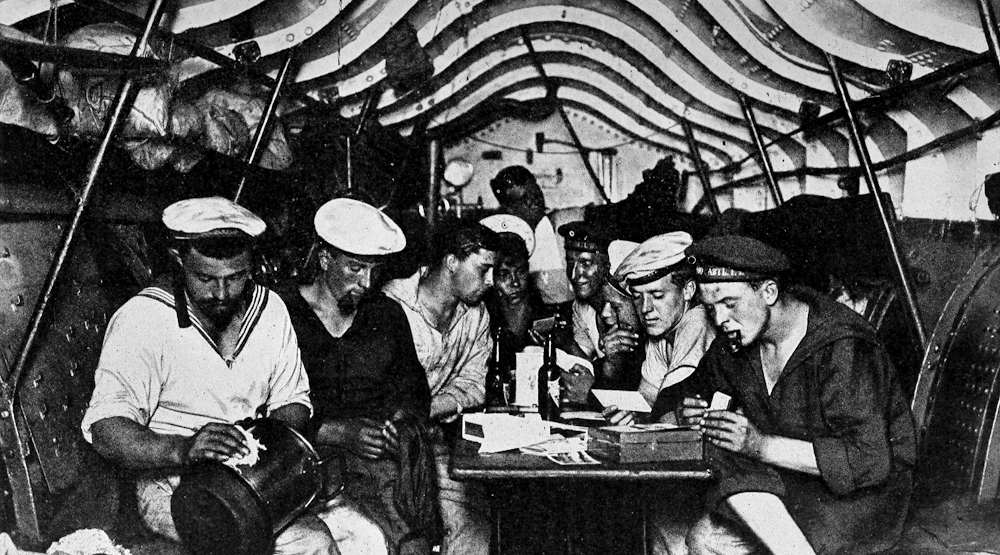
© Press Photo Syndicate.
Crew Quarters Aboard a German Submarine
The vast machinery leaves but little room for the crew. They enjoy none of the conveniences found on vessels that ply above water.
EYE-WITNESS ACCOUNT BY AN OFFICER OF THE Cressy
“I was awakened about 6:15 by the increase of our speed, and, thinking it was nothing more than just a slight spurt to take up our day patrol position, I lay quiet. However, about ten minutes later I felt the engines going full speed astern, so, guessing at once that something out of the ordinary was happening, I sat up, and, opening my scuttle, looked out. Conceive the jump I gave when I saw the Aboukir, about half a mile away, heeling over to port so that the starboard copper plates were plainly visible glistening red in the sun. I could also see considerable commotion on board her, and one of her starboard sea boats was lowered half-way, but seemed to have stuck there.
“While I watched she seemed to heel over still more, so I leapt from my bunk, and, running into the next cabin, I found —— jumping out of his bunk, and together we ran up on to the quarterdeck. From there we could see that in the short time we had taken getting up on deck she turned over much more, and was down by the head, and while we watched we could see the sun shining on pink, naked men walking down her sides inch by inch as she heeled over, some standing, others sitting down and sliding into the water, which was soon dotted with heads. All this time we were hard at it lowering boats.
“Both the sea-boats had gone, manned by nucleus crews, and Lieutenant ——’s voice could be heard as he directed the hands working the main derrick, which was hoisting up the launch—a boat capable of holding two or three hundred men. Other men under the direction of another lieutenant were busily throwing overboard every bit of wood that they could find for the swimming men to clutch—an act which materially aided in our escape afterward. I then ran along to the sick-bay and ordered the stewards to get hot blankets and coffee ready, and went below to get into some clothes.
“THE SHIP LIFTED, QUIVERING ALL OVER”
“I had only been in my cabin about a minute when there was a terrific crash, and the ship lifted up, quivering all over. A second or two later another and duller crash, and a great cloud of smoke, followed by a torrent of water, came pouring in through my open scuttle. The noise for a second or two was deafening; everything seemed to be breaking, and somewhere or other I could hear dishes and glass being crashed to pieces on the deck, and, in addition, all the lights in the ship went out. I ran out of my cabin and along to the first ladder, the aft deck being in darkness and full of smoke; conceive my dismay when I found that it had fallen down.”
However, he found another ladder, farther on. On the deck was worse confusion than before. There was nothing left to do but make escape in the shortest possible order. He climbed down into the sea.
“The first piece I clung to had sharp edges which hurt, so I left that and swam to a table floating near. Then another man came up and climbed on to my table, so I left it to him and struck out for a large spar which I caught sight of some little distance off. This afforded a very comfortable hold, and I lay over it, kicking gently with my legs to keep them warm, and I looked about me. Both the Aboukir and the Hogue had gone, and the Cressy was in front of me, about a quarter of a mile away. Then she began to fire her guns, and, hearing the shells going over my head, I looked behind, and there, about 300 yards off, I saw the periscope of a submarine.
“For some time the firing continued, several of the shells bursting most unpleasantly near, and then the men on the Cressy started cheering, and I heard after that they were unanimously of the opinion—true or not, I don’t know—that they had sunk one of the submarines. However, the firing continued for some time, till there was a sudden explosion, and a great column of smoke, black as ink, flew up as high as the Cressy’s funnels, while she heeled over about ten degrees. Nothing much further seemed to happen, however, and, looking about me, I caught sight of —— hanging on to a large fender of twigs, which kept revolving and ducking him under, so, calling to him, I started to push my spar toward him till I got near enough, and then, giving it a vigorous shove, pushed it alongside him and swam after it.
“The two of us clung to that for some time, till the sound of an explosion made us look round to see the spray and smoke disappearing, and as we watched another torpedo struck, and the Cressy heeled right over and almost entirely disappeared in a very short space of time, the last few feet of ‘island,’ however, taking a very long time to go. Soon after this I realized the wonderful fact that as the Hogue sank she must have righted herself, for the picket boat and steam pinnace had in some miraculous way floated clear quite undamaged, though half full of water, and were now about one hundred yards from us. Turning the spar so that it lay pointing toward the boats, and slipping the fingers of my left hand into a notch that seemed made for the purpose, I turned on my side and started to tow the spar toward the boats.
“These were soon reached, and we found that some four or five people had already boarded them. With their help we scrambled on board, having been in the water about an hour and a quarter. After this there is not much to tell. The Flora hove in sight when we had been in the boat about an hour, followed by the Titan, and in an hour more we naked, shivering mortals were all taken off to the former.”
THE OFFICIAL REPORT
In the official report to the Admiralty made by Commander Bertram W. L. Nicholson we find the expression of the belief that there were several submarines, and that one was sunk. The report is quoted:
“The Aboukir was struck at about 6.25 a.m. on the starboard beam. The Hogue and Cressy closed and took up a position, the Hogue ahead of the Aboukir, and the Cressy about 400 yards on her port beam. As soon as it was seen that the Aboukir was in danger of sinking all the boats were sent away from the Cressy, and a picket boat was hoisted out without steam up. When cutters full of the Aboukir’s men were returning to the Cressy, the Hogue was struck, apparently under the aft 9.2 magazine, as a very heavy explosion took place immediately. Almost directly after the Hogue was hit we observed a periscope on our port bow about 300 yards off.
“Fire was immediately opened and the engines were put full speed ahead with the intention of running her down. Our gunner, Mr. Dougherty, positively asserts that he hit the periscope and that the submarine sank. An officer who was standing alongside the gunner thinks that the shell struck only floating timber, of which there was much about, but it was evidently the impression of the men on deck, who cheered and clapped heartily, that the submarine had been hit. This particular submarine did not fire a torpedo at the Cressy.
“Captain Johnson then maneuvered the ship so as to render assistance to the crews of the Hogue and Aboukir. About five minutes later another periscope was seen on our starboard quarter and fire was opened. The track of the torpedo she fired at a range of 500 to 600 yards was plainly visible and it struck us on the starboard side just before the after-bridge.
“The ship listed about 10 degrees to the starboard and remained steady. The time was 7.15 a.m. All the watertight doors, deadlights and scuttles had been securely closed before the torpedo struck the ship. All the mess stools and table shores, and all available timber below and on deck had been previously got up and thrown over side for the saving of life.
“A second torpedo fired by the same submarine missed and passed about 10 feet astern. About a quarter of an hour after the first torpedo had hit a third torpedo fired from a submarine just before the starboard beam hit us under the No. 5 boiler room. The time was 7.30 a.m. The ship then began to heel rapidly, and finally turned keel up, remaining so for about twenty minutes before she finally sank, at 7.55 a.m.
“A large number of men were saved by casting adrift on Pattern 3 target. The steam pinnace floated off her clutches, but filled and sank.
“The second torpedo which struck the Cressy passed over the sinking hull of the Aboukir, narrowly missing it. It is possible that the same submarine fired all three torpedoes at the Cressy.
“The conduct of the crew was excellent throughout. I have already remarked on the bravery displayed by Captain Phillips, master of the trawler L. T. Coriander, and his crew, who picked up 156 officers and men.”
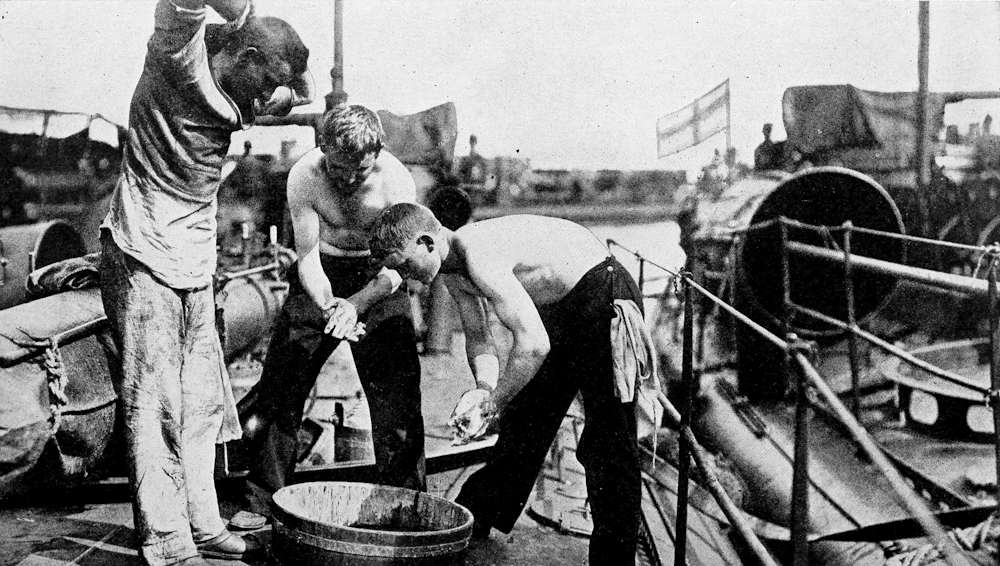
© Press Photo Syndicate.
The Daily Wash Aboard a German Torpedo Boat
Germany’s torpedo boats were outclassed by her U-boats. In the battle of Jutland the world first heard of the torpedo boats’ extensive use.
CAPT. WEDDIGEN’S OWN STORY
And here is the story of the daring enterprise, one of the most extraordinary of naval exploits, told by Captain Lieutenant Otto Weddigen, Commander of U-9. He was 32 years old at the time, and for the five years preceding had been attached to the submarine flotilla. He was married but twenty-four hours to his boyhood sweetheart, a Miss Prete of Hamburg, before he set out on the adventure that offered more than an even chance of making the bride a widow. Besides himself there were twenty-five men in the U-9 and they were a picked crew.
Weddigen’s own story of the cruise, first published in the United States by the New York World, was in part as follows:
“I set out from a North Sea port on one of the arms of the Kiel Canal and set my course in a southwesterly direction. The name of the port I cannot state officially, but it has been guessed at; nor am I permitted to say definitely just when we started, but it was not many days before the morning of Sept. 22, when I fell in with my quarry.
“When I started from home the fact was kept quiet and a heavy sea helped to keep the secret, but when the action began the sun was bright and the water smooth.
“I had sighted several ships during my passage, but they were not what I was seeking. English torpedo boats came within, my reach, but I felt there was bigger game further on, so on I went. I traveled on the surface except when we sighted vessels, and then I submerged, not even showing my periscope, except when it was necessary to take bearings. It was ten minutes after 6 on the morning of Tuesday when I caught sight of one of the big cruisers of the enemy.
“I was then eighteen sea miles northwest of the Hook of Holland. I had then traveled considerably more than 200 miles from my base. My boat was one of an old type, but she had been built on honor, and she was behaving beautifully. I had been going ahead partly submerged, with about five feet of my periscope showing. Almost immediately I caught sight of the first cruiser and two others. I submerged completely and laid my course so as to bring up in the center of the trio, which held a sort of triangular formation. I could see their gray-black sides riding high over the water.
“When I first sighted them they were near enough for torpedo work, but I wanted to make my aim sure, so I went down and in on them. I had taken the position of the three ships before submerging, and I succeeded in getting another flash through my periscope before I began action. I soon reached what I regarded as a good shooting point.”
[The officer was not permitted to give this distance, but it is understood to have been considerably less than a mile, although the German torpedoes had an effective range of four miles.]
THE SHOT WENT STRAIGHT AND TRUE
“Then I loosed one of my torpedoes at the middle ship. I was then about twelve feet under water, and got the shot off in good shape, my men handling the boat as if she had been a skiff. I climbed to the surface to get a sight through my tube of the effect, and discovered that the shot had gone straight and true, striking the ship, which I later learned was the Aboukir, under one of her magazines, which in exploding helped the torpedo’s work of destruction.
“There was a fountain of water, a burst of smoke, a flash of fires and part of the cruiser rose in the air. Then I heard a roar and felt reverberations sent through the water by the detonation. She had been broken apart, and sank in a few minutes. The Aboukir had been stricken in a vital spot and by an unseen force; that made the blow all the greater.
“Her crew were brave, and even with death staring them in the face kept to their posts, ready to handle their useless guns, for I submerged at once. But I had stayed on top long enough to see the other cruisers, which I learned were the Cressy and the Hogue, turn and steam full speed to their dying sister, whose plight they could not understand, unless it had been due to an accident.
“The ships came on a mission of inquiry and rescue, for many of the Aboukir’s crew were now in the water, the order having been given, ‘Each man for himself.’
“But soon the other two English cruisers learned what had brought about the destruction so suddenly.
“As I reached my torpedo depth I sent a second charge at the nearest of the oncoming vessels, which was the Hogue. The English were playing my game, for I had scarcely to move out of my position, which was a great aid, since it helped to keep me from being detected.
“The attack on the Hogue went true. But this time I did not have the advantageous aid of having the torpedo detonate under the magazine, so for twenty minutes the Hogue lay wounded and helpless on the surface before she heaved, half turned over and sank.
“But this time, the third cruiser knew that the enemy was upon her and she sought as best she could to defend herself. She loosed her torpedo defense batteries on boats, starboard and port, and stood her ground as if more anxious to help the many sailors who were in the water than to save herself. In common with the method of defending herself against a submarine attack, she steamed in a zigzag course, and this made it necessary for me to hold my torpedoes until I could lay a true course for them, which also made it necessary for me to get nearer to the Cressy. I had come to the surface for a view, and saw how wildly the fire was being sent from the ship. Small wonder that was when they did not know where to shoot, although one shot went unpleasantly near us.
THE CRESSY TURNS TURTLE
“When I got within suitable range, I sent away my third attack. This time I sent a second torpedo after the first to make the strike doubly certain. My crew were aiming like sharpshooters and both torpedoes went to their bullseye. My luck was with me again, for the enemy was made useless and at once began sinking by her head. Then she careened far over, but all the while her men stayed at the guns looking for their invisible foe. They were brave and true to their country’s sea traditions. Then she eventually suffered a boiler explosion and completely turned turtle. With her keel uppermost, she floated until the air got out from under her and then she sank with a loud sound, as if from a creature in pain.
“The whole affair had taken less than one hour from the time of shooting off the first torpedo until the Cressy went to the bottom. Not one of the three had been able to use any of its big guns. I knew the wireless of the three cruisers had been calling for aid. I was still quite able to defend myself, but I knew that news of the disaster would call many English submarines and torpedo-boat destroyers, so, having done my appointed work, I set my course for home.
“My surmise was right, for before I got very far some British cruisers and destroyers were on the spot, and the destroyers took up the chase. I kept under water most of the way, but managed to get off a wireless to the German fleet that I was heading homeward and being pursued. I hoped to entice the enemy, by allowing them now and then a glimpse of me, into the zone in which they might be exposed to capture or destruction by German warships; but, although their destroyers saw me plainly at dusk on the 22nd, and made a final effort to stop me, they abandoned the attempt, as it was taking them too far from safety, and needlessly exposing them to attack from our fleet and submarines.
“How much they feared our submarines and how wide was the agitation caused by my good little U-9 is shown by the English reports that a whole flotilla of German submarines had attacked the cruisers, and that this flotilla had approached under cover of the flag of Holland.
“These reports were absolutely untrue.
“I reached the home port on the afternoon of the 23rd and on the 24th went to Wilhelmshaven to find the news of my effort had become public. My wife, dry-eyed when I went away, met me with tears. Then I learned that my little vessel and her brave crew had won the plaudits of the Kaiser, who had conferred upon my co-workers the Iron Cross of the second class and upon me the Iron Cross of the first and second classes.”