WHEN THE LIGHT FAILED
Reading edition
One Soldier Tells What It Is Like to Have Eyes Shot Out
You may not think this a story of heroism; but if it does not fall into that class we do not know where to place it. There is no attacking a plane in mid-air and sending it crashing to earth; no leaping into trench and gathering a score or so of prisoners with the tilt of a bayonet; no running to stand on a parapet and hurl hand grenades against a rain of bullets; nothing to set your blood into a gallop to grip you and make you take off your hat to the man about whom Private Jesse A. Whaley, Co. K, 310th Inf., A. E. F., is writing. And this is what Whaley wrote as it appeared in the New York Sunday Times:
“It is dark, the ground is damp and cold. There are men stirring about cleaning their rifles and there is a queer look on their faces. One private is sitting huddled in the trench; he is cold, he is hungry with that gnawing feeling in his stomach which comes from lack of food for many hours. He moves restlessly, thousands of things pass through his mind; home, loved ones. Suddenly a whistle sounds at our right and there is a rushing of men. There is but a second’s wait; it is the signal for the fight. It is now midnight, the men move to and fro, they disappear. When we come upon them again they are all lined up waiting for the barrage to start just outside of the wood. Does it seem possible that these men are the same who just a few minutes ago were sitting in the trench back in the wood? The barrage starts and the scene is lit with the strangest light our eyes ever saw. There is a roar in our cars, and suddenly all is dark with a blackness the eye cannot pierce. A flare breaks in the sky, lighting the strange scene which lies before us. To our right lies a valley in which are many more men. We see flashes of rifles, and now and again a flare shoots up, disclosing a clump of bushes which means almost certain death to those who approach it.”
A DASH STRAIGHT AHEAD
“The line moves steadily forward and a man from the back of the line rushes forward and breaks through with his rifle at the charge. It is the private who sat huddled in the trench. He makes a dash for the bushes, followed by other men. Men drop all along the line, but the clump of bushes is reached, and the men who made it are hidden from our view. Between us and the bushes men are lying where they fell, never to be walking mortals again.
“Suddenly the roar grows louder, and we can hardly hear each other shout, although we are standing side by side. The ground trembles and great holes are dug up by the flying shells. We hear the whine of the deadly fragments and the whiz of machine-gun bullets as they pass us on all sides. It seems death to move, but we go forward so we can see what is happening on the other side of the bushes. As we go we stumble over the bodies of men lying where they fell, some partly blown to pieces. At last we come upon the men again, and the lines are very thin. The private we have been following is still untouched, but something has happened to his rifle and he is down on one knee working fast and furiously until he has fixed it and loaded it. Just as he fixes it we notice another man less than a hundred feet away, and by the light of a flare we see that his uniform is not like that of our private. He is a German, and holds in his hands something that looks strangely like a small soup can with a stick attached to it. It is a deadly hand grenade. Before the American can dodge he throws it, the American starts forward to make another dash, and then the grenade explodes with a roar which shakes the earth, and the American falls, hit in the head. Slowly he rises to his feet in a dazed way and reaches for his rifle. He gropes for it without seeming to realize that it has been blown far out of his reach. He stands up straight and wipes his face, which is running with blood; he pushes his hair back, then takes a step to the left and falls over the body of a dead comrade, killed perhaps by the same grenade and at the same instant.
© National Service Magazine.
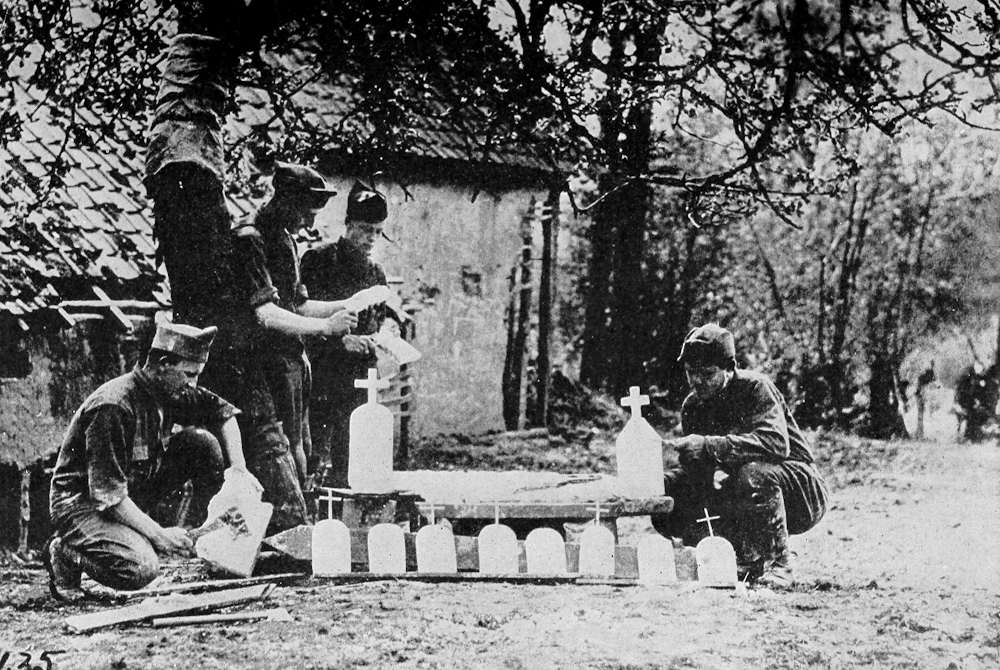
Remembering Their Fallen Comrades
Members of the United States Marine Corps carving stones with which to mark the graves of their former brothers in arms.
“But that soldier was not killed—he was blinded for life. He is myself.”
That is the story of Jesse A. Whaley, told by himself while an inmate of the Red Cross Institute for the Blind, where the blinded soldiers are aught trades and occupations in which the sense of touch serves for the lost eyes. To grip gun in a charge against the foe is possibly no more heroic than to grip life, resolutely to serve though blind.