HER AMBULANCE UNIT
Reading edition
An English Woman’s Contribution Was Her Fortune and the Daily Risk of Her Life
Among the decorations worn by Mrs. Hilda Wynne are the French Croix de Guerre, the Belgian order of Leopold, and the Russian Order of St. George—certificates of preëminent service in circumstances of danger that demand the high courage of utter self-devotion. Mrs. Wynne is a young English woman who gave her fortune to organize an ambulance unit and risked her life driving an ambulance on the firing line. Her organization was known as the Bevan-Wynne Unit, and it cared for some 40,000 wounded soldiers in the course of the war. Mrs. Wynne visited this country in the Autumn of 1917 for the purpose of arousing interest in the public in the needs of soldiers in France. Happily her mission was a successful one.
While she was in Denver the Post of that city induced Mrs. Wynne to tell some of her experiences, which are here reproduced.
“Looking upon the human courage I have witnessed, from this distance and in the little breathing space I have taken from service I can recall thousands of heroic acts, but the bravest happened on the Russian front.
“I saw two aviators go up to certain death. They were a Russian and a Frenchman. Both were little men. They went up to meet twenty German aeroplanes. It was suicidal. But they had been ordered to go—and theirs was the spirit of the gallant six hundred. I stood near them as they made ready to go. They said nothing. That is one of the lessons you learn in war—not to waste time nor words.
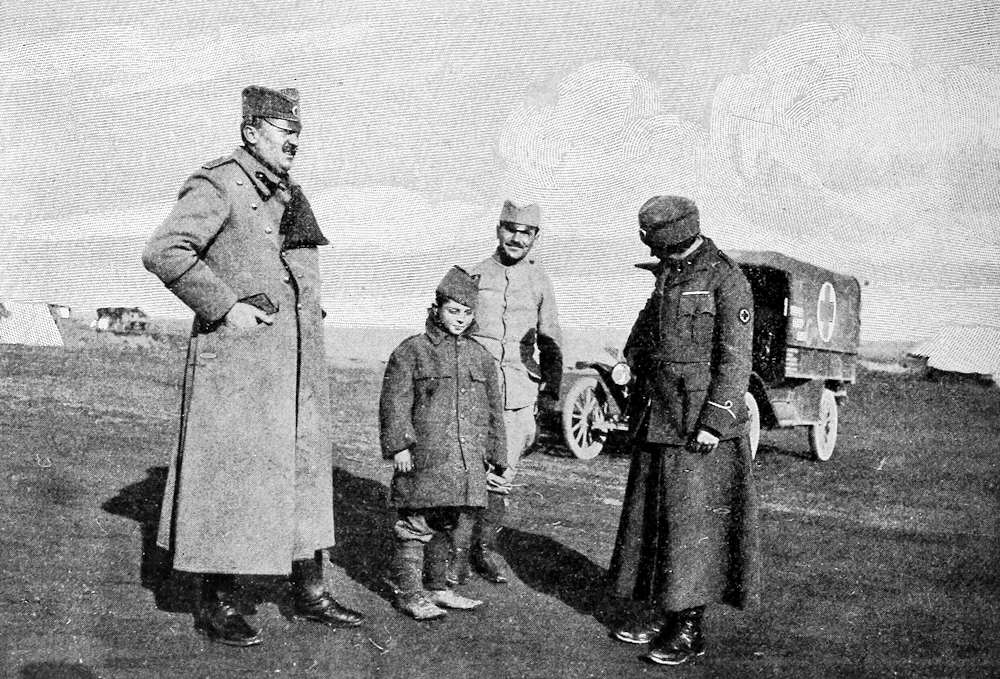
Women Ambulance-Drivers Served With All the Allied Armies
Many of them received decorations for conspicuous bravery while under fire.
“They got their machines ready as a rider tests his saddle-straps and stirrups before starting for his morning gallop through the park. A little pothering and fixing of the machinery and they had gone. They went straight up and began blazing away at the German planes. I watched and the cords of my heart tightened, for the German planes, looking like great gray birds with wings widespread, came closer and closer. They surrounded them. They formed a solid double circle about them. Then they began to fire. And I turned and covered my eyes with my hands. A few seconds later what had been aeroplanes were splintered wood and what had been men a broken mass covered by smoking rags.
“While this was the bravest act I saw in two and a half years on the firing line, I readily recall the most pathetic. It was the second line of men in the Russian trenches. They were unarmed soldiers. There were no guns for them. They took their places there expecting that the man in front might drop, and the second-line man could pick up his gun and take his place.
“I have seen many of the Allies die. They all die bravely. At Dixmude when the fusiliers arrived 8,000 and went out 4,000 there was magnificent courage in death. The Frenchman dies calling upon his God. The Englishman says nothing or feebly jests; just turns his face to the wall and is still. The Russian is mystic and secretive. The Russian lives behind a veil of reserve. You never fully know him. In the last moments you know by his rapt look that his soul is in communion with his God.
AN IMPLACABLE BREED
“One of the deepest, unalterable truths of the war is the German power of hatred. It is past measuring. An example occurred at Dixmude. When we had been there three days we were driven out. I took my car filled with the wounded across a bridge just in time. A second after we had crossed there was a roar, then a crash. A shot had torn the bridge to pieces. Three weeks later to our hospital was brought a wounded German.
“‘I know you,’ he said. ‘We nearly got you at the bridge at Dixmude.’
“‘I remember,’ I said.
“That man’s eyes used to follow me in a strange way. Build no beautiful theories of his national animosity disappearing, or being swallowed up in his gratitude. There was no such thought in his mind. The eyes said: ‘I wish I had killed you. But since I didn’t I wish I might have another chance.’
“This, after I had driven away a group of zouaves who had taken everything from him, including his iron cross, and who were debating whether to toss him into the canal then or that night.
“Shells have a disturbing way about them, more disturbing to your plans than your equanimity. Shells prevented my having a nice comfortable illness. In southern Russia one can get little to eat. Coarse black bread is the chief food. It causes various disorders. I, afflicted with one of them, arranged a table in the corner of my tent, placed remedies on the table, undressed, and turned in, intending to have a cozy illness of a few days. But as I lay came an angry buzzing. A shell hissed through, carrying away a corner of my tent. That ended my illness. I had no more time to think of it.
“The greatest peril I encountered was not from shells. One becomes used to them. One of the greatest dangers I faced was on a dark night drive along a precipice in the Caucasus. It was while the plan to bring troops through Persia to Russia was expected to be successful. I went ahead with some ambulances. It was necessary to take two Russian officers across the mountain. I offered my services. The road was an oddly twisting one. On one side was a high wall, on the other a precipice whose depth no one calculated. But as I allowed myself to look into it at twilight I could see no bottom to it. We started on the all-night drive at dusk. The precipice remained with us, a foot away, most of the distance. Had my car skidded twelve inches the story would have been different.
“Then, too, I wandered once within the Turkish lines, mistaking them for our own. But amid a courteous silence I was allowed to discover my mistake and escape without harm.
TOO BUSY TO REFUSE HER
“I think I owe my opportunity to do my bit, in the way I have, to the fact that I arrived in Flanders a few hours before the fight and the officers were too busy to send me back. I had seven automobiles, and knew how to use them. I took them to Dixmude and offered the automobiles and my services to the cause. I established headquarters at Furnes, which is seven miles from Nieuport, eight from Dixmude, and twenty from Ypres. I drove along the Yser Canal to the parts of the field that were under the heaviest fire, for there, I knew, my cars and I would be most needed. For a year I worked for the relief of the wounded of the French armies. Then I went to Russia, where I found the need of help and the sacrifice of life because of lack of that help almost inconceivable. The French armies have 6,000 ambulances. The Germans have 6,200. Russia, with a firing line of 6,000 miles, has only 600 motor-ambulances.
“I established dressing-stations in the mountains. Some of these were 10,000 feet above the sea-level. There, on the canvas stretched between two horses, the wounded were brought, or so they started. For many of them died in the long journey, every step of which was torture to a wounded man.
“The most exciting experience I ever had was on the Galician border. We could approach the battle-line only along the Tarnopol road, which ran for fifteen miles directly under German guns. I was speeding along it with an ambulance full of wounded soldiers when a shell struck the roadside and exploded, tearing a great hole in the earth fifty feet away. The concussion stopped us. Then we went on. I travel on my luck. Some time, I suppose, I shall travel too far.”