FROM SADDLE TO COCKPIT
Reading edition
It Was a Problem of Mud That Turned Trooper Bishop Into an “Ace” of the Royal Flying Corps
It was not unnatural that intrepidity in the air should have commanded more of public attention and enthusiasm during the war than did the courage, daring and amazing fortitude of the men in the trenches. The sensation of novelty makes stronger appeal to the curious interest of humanity than do deeds and events no less masterful though more familiar to experience. So it was that the invaders of the air, who fought their duels or delivered their assaults above the clouds, came in for the lion’s share of the popular plaudits,—the miracles of the flyers having the advantage of the romantic and picturesque over the miracles of the men who kept their feet on the earth. That is why there are more stories of the one than of the other. But are they not wonder stories? The career of any of the “Aces,” American, French, British, Italian, German, compels an affirmative answer.
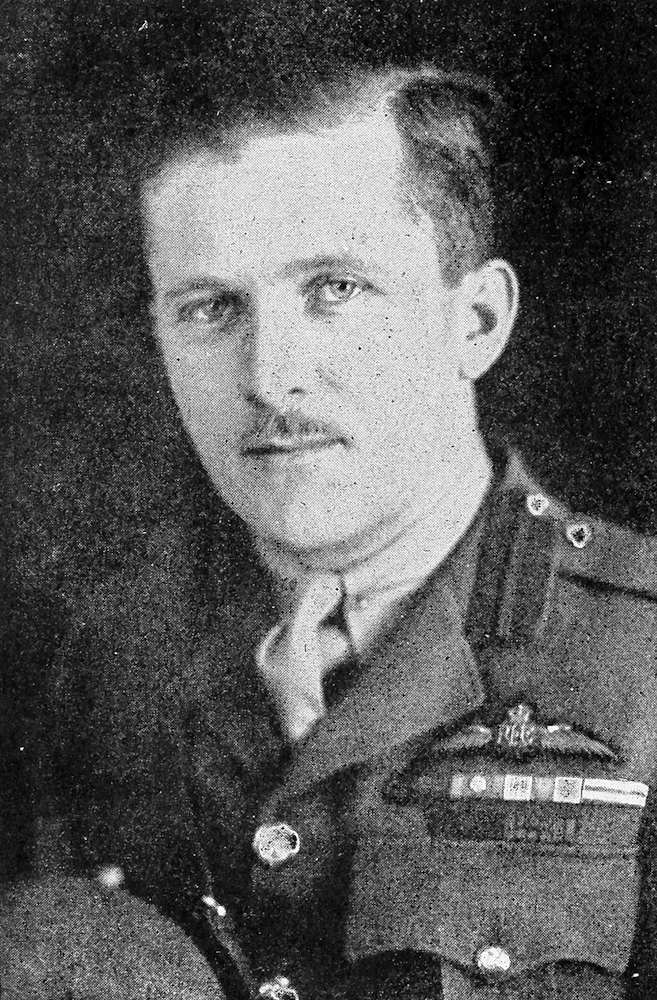
© Underwood and Underwood.
Colonel William A. Bishop, a Canadian “Ace” of the Royal Flying Corps
Among the many is that of Col. William A. Bishop, a Canadian member of the British Royal Flying Corps, his story rather the more interesting by reason of his living to tell it himself after the battles of the air had ceased. He had a record of forty-nine German planes and balloons actually destroyed. In addition to this, he was the victor in eighty to a hundred other fights high in air, the enemy engaged being driven from the field, either because of wounds or of that discretion said to be the better part of valor. In recognition of these achievements he received the Victoria Cross, the Distinguished Service Order, twice bestowed, and the Military Cross—all in a single fighting season and before he was twenty-three years of age. Perhaps the most remarkable thing about it all was that the hero of these officially honored achievements was little known, until the war ended, to the public at large. But that was due to the fact that the British policy was not to emphasize the performances of one branch of the service more than those of another. It is claimed that there were about forty “aces” of the British Royal Flying Corps of whom the world has never heard. Only when there was repeated mention of a name in The Official Gazette was the public made aware that a flyer had won exceptional title to honors.
Bishop went to England as a cavalry officer in a unit of the Second Canadian Division, and expected that his services would be in the saddle, not in the cockpit. That was in July, 1915, in a period of torrential rains and consequent mud—cheer-despoilers of a cavalry camp. It was while wallowing in knee-deep mud that he viewed with envy a pilot gliding overhead in a trim little aeroplane, and the sudden desire possessed him to follow that airy mind-free branch of the service. He talked with a friend in the Royal Flying Corps who approved his purpose, and assured him the transfer could be made quite easily. He got the transfer and was soon training as an observer, his first lessons being flights in a ponderous training “bus” (as the airmen name their planes) that was not equal to a speed of more than fifty miles an hour. In a few months he got the observer’s badge or insignia, an O with a spread wing attached to one side, and within a little while was making observations and taking photographs in France over the enemy lines.
This useful work, so highly important to the men fighting on the ground, was drudgery to him because he was burning to become a fighter. Some six months later his longing was gratified; he returned to England and set about acquiring the knowledge and skill to fly “on his own.” He had the usual experience of the beginner,—elation over his first “solo”; uncertainties, anxieties as to how to get back to earth safely; a somewhat humiliating landing, etc.; but he suffered no misadventure. The first week in March, 1917, he landed in Boulogne with ten or twelve other flying men for his second experience on the fighting front.
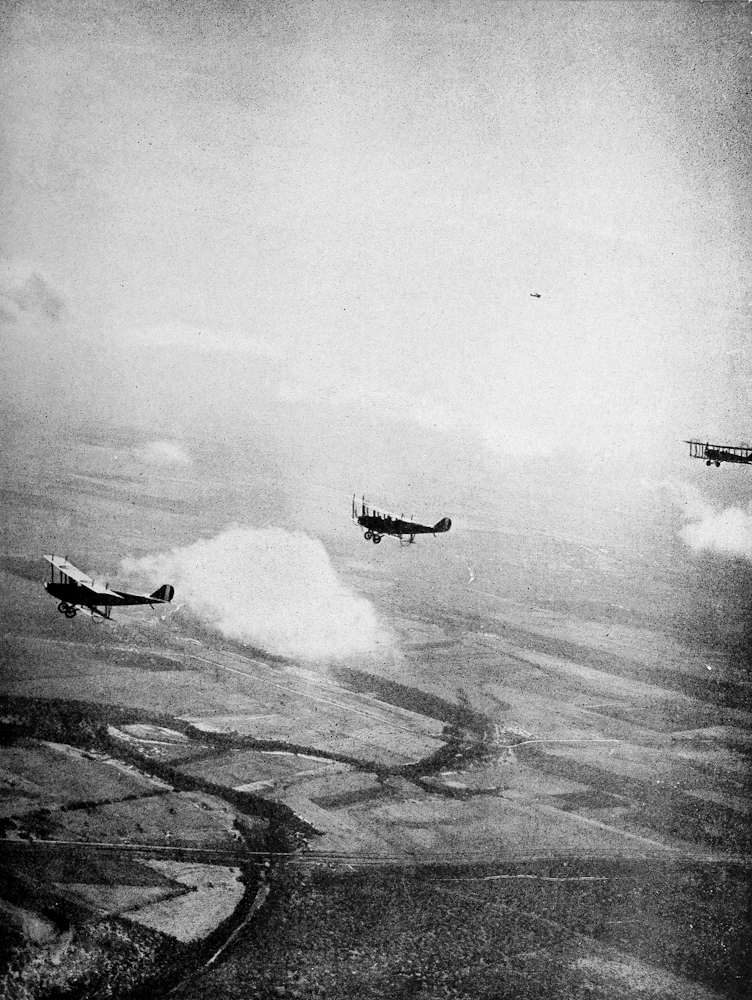
Courtesy Red Cross Magazine.
In Formation
These airplanes have ascended early in the morning for battle formation. The range of vision is interesting from this altitude.
KEEPING UP WITH THE FORMATION
The first time he was to go over the lines his orders were to bring up the rear of a flight of six machines, and he found keeping up with the formation such a busying task that he could be conscious of little else. “Every time the formation turned or did anything unexpected,” he says, “it took me two or three minutes to get back in my proper place. But I got back every time as fast as I could. I felt safe when I was with the formation and scared when I was out of it, for I had been warned many times that it is a fatal mistake to get detached and become a straggler. And I had heard of German ‘head hunters’ too. They are German machines that fly very high and avoid combat with anything like an equal number, but are quick to pounce down upon a straggler, or an Allied machine that has been damaged and is bravely struggling to get home. Fine sportsmanship that!
“The way I clung to my companions that day reminded me of the little child hanging to its mother’s skirts while crossing a street. I remember I also felt as a child does when it is going up a dark pair of stairs and is sure something is going to reach out somewhere and grab it. I was so intent on the clinging part that I paid very little attention to anything else.”
Some distance off was another formation on patrol that became engaged with a Hun formation and he saw the young flyer of one of the machines, “one of our own,” going down in flames, but his reflections on that incident were suddenly interrupted by a “bang” of terrifying violence close to his ears. The tail of his machine shot up in the air and he fell three or more hundred feet before he could recover control. It was a shot from an “Archie” (an anti-aircraft gun), and Colonel Bishop says of it: “That shot, strange to relate, was the closest I have ever had from anti-aircraft fire.”
THE GERMAN “FLYING PIG”
In his highly entertaining book, Winged Warfare, Colonel Bishop introduces an amusing incident as the finish of this night’s patrol. He says:
“We continued to patrol our beat, and I was keeping my place so well I began to look about a bit. After one of these gazing spells, I was startled to discover that the three leading machines of our formation were missing. Apparently they had disappeared into nothingness. I looked around hastily, and then discovered them underneath me, diving rapidly. I didn’t know just what they were diving at, but I dived, too. Long before I got down to them, however, they had been in a short engagement half a mile below me, and had succeeded in frightening off an enemy artillery machine which had been doing wireless observation work. It was a large white German two-seater, and I learned after we landed that it was a well-known machine and was commonly called ‘the flying pig.’ Our patrol leader had to put up with a lot of teasing that night because he had attacked the ‘pig.’ It seems that it worked every day on this part of the front, was very old, had a very bad pilot and a very poor observer to protect him.
“It was a sort of point of honor in the squadron that the decrepit old ‘pig’ should not actually be shot down. It was considered fair sport, however, to frighten it. Whenever our machines approached, the ‘pig’ would begin a series of clumsy turns and ludicrous maneuvers, and would open a frightened fire from ridiculously long ranges. The observer was a very bad shot and never succeeded in hitting any of our machines, so attacking this particular German was always regarded more as a joke than a serious part of warfare. The idea was only to frighten the ‘pig,’ but our patrol leader had made such a determined dash at him the first day we went over that he never appeared again. For months the patrol leader was chided for playing such a nasty trick upon a harmless old Hun.”
As Colonel Bishop’s story is that of one thrilling and perilous adventure following fast upon another, it is impossible to give his career in detail or recount even the chief of his many engagements. The fight in which he won the Military Cross is a good illustration of the clear judgment and fearlessness which characterized his exploits in general.
The Allies had been preparing for the great offensive that began with the battle of Arras, and for a week in advance of the date set for the initiative (April 9th, 1917) the airmen had been carrying out orders to keep the sky free from prying eyes of men in planes and to attack and destroy enemy observation balloons. The balloons flew from the same places every day because there were batteries of anti-aircraft guns stationed below that area. Bishop was assigned to the destruction of a particularly annoying balloon that went up daily in contempt of scouting planes. The balloon, because of cloudy weather, did not go up the first day after the assignment. The character of the fighting may be determined from the fact that in two days, April 6 and 7, the Allies lost twenty-eight machines as against fifteen German machines accounted for. But, says Bishop, “We considered this a small price to pay for the amount of work accomplished and the number of machines engaged (every class of machine was thrown into the clearing process) coupled with the fact that all our work was done within the German lines.”
HOW HE WON THE MILITARY CROSS
“My own experiences on the seventh of April brought me my first decoration—the Military Cross. The thrills were all condensed into a period of two minutes for me. In that time I was fortunate enough to shoot down an enemy machine and destroy the ‘sausage’ I had started for two days before. This should have been excitement enough, but I added to it by coming within fifteen feet of being taken a German prisoner and becoming an unwilling guest of the Huns for the ‘duration.’
“I was ordered after my particular balloon and had climbed to about 5,000 feet before heading for the lines. On my way there I had to pass over one of our own observation balloons. I don’t know what it was that attracted my attention, but looking down I saw what appeared to be two men descending in parachutes. A moment later the balloon below me burst into flames. I saw the enemy machine which had set it on fire engaged with some of ours, but as I had definite orders to proceed straight to the lines and destroy the hostile balloon which had been allotted to me, I was unable to join in the fighting.
“Just about this time an amusing incident was in progress at our aerodrome. A Colonel of the Corps was telephoning my squadron commander, informing him that one of our balloons had just been destroyed.
“Well, if it is any consolation, young Bishop, of my squadron, has just gone over to get one of theirs,’ replied my commander.
“‘Good God,’ said the Colonel, ‘I hope he has not made a mistake in the balloon and set ours on fire.’
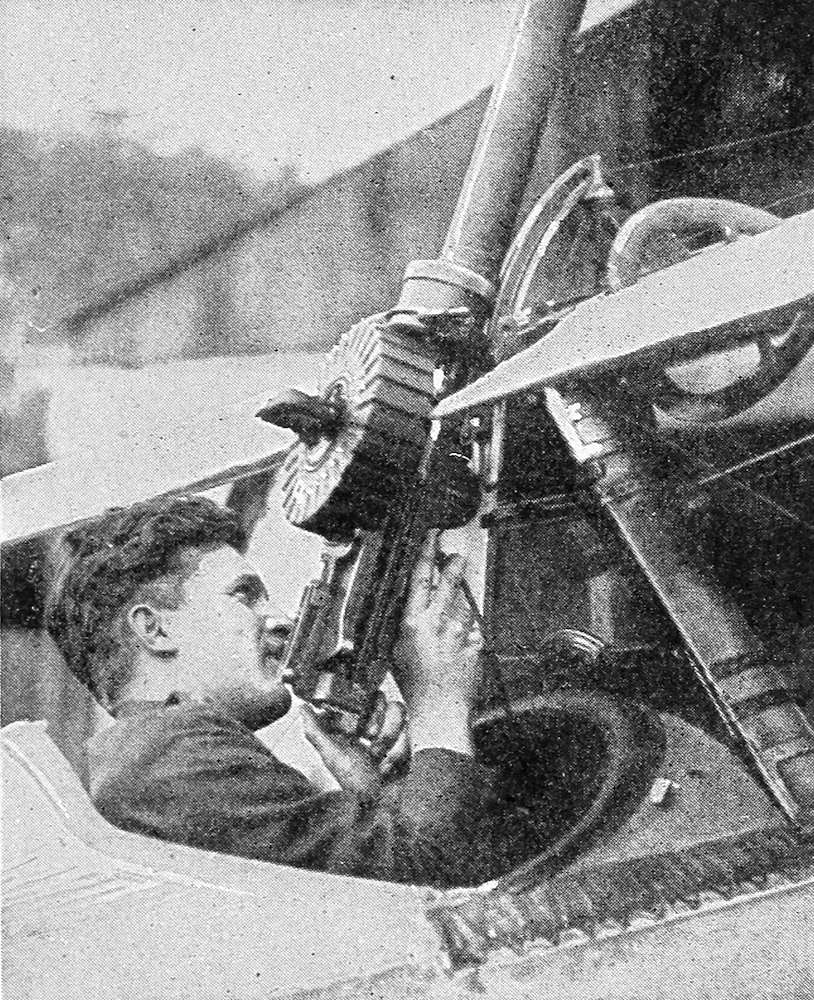
© Western Newspaper Union.
Colonel Bishop Inspecting a Lewis Aircraft Gun
“At this moment I was serenely sailing over the enemy trenches keeping a sharp lookout for some sign of my own balloon. After flying five miles over the lines I discovered it and circled around as a preliminary to diving down upon it. But just then I heard the rattle of machine guns directly behind me and saw bullet holes appear as if by magic in the wings of my machine. I pulled back as if to loop, sending the nose of my machine straight up into the air. As I did so the enemy scout shot by underneath me. I stood on my tail for a moment or two, then let the machine drop back, put her nose down and dived after the Hun, opening fire straight behind him at very close range. He continued to dive away with increasing speed and later was reported to have crashed just under where the combat had taken place. This victory I put down entirely to luck. The man flew directly in line with my gun and it would have been impossible to have missed him.
“I proceeded now to dive for the balloon, but having had so much warning, it had been pulled down to the ground. I would have been justified in going home when I saw this, for our orders were not to go under 1,000 feet after the sausages. But I was just a bit peevish with this particular balloon, and to a certain extent my blood was up. So I decided to attack the ungainly monster in its ‘bed.’ I dived straight for it and when about 500 feet from the ground, opened fire. Nothing happened. So I continued to dive and fire rapid bursts until I was only fifty feet above the bag. Still there were no signs of it catching fire. I then turned my machine gun on the balloon crew who were working frantically on the ground. They scattered and ran all about the field. Meantime a ‘flaming onion’ battery was attempting to pelt me with those unsavory missiles, so I whirled upon them with a burst of twenty rounds or more. One of the onions had flared within a hundred yards of me.”
“SUDDENLY MY ENGINE HAD FAILED”
“This was all very exciting, but suddenly, with a feeling of faintness, I realized that my engine had failed. I thought that again, as during my first fight, the engine had oiled up from the steep diving I had done. It seemed but a moment before that I was coming down at a speed that must have been nearly 200 miles an hour. But I had lost it all in turning my machine upon the people on the ground.
“There was no doubt in my mind this time as to just where I was, and there appeared no alternative but to land and give myself up. Underneath me was a large open field with a single tree in it. I glided down, intending to strike the tree with one wing just at the moment of landing, thus damaging the machine so it would be of little use to the Huns, without injuring myself.
A MIRACULOUS RECOVERY
“I was within fifteen feet of the ground, absolutely sick at heart with the uselessness of it all, my thoughts having turned to home and the worry they would all feel when I was reported in the list of the missing, when without warning one of my nine cylinders gave a kick. Then a second one miraculously came to life, and in another moment the old engine—the best old engine in all the world—had picked up with a roar on all the nine cylinders. Once again the whole world changed for me. In less time than it takes to tell it I was tearing away for home at a hundred miles an hour. My greatest safety from attack now lay in keeping close to the ground, and this I did. The ‘Archies’ cannot fire when you are so close to earth, and few pilots would have risked a dive at me at the altitude which I maintained. The machine guns on the ground rattled rather spitefully several times, but worried me not at all. I had had my narrow squeak for this day and nothing could stop me now.
“I even had time to glance back over my shoulder, and there, to my great joy, I saw a cloud of smoke and flames rising from my erstwhile bête noir—the sausage. We afterward learned it was completely destroyed.
“It was a strange thing to be skimming along just above the ground in enemy territory. From time to time I would come on groups of Huns who would attempt to fire on me with rifles and pistols, but I would dart at them and they would immediately scatter and run for cover. I flew so low that when I would come to a clump of trees I would have to pull my nose straight up toward the sky and ‘zoom’ over them. Most of the Germans were so startled to see me right in their midst, as it were, they either forgot to fire or fired so badly as to insure my absolute safety. Crossing the three lines of German trenches was not so comfortable, but by zigzagging and quick dodging I negotiated them safely and climbed away to our aerodrome. There I found that no bullets had passed very close to me, although my wingtips were fairly perforated.
“That evening I was delighted to get congratulations not only from my Colonel, but my Brigadier as well, supplemented later by a wire from the General commanding the Flying Corps. This I proudly sent home the same evening in a letter.”
“LIKE SHOOTING CLAY PIGEONS”
There seems to be a general feeling among airmen that theirs is not a business or profession, but a game. Colonel Bishop declares that it did not seem to him to be killing a man to bring down a machine; “it was more as if I were destroying a mechanical target, with no human being in it. Once or twice the idea that a live man had been piloting the machine would occur to me, and it would worry me a bit. My sleep would be spoiled perhaps for a night. I did not relish the idea of killing even Germans, yet, when in a combat in the air, it seemed more like any other kind of sport, and to shoot down a machine was very much the same as if one were shooting down clay pigeons. One has the great satisfaction of feeling that he had hit the target and brought it down; that one was victorious again.” The fascination that such a game has for the airman is easily understood.
Bishop brought down his fortieth enemy plane six miles within the enemy lines, and escaped in spite of a hail of shells from anti-aircraft guns for five miles of the return trip, his machine being fairly well riddled; and, one day just at that time, his cup of happiness filled and overflowed with the award of the Victoria Cross.