WITHIN THE CAPITOL CHARLES DICKENS
Reading edition
The principal features of the Capitol are, of course, the two Houses of Assembly. But there is, besides, in the centre of the building, a fine rotunda, ninety-six feet in diameter, and ninety-six high, whose circular wall is divided into compartments, ornamented by historical pictures. Four of these have for their subjects prominent events in the revolutionary struggle. They were painted by Colonel Trumbull, himself a member of Washington’s staff at the time of their occurrence; from which circumstance they derive a peculiar interest of their own. In this same hall Mr. Greenough’s large statue of Washington has been lately placed. It has great merits of course, but it struck me as being rather strained and violent for its subject. I could wish, however, to have seen it in a better light than it can ever be viewed in, where it stands.
There is a very pleasant and commodious library in the Capitol; and from a balcony in front, the bird’s-eye view may be had, together with a beautiful prospect of the adjacent country. In one of the ornamented portions of the building, there is a figure of Justice; whereunto the Guide Book says, “the artist at first contemplated giving more of nudity, but he was warned that the public sentiment in this country would not admit of it, and in his caution he has gone, perhaps, into the opposite extreme.” Poor Justice! she has been made to wear much stranger garments in America than those she pines in, in the Capitol. Let us hope that she has changed her dressmaker since they were fashioned, and that the public sentiment of the country did not cut out the clothes she hides her lovely figure in, just now.
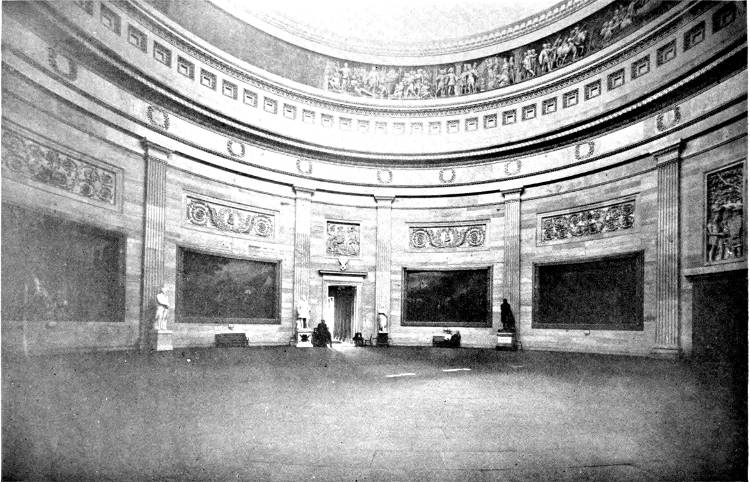
THE CAPITOL (ROTUNDA)
The House of Representatives is a beautiful and spacious hall, of semicircular shape, supported by handsome pillars. One part of the gallery is appropriated to the ladies, and there they sit in front rows, and come in, and go out, as at a play or concert. The chair is canopied, and raised considerably above the floor of the House; and every member has an easy-chair and a writing-desk to himself: which is denounced by some people out of doors as a most unfortunate and injudicious arrangement, tending to long sittings and prosaic speeches. It is an elegant chamber to look at, but a singularly bad one for all purposes of hearing. The Senate, which is smaller, is free from this objection, and is exceedingly well adapted to the uses for which it is designed. The sittings, I need hardly add, take place in the day; and the parliamentary forms are modelled on those of the old country.
I was sometimes asked, in my progress through other places, whether I had not been very much impressed by the heads of the lawmakers at Washington; meaning not their chiefs and leaders, but literally their individual and personal heads, whereon their hair grew, and whereby the phrenological character of each legislator was expressed: and I almost as often struck my questioner dumb with indignant consternation by answering “No, that I didn’t remember being at all overcome.” As I must, at whatever hazard, repeat the avowal here, I will follow it up by relating my impressions on this subject in as few words as possible.
In the first place—it may be from some imperfect development of my organ of veneration—I do not remember having ever fainted away, or having even been moved to tears of joyful pride, at sight of any legislative body. I have borne the House of Commons like a man, and have yielded to no weakness, but slumber, in the House of Lords. I have seen elections for borough and county, and have never been impelled (no matter which party won) to damage my hat by throwing it up into the air in triumph, or to crack my voice by shouting forth any reference to our Glorious Constitution, to the noble purity of our independent voters, or the unimpeachable integrity of our independent members. Having withstood such strong attacks upon my fortitude, it is possible that I may be of a cold and insensible temperament, amounting to iciness, in such matters; and therefore my impressions of the live pillars of the Capitol at Washington must be received with such grains of allowance as this free confession may seem to demand.
Did I see in this public body an assemblage of men, bound together in the sacred names of Liberty and Freedom, and so asserting the chaste dignity of those twin goddesses, in all their discussions, as to exalt at once the Eternal Principles to which their names are given, and their own character, and the character of their countrymen, in the admiring eyes of the whole world?
Did I recognize in this assembly, a body of men, who, applying themselves in a new world to correct some of the falsehoods and vices of the old, purified the avenues to Public Life, paved the dirty ways to Place and Power, debated and made laws for the Common Good, and had no party but their Country?
I saw in them the wheels that move the meanest perversion of virtuous Political Machinery that the worst tools ever wrought. Despicable trickery at elections; under-handed tamperings with public officers; cowardly attacks upon opponents, with scurrilous newspapers for shields, and hired pens for daggers; shameful trucklings to mercenary knaves, whose claim to be considered, is, that every day and week they sow new crops of ruin with their venal types, which are the dragons’ teeth of yore, in everything but sharpness; aidings and abettings of every bad inclination in the popular mind, and artful suppressions of all its good influences: such things as these, and in a word, Dishonest Faction in its most depraved and most unblushing form, stared out from every corner of the crowded hall.
Did I see among them the intelligence and refinement: the true, honest, patriotic heart of America? Here and there, were drops of its blood and life, but they scarcely coloured the stream of desperate adventurers which sets that way for profit and for pay. It is the game of these men, and of their profligate organs, to make the strife of politics so fierce and brutal, and so destructive of all self-respect in worthy men, that sensitive and delicate-minded persons shall be kept aloof, and they, and such as they, be left to battle out their selfish views, unchecked. And thus this lowest of all scrambling fights goes on, and they who in other countries would, from their intelligence and station, most aspire to make the laws, do here recoil the farthest from that degradation.
That there are, among the representatives of the people in both Houses, and among all parties, some men of high character and great abilities, I need not say. The foremost among those politicians who are known in Europe, have been already described, and I see no reason to depart from the rule I have laid down for my guidance, of abstaining from all mention of individuals. It will be sufficient to add, that to the most favourable accounts that have been written of them, I more than fully and most heartily subscribe; and that personal intercourse and free communication have bred within me, not the result predicted in the very doubtful proverb, but increased admiration and respect. They are striking men to look at, hard to deceive, prompt to act, lions in energy, Crichtons in varied accomplishments, Indians in fire of eye and gesture, Americans in strong and generous impulse; and they as well represent the honour and wisdom of their country at home, as the distinguished gentleman who is now its Minister at the British Court sustains its highest character abroad.
I visited both Houses nearly every day, during my stay in Washington. On my initiatory visit to the House of Representatives, they divided against a decision of the chair; but the chair won. The second time I went, the member who was speaking, being interrupted by a laugh, mimicked it, as one child would in quarrelling with another, and added, “that he would make honourable gentlemen opposite, sing out a little more on the other side of their mouths presently.” But interruptions are rare; the Speaker being usually heard in silence. There are more quarrels than with us, and more threatenings than gentlemen are accustomed to exchange in any civilized society of which we have record: but farm-yard imitations have not as yet been imported from the Parliament of the United Kingdom. The feature in oratory which appears to be the most practiced, and most relished, is the constant repetition of the same idea or shadow of an idea in fresh words; and the inquiry out of doors is not, “What did he say?” but, “How long did he speak?” These, however, are but enlargements of a principle which prevails elsewhere.