THE TABERNACLE, SALT LAKE CITY LADY HARDY
Reading edition
There are few passengers on board the train as we steam through the suburban districts of Mormonland. The magnificent chain of the Wahsatch Mountains rising in the east and the great Salt Lake stretching away towards the west, the rest of the scene made up of fertile lands, green meadows, fields of yellow corn and purple clover, form an enchanting panorama as we fly past them; we are full of an undefined curiosity and anxious to see this City of the Saints of which we have heard so much.
We reach the City of the Saints at last, and find it as fair and beautiful as we had expected. It is in truth an oasis in a desert, a blooming garden in a wilderness of green. We can scarcely conceive how this flowery world has lifted itself from the heart of desolation; it is only one more proof that the intellect and industry of man can master the mysteries of nature, and force her in her most harsh uncompromising moods to bring forth fair fruits. It lies in a deep wide valley, bounded on the east by the mighty range of the Wahsatch Mountains, which lift their rugged stony feet stretching away and reaching towards the west, where the great Salt Lake unrolls its dark waters, and widens and wanders away until it is lost in the distance. The streets are wide, the houses of all sorts and sizes, some one-story high, some two or even three, all built in different styles, or no style of architecture; each man having built his dwelling in accordance with his own taste, or convenience. The streets are all arranged in long straight rows, and stretch away till they seem to crawl up the mountain-sides and then are lost. On either side of the roadways are magnificent forest-trees, which in summer-time must form a most delightful shade, though now it is autumn and the leaves are falling fast. Streams of water with their pleasant gurgling music flow on either side, through a deep cutting (which we should irreverently call the gutter), rushing along as though they were in a hurry to reach some everlasting sea. The women come out with their buckets and help themselves, while the children sail their toy boats, clapping their hands gleefully as the tiny craft is tossed and tumbled and borne along on the face of the bubbling water. Street-cars come crawling along the straight streets, crossing and re-crossing each other at different points; but a private cab or carriage is rarely to be seen. Every house, be it only composed of a single room, is surrounded by a plot of garden ground, where fruits, flowers and vegetables all grow together in loving companionship. Everything seems flourishing, and everybody seems well-to-do; there are no signs of poverty anywhere; no bare-footed whining beggars fill the streets; tramps there may be, passing from one part of the State to another, but these are all decently dressed and well fed, for at whatever door they knock, they are sure to find food and shelter, charity to those in need being a part of the reigning religion.
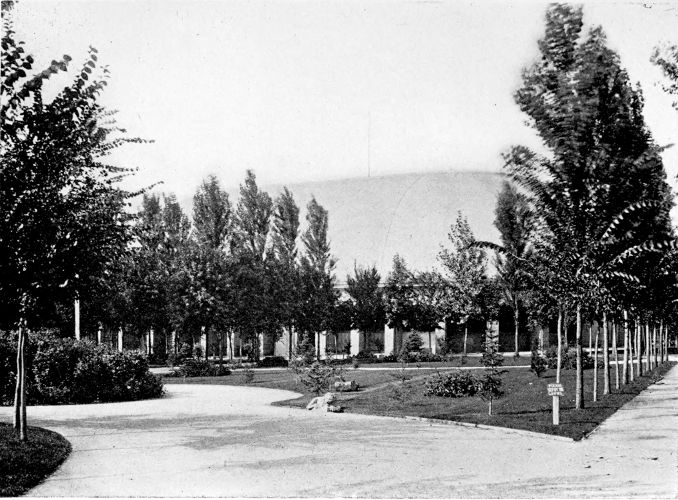
THE TABERNACLE, SALT LAKE CITY, UTAH
The far-famed tabernacle strikes one as a huge monstrosity, a tumour of bricks and mortar rising on the face of the earth. It is a perfectly plain egg-shaped building, studded with heavy entrance doors all around; there is not the slightest attempt at ornamentation of any kind; it is a mass of ugliness; the inside is vast, dreary, and strikes one with a chill, as though entering a vault; it is 250 feet long and 80 feet high; its acoustic properties are wonderful—the voice of him who occupies the rostrum can be distinctly heard in the remotest corner of the building. If you whisper at one end your words are repeated aloud at the other, without being caught up and hunted through every crevice by ghostly mocking echoes. A gallery runs all around, supported by rows of thin, helpless-looking pillars. The seats in the body of the building are raised on sloping ground, like the pit of a theatre,—a wide expanse of empty benches, dreary and depressing to the wandering eye, which finds no pleasant spot to dwell upon. In the centre stands a fountain with four plaster-of-Paris lions couchant, poor, mangy-looking beasts at best. From the white plastered ceiling or dome, being concave perhaps it may be called so, hangs a gigantic star, hung round with artificial flowers and evergreen pendants, something like a monstrous jack-in-the-green turned upside down. The whole interior is gloomy and dark; I doubt if people could ever see to read their prayers. At one end of this huge barn-like building hangs an immense blue banner emblazoned with a golden beehive, which flaunts over the heads of the faithful. At the other end stands an organ, the largest in the world they say, and it may be so, for it is certainly immense. They are justly proud of it, for it is of home manufacture entirely, and was built precisely where it stands, under the supervision of an English convert named Ridges, and contains upwards of a thousand pipes, some of such a circumference you feel as though you could wander up and down them, and be lost in a world of music. Notwithstanding its immense size, it has not a single harsh or metallic sound; on the contrary, it is marvellously soft-toned; from the low flute-like wailing voice of the vox humana to the deep bass roll which stirs the air like a wave of melodious thunder, it has all the delicacy of the Æolian harp, with the strength and power of its thousand brazen voices. The case is of polished pine of elegant and simple design. All wood, metal and other material used was brought from the forest or mines of Utah.
Sloping down from the organ towards the auditorium are semicircular rows of seats, for the elders and dignitaries of the Church. In the centre is a desk with a shabby blue sofa behind it; this was used by Brigham Young and his two chief councillors. Below this are the seats for the twelve apostles and for the choir and benches where the elders may congregate to consult together. In front of all this combination stands a long narrow table, an altar perhaps it may be called, covered with a red cloth, whereon is arranged a gorgeous array of silver cups, of all shapes and sizes, as though prepared for an unlimited christening party or an everlasting service libation to some heathen deity rather than to a Christian God.
Passing out from the tabernacle, we glanced at the Endowment House, where many of their religious ceremonies are performed, and where, if rumour speaks truly, gross licentiousness is carried on under the sanction of the Church—where some ugly secrets and mysteries lie hidden, of which no one can speak and live. Across the road stands the president’s office, and next to that the “Beehive House” of Brigham Young notoriety. It is a long low-roofed, adobe building, railed in, a desolate-looking place where, in old days, some dozens of his wives were domiciled; it is now occupied by his wives—some of them. A high stone wall filled in with adobe encloses the president’s residence and many other buildings, with arched gateways and heavy wooden gates; there is a double archway leading to some factories and stables, surmounted by a beehive in the grip of a monstrous eagle—an illustration of the Mormon faith in the cruel clutch of the Stars and Stripes. Close by is the school-house, first erected for the sole education of Brigham Young’s family, which was large enough to fill it; it is now devoted to the benefit of the masses. The whole of these buildings are crowded together, and are generally surrounded by a high wall, which gives them a gloomy appearance, suggestive of an Eastern harem.