THE NATIONAL WASHINGTON MONUMENT JOSEPH B. VARNUM
Reading edition
“Yonder shaft, Which States and peoples piled the stones That from its top the very winds might waft upon, To distant shores, the name of Washington.”
The most interesting fact connected with the Monument is, that it stands on the site where Washington supposed he was to be commemorated. In 1783, Congress passed resolutions directing the Minister at Versailles to secure the services of the best artist in Europe, for the preparation of a statue of Washington, “to be erected at the place where the residence of Congress shall be established.”
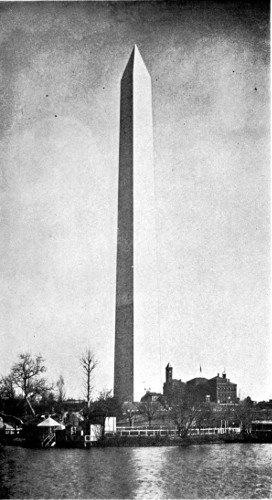
THE WASHINGTON MONUMENT
WASHINGTON, D. C.
The Commissioners who planned the Federal City, set apart the place where the Monument now stands, as the site for this statue; and their report with this provision, was communicated by Washington to Congress. It has been said that the statue by Houdon, in Virginia, was from the cast which Jefferson, then Minister to France, procured, with reference to fulfilling this resolution of Congress; but the statue never appears to have been ordered, probably for want of funds. Like many other acts of the Continental Congress, it was probably delayed in its execution by the uncertainty which existed about a Seat of Government, as well as the embarrassments incident to a government just emerging from a war, and dependent for all its resources on the action of the States.
In 1799, Congress directed President Adams to correspond with Mrs. Washington, and ask her consent to the interment of the remains of her illustrious husband, under a monument to be erected by the United States in the Capitol at the City of Washington. Mrs. Washington gave her assent in the following letter:
“Taught by the great example I have so long had before me never to oppose my private wishes to the public will, I must consent to the request of Congress which you have had the goodness to transmit to me; and, in doing this, I need not, I cannot, say what a sacrifice of individual feeling I make to a sense of public duty.”
But the monument was not erected, and the remains, therefore, were not removed from Mount Vernon.
In 1816, the subject was revived in a report by Mr. Huger, of South Carolina, from a joint committee for a public monument and the removal of the remains, but nothing was done. In February of the same year the legislature of Virginia authorized Governor Nicholas to apply to Judge Bushrod Washington, then proprietor of Mount Vernon, for leave to remove the remains of General and Mrs. Washington from Mount Vernon to Richmond, to be placed under the monument proposed to be erected to the honour of Washington, at the capital of the State. Judge Washington declined, and, among other reasons stated the following:
“But obligations more sacred than anything which concerns myself—obligations with which I cannot dispense—command me to retain the mortal remains of my venerated uncle in the family vault where they are deposited. It is his own will, and that will is to me a law which I dare not disobey. He has himself directed his body should be placed there, and I cannot separate it from those of his near relatives, by which it is surrounded.”
Mr. John A. Washington declined on a similar ground, a proposition made by Congress in 1832, to remove the remains of General and Mrs. Washington to a vault under the rotunda of the Capitol.
On the 26th of September, 1833, a number of citizens of Washington digested a plan for the erection of a monument which, in the language subsequently used by Mr. Winthrop, should “bespeak the gratitude, not only of the State, or of cities, or of Governments, not of separate communities, or of official bodies; but of the people, the whole people of the nation: a national monument erected by the citizens of the United States of America.”
At first the plan was to raise the funds by dollar subscriptions; but the whole collection amounted to only $28,000, when, owing to the financial embarrassments of the country, the collections were suspended. But the amount on hand was invested, and the interest regularly re-invested, so that it had increased to $40,000 when the new collection was begun in 1846.
As to the design, it is not easy to say what would have suited the public at large, and satisfied to a reasonable degree the critics. For our own part we should have thought that something might have been designed more particularly expressive of its object and more American in its details, less of a mere imitation of the ancients, something which would have embodied in it the trees and products peculiar to our country, something a little less like a second edition of Bunker Hill Monument, and which could present internal as well as outward attractions.
The obelisk presents some decided advantages—
First: It is of all monuments the strongest and most enduring, next to that of the pyramid. In 1800, when the question in Congress was between adopting the statue of 1783, or a mausoleum in pyramidal form, it was stated in debate, without any concert whatever, a remarkable concurrence had taken place between West, Trumbull and other respectable artists, who gave an unequivocal preference to a mausoleum. A mausoleum would last for ages, and would present the same imperishable appearance two thousand years hence that it would now; whereas a statue would only remain until some civil convulsion, or foreign invasion, or flagitious conqueror, or lawless mob should dash it into atoms, or until some invading barbarian should transport it as a trophy of his guilt to a foreign shore. Besides, a statue was minute, trivial, perishable. It was a monument erected to all that crowd of estimable but subordinate personages that soar in a region elevated indeed above common characters, but which was infinitely below that of Washington. At that session, after a long discussion, a bill passed one House for the erection of a “mausoleum of American granite and marble in a pyramidal form, 100 feet square at the base and of a proportional height.”
Secondly: It is like the Government and character of Washington, simple and majestic, with no attempt at ornament. It cannot well be spoiled in building, or by bad sculpture. We could not hope to rival the magnificent productions of the Old World in structure, however creditable the works of our artists may have been in one or two instances.
Thirdly: It excels all others in one respect, that of height.
Note.—The work was begun in 1858 and finished in 1885. The original designs were by Robert Mills and the total cost reached the sum of $1,187,710.31. In 1878, it was noticed that the foundations were not secure, and deep excavations were made around the base to strengthen the obelisk which had by that time reached the height of 156 feet. The area of the foundation was enlarged from 6,400 to 16,000 feet. The National Washington Monument has a total height of 555 feet 5⅓ inches, higher than St. Paul’s, London (404 feet), St. Peter’s, Rome (434¾ feet), the Strasburg Cathedral (495 feet) and the Cologne Cathedral (514 feet). It is 231 feet higher than Bartholdi Statue of Liberty in the harbour of New York.—E. S.