THE WHIPPLE HOUSE, IPSWICH W. H. DOWNES
Reading edition
The old house bought by the Ipswich Historical Society is the best surviving example in New England of the earliest Seventeenth-Century colonial architecture. There are several finer and grander specimens of the domestic architecture of later periods in Essex County, but in all the category of colonial houses there is no such perfectly preserved and authentic type of the domestic architecture of the middle of the Seventeenth Century. The exact date of its erection is unknown, but all the valid evidence available, in the absence of documentary records bearing directly on this point, indicates that it was built as early as 1650, and there are architects who believe that it was erected still earlier. The extreme rarity of houses dating from that remote period, so soon after the settlement of Massachusetts, is due primarily to the limited longevity of wooden building, and secondarily to the fact that the colonists were at first obliged by the paucity of proper building materials to erect only temporary cabins of logs, which were subsequently abandoned and neglected, after more comfortable dwellings were made possible by the establishment of saw-mills and forges and roads. Ipswich was settled in 1633. The first saw-mill in the town was established in 1649. The great posts and girders, with other surviving timbers of the frame of the old house in question, bear no marks of the axe or the adze, and it would be a fair inference that they were sawed, though not necessarily by water power, for we know that some extensive sawing was done by hand in sawpits.
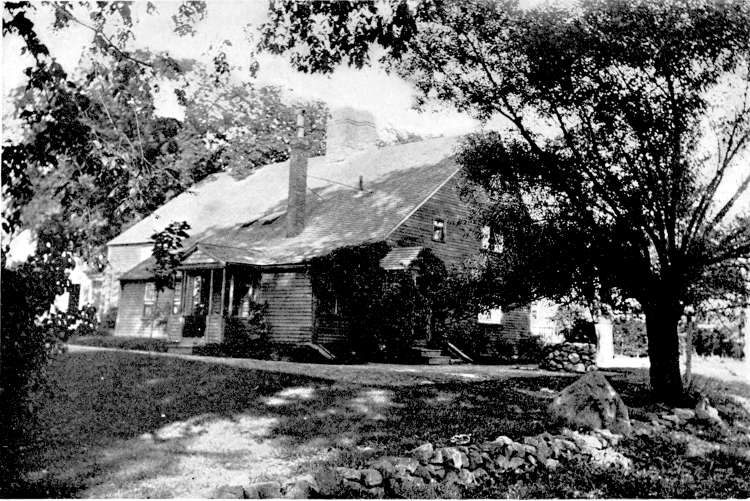
WHIPPLE HOUSE, IPSWICH, MASS.
... There are three or four successive parts or chapters in the serial story of the old house. The west end of the main structure was built first; of this there is evidence in the material, the workmanship, the age of the woodwork, and in indirect, but convincing written evidence. The main beams of the frame—the posts, sills, girders, joists, rafters, etc.—in this wing are of American larch or tamarack, a soft wood, which, however, has shown astonishing durability in every part except where it has been exposed to moisture. The east part of the main structure, the second chapter, was possibly added in the time of the affluent and pious Captain John Whipple, the second of that name, who, in 1683, was estimated to be “worth” $16,570. In this part of the house the main beams are of oak, and the posts and girders are carved with some attempt at elegance of finish. Later a lean-to was added, the rafters on the north (rear) side of the roof being supplemented by a new set of rafters at an easier angle, carrying the roof at one point almost to the ground. Whether the lean-to was entirely built at one time, or in two sections, is unknown and is not of importance. The lean-to is a relatively modern part, and the original profile of the exterior must have been very angular and high-shouldered in proportion to its ground area.
Now, here are the more interesting dimensions of the building, as it stands. Length, on the ground, fifty feet; width, thirty-six feet. Great east room, ground floor, twenty-four by seventeen and one-half feet; height seven feet. Fireplace in this room, seven feet and three inches wide; two feet, nine inches deep. Dimensions of oak girders, fourteen by fourteen inches. Windows, diamond panes, and hung on hinges, five feet, three inches wide, and two feet, six inches high; three sashes each; should be leaded glass. East chamber, same measurements as east room below. Fireplace in this room, six feet, two inches wide, and two feet, two inches deep. These figures may mean but little to the layman, but they are full of significance to the architect, the builder, and the antiquarian. The exterior of the Whipple house has nothing in its aspect that would serve to draw especial attention to it; but the interior possesses these two distinct points of architectural merit, remarkable massiveness of construction, and fine, dignified proportions. The two main rooms on the ground floor are in fact superb for their simplicity, size and solidity. The beautiful rich brown tone of the old oak posts, girders and joists gives the key of colour. There is a white plastered ceiling between the joists, the plaster being put directly on the floor-boards of the second story....
One thing is evident, to any visitor who stands in the great east room, and contemplates the stately proportions of the interior; that is, that the Whipples must have been great swells in their day, to possess such a mansion. Indeed, no further proof of their status, so far as means are concerned, is needed than is furnished by the entertaining inventory of Captain John Whipple’s estate in 1683, with its painful particularity, itemizing each separate article of household use, apparel, tools, edibles, beverages, and even “Lawrence ye Indian,” who was valued at four pounds, a sum which seems inexpensive, even where the supply of Indians exceeded the demand. It is enough to make collectors’ mouths water to run over this list of old furniture, silverware, pewter, china, arms, andirons, brasses, coppers, gallipots, buckles and buttons, “kittles,” warming-pans, trenchers, candlesticks, “tin lanthorns,” beakers, flagons, “basons,” piggins, “sully bub” pots, spinning wheels, and a score of other things, more or less phonetically spelled, after the excellent fashion of the epoch, when, as George Eliot remarks, spelling was mostly a matter of taste.
The first John Whipple, whose estate was inventoried in 1669, was not nearly so well off as his son afterwards became, though he had a farm of about 360 acres of land, worth $750, and houses and lands in the town, worth $1,250, with $45 worth of “apparell,” $35 worth of “feather beds,” $6.75 worth of “chayres,” and $12 worth of “bookes.”
Speaking of books, the Ipswich Historical Society has in its custody, in the west room of the old house, the most unmitigatedly pious lot of old books I ever saw. They come from the Religious Society in Ipswich, and the visitor may while away long hours in reading such light literature as Jonathan Edwards’ “Sinners in the Hands of an Angry God” (Salem, 1786), Increase Mather’s “Angelagraphia” (Boston, 1696), or “The Loving Invitation of Christ to the Aged, Middle-Aged, Youth and Children, from the mouth of Elizabeth Osborn, only Three Years and Nine Months Old.” The collection of books, manuscripts, autographs, etc., displayed in this room embraces a copy of the Breeches Bible (1615); an autograph letter from John Winthrop, Jr., founder of Ipswich (1634); an inventory of the household goods in Winthrop’s house in Ipswich; several old petitions, deeds, wills, and other Colonial and Revolutionary documents of interest. On rainy days, when the outside world is dark and dismal, and the time hangs heavy on one’s hands, it will be consoling for the people who like that sort of thing to sit down and run through Owen’s work on “Indwelling Sin,” Baxter’s “Call to the Unconverted,” Woodward’s “Fair Warning,” Crawford’s “Dying Shots,” the account of “Count Struensee’s Conversion,” Cooper on “Predestination,” Edwards on “Original Sin,” Shepard’s “Sound Believer,” Langdon on “The Revelation,” Coleman’s “Parable of the Ten Virgins,” Webb’s “Direction for Conversion,” Bellamy’s “Glory of the Gospel,” Ditton on “The Resurrection,” Doddridge on “Regeneration,” or Stoddard’s “Safety of Appearing in ye Righteousness of Christ.” But, though the theology of these stalwart Calvinists may seem a bit inflexible and unlovely to modern eyes, what they did not know about setting up a title-page was not worth knowing. As religionists they were of their day, took their creeds straight and hot, and their rum ditto; but they were first-rate printers!
The house is a veritable museum of Seventeenth- and Eighteenth-Century relics and curios. There is a buffet full of old china in the west room which contains some very rare and choice pieces. The andirons in this room are cast-iron figures of Hessians, in grenadier caps, picked out with gilt. The iron fire-back is dated 1693. The andirons in the east room are dated 1596. The great east room is fitted up as a kitchen. The fire burns on the hearth as of yore, and the spacious fireplace is fully equipped with ancient cooking utensils. Huge pewter platters and obsolete fire-arms adorn the walls. The spinning-wheels, cheese-press and churns are in their places. Here we find the yarn reels, the great winnowing fan, the old cradle, foot-stove, candle-mould, candlesticks, nice pieces of old needlework, samplers, old lamps, pewter porringers, tinder-boxes, trivets, lanthorns, trammels, tin kitchens with spits, etc., and a highly interesting collection of old furniture. In the west room are the cabinet of old china, sundry heirlooms, an ancient piano, antique chairs and pictures. The paintings comprise a smoky old panel depicting the harbour of Ipswich, in which the vessels fly the British flag, showing that it was painted prior to the Revolution, and a life-size bust portrait of Whitefield, anonymous, and somewhat queer about the eyes. Whitefield preached in Ipswich, and he did so to such good effect that Satan fled through the meeting-house window, leaving on the window-ledge the print of his cloven hoof. Mr. Waters may not believe this, but it is just as true as some other local traditions.
“The old mansion,” says President Waters, in a passage of retrospect which shows how sympathetic is his vein of fancy, “is a constant reminder of all the glorious names which hallow and illumine the early years of our town life,—Saltonstall and Winthrop, Symonds and Denison, Ward and Norton and Hubbard and all the rest. They were all friends of the Elder. Every one of them may have crossed our threshold. As we sit here in the flickering firelight we seem to see them sitting, as of old, and conversing on the great themes.... The old pavement in the dooryard rings again with the hoof-beats of Captain Whipple’s horse hurrying to lead his troopers on a swift ride to Andover to repel an Indian assault. John Appleton and Thomas French are talking in this very room of their imprisonment and trial for advocating resistance to the royal governor’s edict and demanding representation before they would submit to taxation. Colonel Hodgkins and Colonel Wade and Major Burnham smoke and sip their steaming cups and chat of Bunker Hill and Yorktown, of Burgoyne and Cornwallis, Washington and Lafayette.” And he evokes a vision of the ancient life, its feasts, weddings, funerals, departures and home-comings, its daily toil, and all the lights and shadows of the remote Puritan home life, that revives the far-off days with a singular and touching reality.