OLD STONE TOWER, NEWPORT BENSON J. LOSSING
Reading edition
The object of greatest attraction to the visitor at Newport is the Old Tower or windmill, as it is sometimes called. On the subject of its erection history and tradition are silent, and the object of its construction is alike unknown and conjectural. It is a huge cylinder composed of unhewn stones—common granite, slate, sandstone, and pudding-stone—cemented with coarse mortar, made of the soil on which the structure stands, and shell lime. It rests upon eight round columns, a little more than three feet in diameter and ten feet high from the ground to the spring of the arches. The wall is three feet thick, and the whole edifice is twenty four feet high. The external diameter is twenty-three feet. Governor Gibbs informed me that, on excavating the base of one of the pillars, he found the soil about four feet deep, lying upon a stratum of hard rock, and that the foundation of the column, which rested upon this rock, was composed of rough-hewn spheres of stone, the lower ones about four feet in circumference. On the interior, a little above the arches, are small square niches, in depth about half the thickness of the wall, designed apparently to receive floor-timbers. In several places within, as well as upon the inner surface of some of the columns, are patches of stucco, which, like the mortar, is made of coarse sand and shell lime, and as hard as the stone it covers. Governor Gibbs remembers the appearance of the tower when it was partially covered with the same hard stucco upon its exterior surface. Doubtless it was originally covered within and without with plaster, and the now rough columns, with mere indications of capitals and bases of the Doric form, were handsomely wrought, the whole structure exhibiting taste and beauty. During the possession of Rhode Island by the British in the Revolution, the tower was more perfect than now, and the walls were three or four feet higher than at present. The British used it for an ammunition magazine, and when they evacuated the island, they attempted to demolish the old “mill,” by igniting a keg of powder within it. But the strong walls resisted the vandals, and the only damage the edifice sustained was the loss of its roof and two or three feet of its upper masonry. Such is the Old Tower at Newport. Its early history is yet unwritten and may forever remain so.
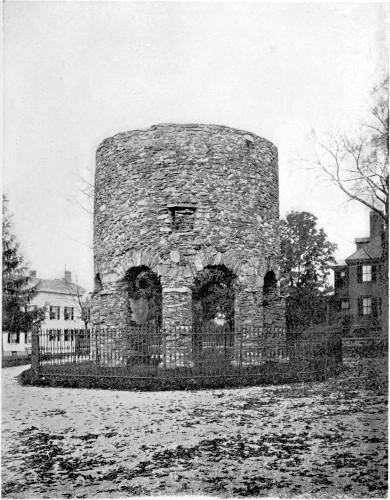
OLD STONE TOWER, NEWPORT
There has been much patient investigation, with a great deal of speculation, concerning this ancient edifice, but no satisfactory conclusion has yet been obtained. Of its existence prior to the English emigration to America there is now but little doubt; and it is asserted that the Indians, of whom Mr. Coddington and other early settlers upon Aquitneck (now Rhode Island) solicited information concerning the structure, had no tradition respecting its origin. Because it was called a “mill” in some old documents, some have argued, or rather, have flippantly asserted, that it was built by the early English settlers for a windmill. Thus Mr. Cooper disposes of the matter in his preface to Red Rover. A little patient inquiry would have given him a different conclusion; and if the structure is really ante-colonial, and perhaps ante-Columbian, its history surely is worthy of investigation. That it was converted into and used for a windmill by some of the early settlers of Newport, there is no doubt, for it was easily convertible to such use, although not by a favourable arrangement. The English settlement upon the island was commenced in 1636, at the north end, and in 1639 the first house was erected on the site of Newport, by Nicholas Easton. Mention is made in the Colonial records of a windmill by Peter Easton, in 1663, twenty-five years after the founding of Newport; and this was evidently the first mill erected there, from the fact that it was considered of sufficient importance to the Colony to induce the General Court to reward Mr. Easton for his enterprise, by a grant of a tract of fine land, a mile in length, lying along what is still known as Easton’s Beach. That mill was a wooden structure, and stood upon the land now occupied by the North Burying-ground in the upper suburbs of Newport. The land on which the tower stands once belonged to Governor Benedict Arnold, and in his will, bearing the date of 1678, forty years after the settlement, he mentions the “stone-mill,” the tower having evidently been used for that purpose. Its form, its great solidity, and its construction upon columns, forbid the idea that it was originally erected for a mill; and certainly, if a common windmill made of timber was so highly esteemed by the people, as we have seen, the construction of such an edifice, so superior to any dwelling or church in the colony, would have received special attention from the magistrates and the historians of the day. And wherefore, for such a purpose, were the foundation-stones wrought into spheres and the whole structure stuccoed within and without?
When, in 1837, the Royal Society of Northern Antiquaries of Copenhagen published the result of their ten years’ investigations concerning the discovery of America by the Northmen in the Tenth Century, in a volume entitled Antiquitates-Americana, the old mill at Newport, the rock inscription at Dighton, in Massachusetts, and the discovery of skeletons evidently of a race different from the Indians, elicited the earnest attention of inquirers, as subjects in some way connected with those early discoveries. Dr. Webb, who was then a resident of Providence, and secretary to the Rhode Island Historical Society, opened a correspondence with Charles C. Rafn, the Secretary to the Royal Society of Copenhagen, Dr. Webb employed Mr. Catherwood to make drawings of the mill, and these, with a particular account of the structure, he transmitted to Professor Rafn. Here was opened for the society a new field of inquiry, the products of which were published, with engravings from Mr. Catherwood’s drawings. According to Professor Rafn, the architecture of this building is in the ante-Gothic style, which was common in the north and west of Europe from the Eighth to the Twelfth Centuries. “The circular form, the low columns, their thickness in proportion to their distance from each other, and the entire want of ornament,” he says, “all point out this epoch.” He imagines that it was used for a baptistery, and accounts for the absence of buildings of a similar character by the abundance of wood in America. The brevity of the sojourn of the Northmen here was doubtless another, and perhaps principal reason, why similar structures were not erected. The fact that the navigators of Sweden, Norway and Iceland visited and explored the American coast, as far as the shores of Connecticut, and probably more southerly, during the Tenth and Eleventh Centuries (five hundred years before the voyages of Columbus), appears to be too well attested to need further notice here. For the proofs the reader is referred to the interesting work alluded to Antiquitates-Americana.