THE CLARKE-HANCOCK HOUSE, LEXINGTON
Reading edition
In 1778, the City of Boston placed a tablet on the walls of Christ Church, Boston, which reads: “The signal lanterns of Paul Revere displayed in the steeples of this church, April 18, 1775, warned the country of the march of the British troops to Lexington and Concord.”
Important as the “midnight ride of Paul Revere” was, it owes its chief fame to Longfellow, who made it the subject of a story in The Tales of a Wayside Inn, written in 1863. The Landlord begins:
“Listen my children and you shall hear Of the midnight ride of Paul Revere In the Eighteenth of April, Seventy-five; Hardly a man is now alive Who remembers that famous day and year. “He said to his friend, ‘If the British march By land or sea from the town to-night, Hang a lantern aloft in the belfry arch Of the North Church tower as a signal light,— One, if by land, and two, if by sea; And I on the opposite shore will be, Ready to ride and spread the alarm Through every Middlesex village and farm, For the country folk to be up and to arm.’ Then he said ‘Good-night!’ and with muffled oar Silently rowed to the Charlestown shore, Just as the moon rose over the bay, Where swinging wide at her moorings lay The Somerset, British man-of-war; A phantom ship, with each mast and spar Across the moon like a prison bar, And a huge black hulk, that was magnified By its own reflection in the tide. ***** “Meanwhile his friend, through alley and street, Wanders and watches with eager ears, Till in the silence around him he hears The muster of men at the barrack door, The sound of arms and the tramp of feet, And the measured tread of the grenadiers, Marching down to their boats on the shore. ***** “Meanwhile impatient to mount and ride, Booted and spurred, with a heavy stride, On the opposite shore walked Paul Revere. Now he patted his horse’s side, Now gazed at the landscape far and near, Then, impetuous, stamped the earth, And turned and tightened his saddle-girth; But mostly he watched with eager search The belfry-tower of the Old North Church, As it rose above the graves on the hill Lonely and spectral and sombre and still. And lo! as he looks, on the belfry’s height A glimmer, and then a gleam of light! He springs to the saddle, the bridle he turns, But lingers and gazes, till full on his sight, A second lamp in the belfry burns! “A hurry of hoofs in a village street, A shape in the moonlight, a bulk in the dark, And beneath, from the pebbles, in passing, a spark Struck out by a steed flying fearless and fleet: That was all! And yet, through the gloom and the light, The fate of a nation was riding that night; And the spark struck out by that steed, in his flight Kindled the land into fame with its heat. ***** “It was one by the village clock When he galloped into Lexington. He saw the gilded weathercock Swim in the moonlight as he passed, And the meeting-house windows, blank and bare, Gaze at him with a spectral glare, As if they already stood aghast At the bloody work they would look upon. ***** “So through the night rode Paul Revere; And so through the night went his cry of alarm To every Middlesex village and farm,— A cry of defiance and not of fear, A voice in the darkness, a knock at the door, And a word that shall echo forevermore! For, borne on the night-wind of the Past, Through all our history, to the last, In the hour of darkness and peril and need, The people will waken and listen to hear The hurrying hoof-beats of that steed And the midnight message of Paul Revere.”
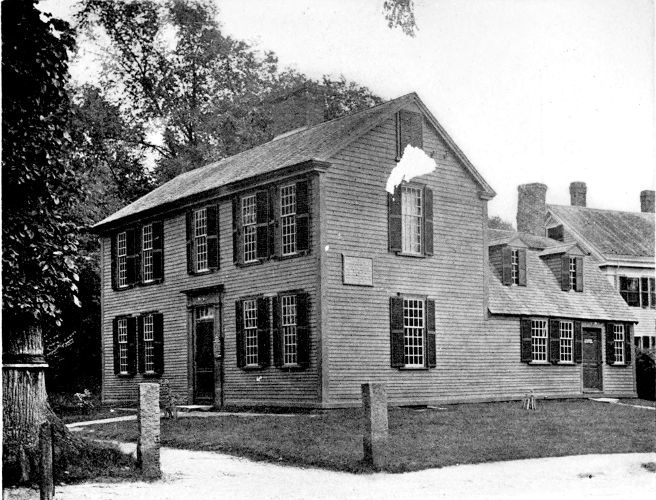
CLARKE-HANCOCK HOUSE, LEXINGTON, MASS.
Closely associated with this ride is the old house known as the Clarke-Hancock House and now owned by the Lexington Historical Society. On the night of Paul Revere’s ride, two of the leaders of the American cause were sleeping quietly there,—John Hancock and Samuel Adams, upon whose heads a price had been set. They were attending the daily sessions of the Provincial Congress in Concord and returned every night to Lexington where they lodged in the home of the Rev. Jonas Clarke, who had married a niece of Hancock’s. Another inmate of the house at this time was Hancock’s betrothed bride, Dorothy Quincy, whom he married in the following year. It was very important that Hancock and Adams should be kept informed of the progress of events in Boston, and Paul Revere, then a man of forty, was a regularly employed and paid messenger from the patriots of Boston to them Revere, an engraver and silversmith, was one of the “Sons of Liberty,” a society composed largely of artisans and workmen; and, moreover, he was one of a company who patrolled the streets of Boston to watch the movements of British soldiers and Tories.
Revere’s own account of this ride, written about 1783 and published in an early number of the Massachusetts Historical Society’s publications, reads:
“About ten o’clock, Dr. Warren sent in great haste for me, and begged that I would immediately set off for Lexington, where Messrs. Hancock and Adams were, and acquaint them of the movement, and that it was thought they were the objects. When I got to Dr. Warren’s house, I found he had sent an express by land to Lexington—a Mr. William Dawes. The Sunday before, by desire of Dr. Warren, I had been to Lexington, to Messrs. Hancock and Adams, who were at the Rev. Mr. Clarke’s. I returned at night through Charlestown; there I agreed with a Colonel Conant and some other gentlemen, that if the British went out by water, we would show two lanthorns in the North Church steeple; and if by land, one as a signal; for we were apprehensive it would be difficult to cross the Charles River, or get over Boston Neck. I left Dr. Warren, called upon a friend, and desired him to make the signals. I then went home, took my boots and surtout, went to the north part of the town, where I kept a boat; two friends rowed me across Charles River a little to the eastward, where the Somerset man-of-war lay. It was then young flood, the ship was winding and the moon rising. They landed me on the Charlestown side. When I got into town, I met Colonel Conant and several others; they said they had seen our signals. I told them what was acting, and went to get me a horse; I got a horse of Deacon Larkin.”
Revere went directly to the Clarke house. His narrative continues:
“After I had been there for about an hour Mr. Dawes came; we refreshed ourselves, and set off for Concord, to secure the stores, etc., there. We were overtaken by a young Dr. Prescott, whom we found to be a high Son of Liberty. I told them of the ten officers that Mr. Devens met, and that it was probable we might be stopped before we got to Concord; for I supposed that after that night, they divided themselves, and that two of them had fixed themselves in such passages as were most likely to stop any intelligence going to Concord. I likewise mentioned that we had better alarm all the inhabitants till we got to Concord; the young Doctor much approved of it, and said he would stop with either of us, for the people between that and Concord knew him, and would give the more credit to what we said. We had got nearly half-way; Mr. Dawes and the Doctor stopped to alarm the people of a house; I was about one hundred yards ahead, when I saw two men, in nearly the same situation as those officers were near Charlestown. I called for the Doctor and Mr. Dawes to come up; in an instant I was surrounded by four; they had placed themselves in a straight road, that inclined each way; they had taken down a pair of bars on the north side of the road, and two of them were under a tree in the pasture. The Doctor being foremost, he came up; and we tried to get past them; but they being armed with pistols and swords, they forced us into the pasture; the Doctor jumped his horse over a low stone-wall, and got to Concord.
“I observed a wood at a small distance, and made for that. When I got there, out started six officers on horseback and ordered me to dismount. One of them, who appeared to have the command, examined me, where I came from and what my name was. I told him. He asked me if I was an express? I answered in the affirmative. He demanded what time I left Boston? I told him; and added that their troops had catched aground in passing the river and that there would be five hundred Americans there in a short time, for I had alarmed the country all the way up.”
Revere was ordered to mount his horse, and was led by the soldiers back to Lexington; but when they arrived near the meeting-house, “the militia fired a volley of guns, which appeared to alarm them very much.” The officers rode off with Revere’s horse and he hurried back to Mr. Clarke’s house, where he related his adventures. It was then decided that Hancock and Adams had better leave Lexington, and so they, with Dorothy Quincy, accompanied by Hancock’s secretary, Lowell, and Paul Revere, went to Woburn. Revere and Lowell returned to Lexington, to “find what was going on.” The former tells us that on reaching the town:
“Mr. Lowell asked me to go to the tavern with him to get a trunk of papers belonging to Mr. Hancock. We went up chamber, and while we were getting the trunk, we saw the British very near, upon a full march. We hurried towards Mr. Clarke’s house. In our way, we passed through the militia. They were about fifty. When we had got about one hundred yards from the meeting-house, the British troops appeared on both sides of the meeting-house. They made a short halt; when I saw and heard a gun fired, which appeared to be a pistol. Then I could distinguish two guns, and then a continued roar of musketry; when we made off with the trunk.”
A concise and interesting version of this story is thus told by Thomas Wentworth Higginson:
“When on the night of the 18th April, 1775, Paul Revere rode beneath the bright moonlight through Lexington to Concord with Dawes and Prescott for comrades, he was carrying the signal for the independence of a nation. He had seen across the Charles River the two lights from the church steeple in Boston which were to show that a British force was going out to seize the patriotic supplies at Concord: he had warned Hancock and Adams at Rev. Jonas Clarke’s parsonage in Lexington, and had rejected Sergeant Monroe’s caution against unnecessary noise, with the rejoinder: ‘You’ll have noise enough here before long—the regulars are coming out.’ As he galloped on his way the regulars were advancing with steady step behind him, soon warned of their own danger by alarm-bells and signal guns. By the time Revere was captured by some British officers who happened to be near Concord, Colonel Smith, the commander of the expedition, halted, ordered Pitcairn forward, and sent back prudently for re-enforcements. It was a night of terror to all the neighbouring Middlesex towns, for no one knew what excesses the angry British troops might commit on their return march....
“Before 5 A. M., on April 19, 1775, the British troops had reached Lexington Green, where thirty-eight men, under Captain Parker, stood up before 600 or 800 to be shot at, their captain saying: ‘Don’t fire unless you are fired on; but if they want a war, let it begin here.’ It began there; they were fired upon; they fired rather ineffectually in return, while seven were killed and nine wounded. The rest, after retreating, re-formed and pursued the British towards Concord, capturing seven stragglers—the first prisoners taken in the war. Then followed the fight at Concord, where 450 Americans instead of 38, were rallied to meet the British. The fighting took place between two detachments at the North Bridge, where
“‘Once the embattled farmers stood And fired the shot heard round the world.’”
The old house, which witnessed such exciting scenes, stands not far from the village green of Lexington. It is known as the Clarke-Hancock House, and was built by Thomas Hancock, the rich Boston merchant, in 1740, presumably for his father “Bishop” Hancock, who dwelt there. The following description is by Samuel Adams Drake:
“The house belongs certainly to two, and perhaps to three, periods. It is composed of a main building in the plain, substantial style of the last (Eighteenth) Century, and of a more antiquated structure standing at right angles to it. The first confronts you, if you have come down the road from the Common; the last faces the street from which the whole structure stands back a little distance, with a space of green turf between. A large willow is growing in front of the main house, and on the verge of the grass-plot stands an elm, its branches interlacing those of a fellow-tree on the other side the way, so as to form a triumphal arch under which no patriot should fail to pass. We have christened the twain Hancock and Adams. The one is sturdy, far reaching and comprehensive; the other, graceful, supple, but of lesser breadth. About the house flourish lilacs, syringas and the common floral adjuncts of a New England home....
“The room occupied by ‘King’ Hancock and ‘Citizen’ Adams is the one on the lower floor on the left of the entrance. Care has been taken to preserve its original appearance.
“The woodwork of Southern pine has remained unpainted, acquiring with age a beautiful colour. One side of the room is wainscoted up to the ceiling, the remaining walls bearing the original paper in large figures. The staircase in the front hall has also remained innocent of paint and is handsome enough for a church. Age has given to the carved balusters and panelled casings a richness and depth of hue that scorns the application of any unnatural pigment. The room we have just left is in the south-west corner of the house. Passing to the opposite side of the hall we enter the best room, which corresponds in finish with that just described, except that the painter’s brush has been applied to the wainscot and newer paper to the walls....
“The best room communicates with the ancient or original house, which is seen fronting the street with its single story and picturesque dormer windows and roof. This part was doubtless built by the bishop’s parishioners soon after his settlement. It formerly stood nearer the high-road until the new building was completed, when it was moved back and joined upon it. The house is a veritable curiosity and would not make a bad depository for the household furniture and utensils of the period to which it belongs, being of itself so unique a specimen of early New England architecture. The floors and wainscot are of hard wood, upon which time has left not the least evidence of decay. The farmers clearly meant their minister to inhabit a house of a better sort than their own, as is apparent in the curious panelling of the outer door, which still retains its original fastenings, and in the folding shutters of the little study at the back. A cramped and narrow staircase conducts to the chambers above, from the room in which we are standing. The same old dresser is attached to the wall, garnished of yore by the wooden trenchers and scanty blue china of the good bishop’s housekeeping. Some old three-legged tables are the only relics of the former inhabitants. This one room according to the custom of the times, served as kitchen, dining-room and for the usual avocations of the family. The little study has the narrow windows which first admitted light upon the ponderous folios of the minister, or the half-written sheets of many a weighty sermon.”