FORT SUMTER IZA DUFFUS HARDY
Reading edition
The next morning we sally forth early under a tropical sky of burning blue and take our way to the market, a bright and busy scene, and cool and pleasant even this hot day, the breeze blowing gently through the long airy sheds, supported by open archways, the abundant array of fruit and flowers and vegetables refreshing to the eye. The negro element is in almost exclusive possession behind the stalls, the white in front, but not exclusively. There is a negro majority in South Carolina, in the market as well as elsewhere. Here are all shades of black, yellow and brown; here a good-looking brown girl with immense gold earrings, sits half hidden behind tempting great heaps of rosy tomatoes, golden Florida oranges and crimson plantains; there an old woman, black as a coal, coifed in a gorgeous striped bandana, presses green peas upon our attention; here the tourist is buying bananas and the housekeeper pricing pineapples.
We linger among the fruit-stalls and do not hurry ourselves past the fishmonger’s department, where the cool shining fish lie on slabs spread with green leaves. But we hasten through the butcher’s quarter; it is too hot to look at raw beef. We observe strutting about here, picking up pieces under the stalls and perching over the doorways, a number of large birds, which we take at first for turkeys. They are, however, buzzards, unfit to eat, but useful in picking up offal, and therefore encouraged about this quarter of the market.
Returning to the main street of Charleston, we pass by the ruins of the old church.
“Burnt during the war, of course?”
“No, madam, burnt by accident before the war.”
There its ruined and blackened walls stand still, the long grass growing where aisle and altar were. We pass by the shops and soon come to the private houses, pretty and picturesque detached villas (residences “unattached,” are, of course the rule in these warm climes). Many are surrounded by their own gardens; some nestle in the shadow of tall trees; others are buried from basement to roof in the luxuriant purple blossoms of the wisteria. At the end of this street we come upon the Battery, the most beautiful spot in this beautiful city by the sea.
Here, facing the strip of park which lies between them and the water, stand the finest residences in Charleston, built in the palmy days before the war, some of them survivals of the old Colonial times. No two of these handsome houses are alike; each is stamped with its own character and individuality; they are of all styles—Greek, Gothic, Elizabethan, and nondescript, and of all pale tints of cool grey, white, and light brown. They all luxuriate in balconies, piazzas, verandahs, and every device for enjoying an almost tropical air in shade and sunshine, and many of them rejoice in their own shadowing trees. The scorching breath of the Southern summer has not yet rusted the green of the turf and tree; the grass in the Battery Park is the richest velvet sward that our feet have ever pressed; the spring-leafage of the scrub-oaks is fresh and tender, though the warmer tints of autumn linger yet here and there among the boughs. At the further border of the long narrow slip of park is a fine sea-wall, beyond which the sleepy waters of Charleston Harbour lap the stone of the embankment. Here on the Battery stand various monuments, one, of course, in memory of “the brave who are no more.” It is here, all along this walk, that the ladies of Charleston collected in crowds, on one memorable 12th of April, to watch the bombardment of Fort Sumter in the distance.
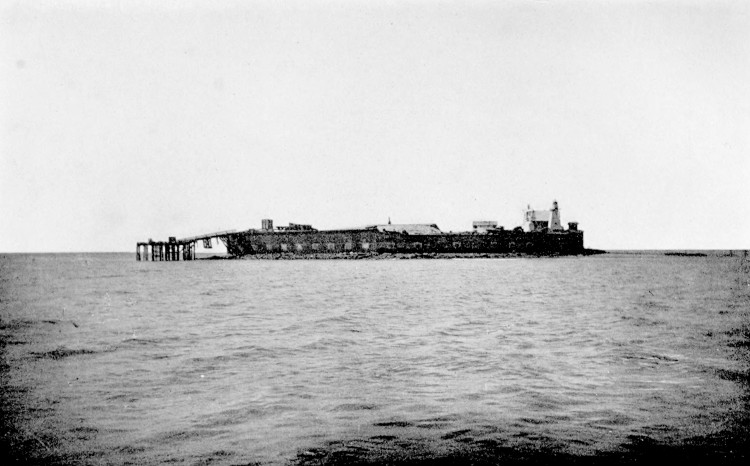
FORT SUMTER, SOUTH CAROLINA
Fort Sumter, of course, is the first excursion the tourist takes from this city. A short cut through the market leads us to the wharf where the little paddle-steamer waits to carry us thither. The sun blazes fiercely in a heaven of dazzling sapphire blue, the little waves lap and gurgle softly in transparent ripples of emerald, as the boat cuts its calm way along. We pass the sunny shores, the green trees and white villas of Mount Pleasant—well so named!—we pass Sullivan’s Island; we near Fort Moultrie; and now we are in sight of Sumter. The deck is crowded with excursionists, most of them Northern tourists; there are a few Southerners, one or two Germans—we discover no English except ourselves. We make acquaintance with some of our fellow-passengers; all seem sociably inclined; all gather together along the bulwarks at the first sight of Fort Sumter. Here are North and South, “Yankee” and rebel harmoniously and amicably associating on a pleasure excursion to the scene of the first conflict of the terrible four years’ struggle, the spot where “twenty years and more” ago, that first shot was fired which rang through the civilized world, which thrilled like a bugle-call through the hearts of North and South, and “let slip the dogs of war” to their dreadful work. Here this morning are the men who wore the vanquished grey and those of the victorious blue, brothers once more! In sight of the shattered walls of Sumter, no word except of friendliness is heard.
We observe in the conversation of the various groups that they one and all delicately refrain from speaking of the “other side” in audible tones except as “Federal” and “Confederate,” although to each other, in their sotto voce discourse, we catch the old terms “Yank” and “Reb” passing freely.
The Federal element, as represented on board this boat, does not appear very well informed as to the facts and details of the siege. We inquire in vain: How many were in the fort? What was the besieging force? How many lives were lost? In answer to this last question, there are a variety of answers, apparently most of them conjectural, and ranging from “three hundred” down to “none.”
“It was from Fort Moultrie yonder that the first gun was fired,” observes one tourist, drawing from his next neighbour the mild correction: “Pardon me, sir, the very first shot was from Fort Johnson.”
Hereupon both parties pull out of their pockets—no, not revolvers, but little blue paper—covered “Guides to Charleston.”
Meanwhile we are drawing nearer and nearer to the low, sandy island that is the goal of our excursion. We wonder, as we look on that barren sand-heap scorching in the yellow sand-glare, was that, once upon a time, the lofty fort of Sumter? Could ever those fragments of battered wall have towered up towards these blue skies in proud defiance? In fancy, we see the pall of smoke wrap Sumter round again, hear the thunder of the cannonade, and above the “burning battlehell” of fire and smoke, we see streaming to the wind the ghost of the “Stars and Bars!”
We land on the little pier, and pick our way along narrow planks laid across the heavy sand, amongst heaps of cannon balls, old guns, new guns, up steps, down steps, underground and overground, in and out of gloomy bomb-proofs, from the loopholes of which the “dogs of war” thrust forth their huge, black muzzles. One of the little garrison of the fort shows us round, and acts as general cicerone to our party. He answers our questions—the Northern tourists put quite as many as we strangers do; is it not twenty-two years since the siege? A whole world behind to them; but our soldier-guide has the whole story fresh in his mind. So has a bronzed and grizzled Southerner, who now for the first time, in the subterranean shades of a bombproof-tunnel, comes to the fore, and thenceforth divides public interest and attention with the lawful cicerone.
Somebody puts to this new authority the old question—how many lives were lost in the opening bombardment?
“Not one, sir,” is the prompt answer, “not one by the Confederate attack. Seems strange, but so ’tis. There was one life lost, and that was after the fort had surrendered. A man was blown up and killed. He laid a mine, as a trap to blow up the Confederates, and he tripped his foot, stumbled, and touched it off, and was killed by his own mine.”
A gentle smile of contemplative satisfaction irradiated the Confederate’s countenance as he narrated this anecdote—of which we afterwards heard divers and contrasting versions. I was walking with a gentleman from Massachusetts, but, as my escort did not appear able to feed my feminine curiosity with all the details I desired, I drew the better-informed Confederate authority to join us; and we rambled on in an exemplarily harmonious trio.
Our Southerner was brimming over with reminiscences, all uttered in dulcet and lamb-like tones which would well have befitted an idyllic love-story.
“With a seven-inch bore, like this,” he observed, resting his boot-heel tenderly on a big gun that lay half buried in the sand, “we sunk the first monitor that came along. Hit the turret and made her careen, and then the lower battery took her right between wind and water.”
He smiled softly, as if cherishing sweet and tender memories.
“I put a little Confederate flag on the buoy out there,” he continued, pointing to a spot on the sunny water, “and it stayed there all the time.”
“Didn’t we come after it?” inquired the tourist from Massachusetts.
“Oh, yes; the Federals, they came after it several times; but they didn’t happen to get it,” the mild Carolinian replied in his soft lingering drawl.
I do not know how much or how little correct history was current amongst us that day; but there certainly was a good deal of information to be had for the asking.
“Getting ready for our cousins!” observed a New York girl, patting a fine new gun approvingly.
“What cousins?” I inquired.
“Our English cousins,” was the reply. “They might take a fancy to come over here!”
“I don’t think we want to come over, except as tourists, as we have come to day,” I observed, mildly deprecating.
“I guess you and the Southerners have had enough of that,” replied the young lady contentedly.
Our bronzed Southerner was picking up a sea-shell from the sand as a souvenir for me, and, probably by way of a coal of fire, he picked up a finer shell for her, and polished it with his pocket handkerchief.
In every group some chapter of the story of the siege was being told—I fear occasionally coloured according to the bias of the narrator. The names of Beauregard, Sherman, Lee, Anderson, were echoing on every side. Indeed it was not 1883, it was 1861, in which we all lived that hour!
Time was up; the whistle sounded. We left the sandy isle of Fort Sumter—deserted now, save for a little garrison to be counted on the fingers of one hand—and returned to our boat, and to the present year of our Lord, 1883.