FANEUIL HALL, BOSTON EDWARD G. PORTER[25]
Reading edition
FANEUIL HALL, BOSTON EDWARD G. PORTER[25]
In 1740 Peter Faneuil, a Huguenot resident of Boston, who had recently inherited a large fortune from his uncle, offered to build a market-house at his own expense and give it to the town, provided they would pass a vote agreeing to accept and maintain it under proper regulations. Accordingly a town-meeting was called to consider the matter, and the thanks of the meeting were unanimously extended to Mr. Faneuil, for his generous offer. But upon the question of accepting it, there was such a division of opinion, that the vote stood 367 in favour and 360 against it. Thus narrowly, by only seven votes in a large meeting, did the project succeed, so slow were the people to see the advantages of the new system.
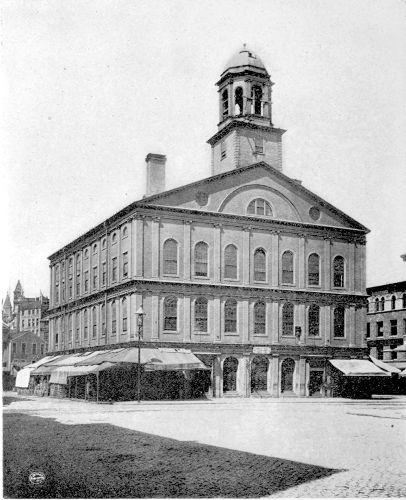
FANEUIL HALL, BOSTON
We can hardly conceive of Boston now without its Faneuil Hall; but the crowds who daily gather about it little imagine how much they are indebted to the energy of its earliest friends in that critical moment when its very existence was hanging in the balance.
The structure was completed in 1742, John Swibert, the portrait painter, being the architect, and Samuel Ruggles the builder. Mr. Faneuil enlarged the original plan and added a hall above the market,—and additional proof of his munificence which was gratefully recognized by the town in its public acceptance of the gift, on which occasion the name “Faneuil Hall” was given to it to be retained forever; and “as a further testimony of respect, it was voted that Mr. Faneuil’s picture be drawn at full length and placed in the hall.” The town also added the Faneuil arms, beautifully carved and gilt by Moses Deshon.
The building was constructed of brick, two stories and a half high, one hundred feet long and forty feet wide, with open arches below and a tower above, and was in many respects the most important edifice in the town. Its architecture was considered imposing and ornate. The spacious hall would contain a thousand persons, and there were various rooms besides. The town-meetings were held here after this, and the selectmen’s offices were removed from the old Town-House in King, now State Street, which was left chiefly to the Legislature and the courts.
Most unexpectedly, a few months after the building was completed, its founder died; and the first oration pronounced in the hall, was his own eulogy by John Lovell, the well-known master of the Latin School.
In January, 1761, the interior of the building caught fire, and nothing but the bare walls remained. The records, fortunately, and some other documents were saved. The hall was rebuilt on the old plan, and opened again in March, 1763, when James Otis, Jr., delivered the dedicatory address. The cause of the patriots was now making such progress in Boston that large meetings were held in Faneuil Hall to give expression to the popular feeling; and hence arose the name “Cradle of Liberty,” which it has borne ever since, and which it so well deserves.
In March, 1767, the hall was illuminated by vote of the town, to commemorate the repeal of the Stamp Act. The following year, a convention of representatives from nearly all the towns in the Province was in session here for a week in September, to consider what measures could be taken in view of the expected arrival of a large force of British troops. Governor Bernard refused to recognize the convention, although its proceedings were throughout orderly and constitutional. The fleet arrived immediately after; and the Fourteenth Regiment, Colonel Dalrymple, was quartered in Faneuil Hall for a month, by order of the Governor, though not without a vigorous protest from the people.
During the stormy period preceding the outbreak of the Revolution, many notable town-meetings were convened here, as on the occasion of the Boston Massacre and on the arrival of the “detestable tea.” But the hall at that time could not hold as many people as the Old South, and this explains why some of the large meetings adjourned to the latter place.
During the siege of Boston the building was at first used as a storehouse for arms and furniture, and then converted into a theatre for the diversion of the troops. Among the performances, the tragedy of Zara and the comedy of The Busybody were frequently given; and, once, at least, a local farce written by General Burgoyne, and entitled The Blockade of Boston. This would be an interesting relic of the period if it could be found, but it does not appear ever to have been printed. After the evacuation of Boston, the portraits of Peter Faneuil, George II., Governor Shirley, General Conway, and Colonel Barré, which had hung in Faneuil Hall, were missing, nor has any trace of them ever been discovered.
In the year 1806, with the new era of prosperity, the hall was very much enlarged by doubling the width and adding a third story. This, of course, has greatly changed the appearance of the structure, although its original style has been fairly well preserved.
The interior, with its lofty galleries and classic columns, has become well known to thousands. Here the great questions of the century, touching the commercial, political and philanthropic interests of Boston, have been eloquently discussed by the foremost orators of the time. Many a Bostonian can recall the occasions when he has stood on the sanded floor for hours with a patient and patriotic crowd, applauding the sentiments of one speaker after another as they came forward upon the platform and emphasized the issues of the hour. Here great public receptions have been given to distinguished guests, together with many civic and military banquets. Here, formerly, were held the industrial exhibitions of the Massachusetts Charitable Mechanic Association. It is emphatically the people’s hall, and will always remain so; for, by a provision in the city charter, neither Faneuil Hall, nor Boston Common, can ever be sold or let for money.
The collection of portraits attracts many visitors. On the west wall is Healy’s large painting of Webster replying to Hayne in the Senate, and near it are Stuart’s Washington and Copley’s Hancock, Warren and Samuel Adams. There are also portraits of Peter Faneuil, John Quincy Adams, Edward Everett, Governor Andrew, Senator Wilson, Robert Treat Paine, Caleb Strong, Commodore Preble, General Knox, Rufus Choate, President Lincoln, Anson Burlingame, Admiral Winslow and Wendell Phillips. Back of the rostrum are busts of John Adams, Samuel Adams and Daniel Webster. The clock was presented to the city by the school children of Boston in 1850.
The upper hall has been chiefly used as an armory by various military corps, especially of late by the Ancient and Honourable Artillery Company, the oldest military organization in the country. The Massachusetts Historical Society held some of its early meetings in the north-west corner of the upper story in the old building from 1792 to 1794.
The grasshopper vane is an interesting survivor of the former structure. It was made by Shem Drowne, the well-known copper-smith of the last century, who also made and repaired the cockerel vane for the Second Church. The famous Indian vane on the Province House was also his handiwork. He died in 1774, at the age of ninety years.
The insect is remarkably well preserved, and shows the fidelity with which it was made; all the details being carefully worked out in copper, as if they were to be closely inspected. The eyes are of glass and shine in the sunlight with great brilliancy. The grasshopper is supposed to have been suggested by the vane on the Royal Exchange of London. It was also the device for the vane on the summer house of the Faneuil estate on Tremont Street.