KING’S CHAPEL, BOSTON F. W. P. GREENWOOD
Reading edition
The Rose frigate must have seemed to the greater part of the Bostonians, or Bostoneers, as Randolph called them, freighted heavily with woe, bearing as it did the Rev. Robert Ratcliffe, of the Church of England, with his surplice and his book of Common Prayer; to say nothing of the commission which appointed a president over them by the King’s sole authority. It was as new to them and as disagreeable to have in their midst a settled clergyman of that church as it was to see at their head a ruler not of their own choosing. “There had been very few instances of even occasional assemblies for religious worship according to the rites and ceremonies of the Church of England for more than fifty years. When the commissioners from King Charles were at Boston in 1665, they had a chaplain with them, but there was no house for public worship. Most of the inhabitants who were upon the stage in 1686, had never seen a Church of England assembly” (Hutchinson). The time was now come for the strange sight to be exhibited, and for the members of the Episcopal communion to rally under the countenance and influence of the Royal government. It should be stated, too, that the general court had declared in 1677, that no persons should be hindered from performing divine service according to the Church of England. The way therefore appeared to lay smooth and open for the Episcopalians to introduce their forms of worship and government.
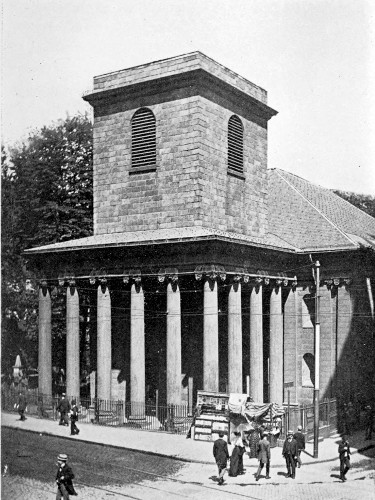
KING’S CHAPEL, BOSTON
As Randolph had the chief hand in overturning the old charter of the Colony, so was he most active and efficient in establishing an Episcopalian Church here, and procuring the services of a clergyman from England.
Randolph carried his two great ends, the destruction of the original Massachusetts Charter, and the importation and introduction of an Episcopal clergyman.
On the 15th of May, 1686, as I have before stated, arrived the Rose frigate, commanded by Captain George. On the 25th Dudley entered on the duties of his temporary presidency. On the 26th, Mr. Ratcliffe waited on the council and Mr. Mason and Randolph proposed that he should have one of the three Congregational meeting-houses to preach in. This was denied, but he was granted the use of the library room in the east end of the town house, which then stood where the Old State House, or, as its present name is, the City Hall, now stands.
This was truly an humble beginning for those who made such high pretensions as did these zealous Royalists and churchmen. As they assembled in the east end of the town house, and looked round on their twelve forms and their movable pulpit, they must have felt the contrast between such a tabernacle and the solemn old cathedrals at home; and have felt, too, that they were among a people who, though of the same blood as themselves, were strangers to their mode of faith and worship, despising what they esteemed most sacred, and setting at nought the power which they deemed unquestionable.
On the 23d of March, 1687, the Governor (Sir Edmund Andros) sent Mr. Randolph for the keys of the South meeting house, now called the Old South, that the Episcopalians might have prayers there. A committee of six, of whom Judge Sewall was one, thereupon waited on his Excellency to show that the house was their own property, and to repeat that they could not consent to part with it to such use. This was on Wednesday. The following Friday, which was Good Friday, Sir Edmund Andros sent to command the sexton of the South church to open the door and ring the bell for those of the Church of England. The sexton, though he had resolved not to do so, was persuaded or intimidated into compliance, and the Governor and his party took possession of the house, and the church service was performed there.
We now approach the close of Andros’s tyrannical government, which was brought about through the influence of one of the most auspicious changes in the government of the mother country, the Glorious Revolution, as it is called, of 1688. The spring succeeding the landing of William of Orange at Torbay, news was brought to Boston of the event, by way of Virginia, by a Mr. Winslow. Sunday, the 26th of May, the joyful news arrived of the proclaiming of William and Mary and on the 29th, the proclamation was published in Boston with great ceremony. Late in the year, an order from the King was received, requiring that Sir Edmund Andros, Edward Randolph, John Trefry, and others that had been seized by the people of Boston, should be sent to England in the first ship bound thither, and in February, 1690, they embarked, and Boston was rid of them and their tyranny.
Mr. Ratcliffe and his assistant, Mr. Clark, must have also gone back to England about this time, as I find no notice of either of them, after the disposition of Andros. But in the meantime, the Episcopal Church had been built. How the land was procured, or of whom, when the building was dedicated, or by whom, there is no record, or if there be one, I have not met with it.
This first church was built of wood. It stood on the spot covered by the present church, but did not occupy nearly so much ground. In an old engraving which I have examined, representing the town of Boston as it was in 1720, this church, among others, is introduced. It stands in the same position with the present one, has a square tower at the west end, from the roof of which rises a staff supporting the vane, and just under the vane is a large and quite observable crown. It was the fifth house of public worship erected in Boston. The Congregational houses were then three in number, and the Baptists had succeeded in building themselves a church several years before the Episcopalians commenced theirs.
In the beginning of the year 1702, news was received of the death of King William, and the Church was put in mourning. Before his decease, Mr. Joseph Dudley, who had rendered himself so obnoxious here, as in many things the coadjutor, and, for his own selfish ends almost the creature of Randolph, had interest enough to obtain while in London, the appointment of Governor of Massachusetts, which he had so long and eagerly coveted. On his reappearance in Boston, invested with his new dignity, he was received kindly and with a forgetfulness of past offences. He joined himself to the congregation of Queen’s Chapel, as it was now called, on the accession of Queen Anne; and his name, together with that of the Lieutenant-Governor, constantly appears on the list of vestrymen.
At the Easter meeting in 1708, it was “agreed, that on Whitsunmonday there be a meeting of the congregation about enlarging the Queen’s Chappell.” The work, however, seems not to have been commenced till the year 1710, when a subscription was raised to effect its accomplishment. It amounted, indeed, to a rebuilding of the church, which was enlarged to twice its original size; nor was it till the year 1713, that the pillars, capitals and cornice were painted, and the scaffolding taken down. Places were assigned anew to the proprietors, and each person paid for the building of his own pew. And whereas the pews had been built before, according to the usual fashion, with little rails or banisters running round the top, it was now voted that they should “be built in one forme without banisters.” The pulpit was removed from its former situation “to the next pillar at the East, being near the centre of the Church.” The two long pews fronting the pulpit were made into two square pews, one for Col. Tailer, Lieutenant-Governor, the other for Mr. Jekyll, and the two pews behind them were made into one, for the use of masters of vessels; and the pew behind that was appropriated to the accommodation of eight old men. A shell was placed over the south door.
A clock was given by “the Gentlemen of the British Society”; and a more important present, that of an organ, demands a more particular notice.
A Record of Votes and Resolutions, etc., together with some brief Memoirs of the Transactions relating to the Rebuilding King’s Chapel in Boston begins with stating that King’s Chapel was first erected of wood in the year 1688, that it was enlarged in 1710, and being found in the year 1741 in a state of considerable decay, that it was proposed to rebuild it of stone. The Rev. Roger Price was at that time “minister,” and William Shirley, Esq. (about the same time appointed Governor of the Province), and Mr. Sam’l Wentworth, wardens. A voluntary subscription was set on foot, and Peter Faneuil, Esq., chosen treasurer for receiving sums subscribed. The building was to be stone and cost £25,000 old tenor. It was not to be commenced till £10,000 were subscribed.
In March, 1753, the new church being so far advanced that it was necessary to desert the old one, the congregation requested and obtained leave to meet in Trinity Church on Sundays, at separate hours from the congregation of that church, and on festival and prayer days in Mr. Croswell’s meeting-house. In April the old church was pulled down. Before it falls to the ground, let us take such a glimpse of its venerable interior, as the mist of dim ages will allow us.
Since the enlargement of the Chapel in 1710, and the erection subsequently of galleries, it contained 122 pews, of which number 82 were on the ground floor. But these pews must have been small, as the present church contains no more. The pulpit was on the north side of the church, at about the midst. A finely decorated pew for the Governor who sat successively in it, was opposite; and near it there was another pew reserved for the officers of the British Army and Navy. In the west gallery of this first Episcopal Church was the first organ which ever pealed to the praise of God in this country; while displayed along its walls, and suspended from its pillars, after the manner of foreign churches, were escutcheons and coats-of-arms being those of the King, Sir Edmund Andros, Francis Nicholson, Captain Hamilton, and Governors Dudley, Shute, Burnet, Belcher and Shirley. In the pulpit there was an hourglass, according to the old fashion, mounted on a large and elaborate stand of brass. At the east end there was “the Altar piece, whereon was the Glory painted, the Ten Commandments, the Lord’s Prayer, the Creed and some texts of Scripture.” It was a strange sight among the bare churches of New England.
In 1756 the noble organ which now stands in our west gallery was procured from England, and paid for by the subscription of individuals belonging to the church. Its original cost in London was £500 sterling; and when all charges were added, its whole expense amounted to £637. As it was obtained by private subscription, no notice of it whatever is taken in the church records. The only memorial concerning it with which I am acquainted, is a paragraph in the Boston Gazette and Country Journal of 30th of August, 1756, which is copied into our later records, and is as follows:
“We hear that the organ, which lately arrived from London by Capt. Farr for King’s Chapel in this Town, will be opened on Thursday next in the Afternoon; and that said organ (which contains a variety of curious stops never yet heard in these parts) is esteemed by the most eminent masters in England, to be equal, if not superior to any of the same size in Europe.—There will be a sermon suitable to the occasion; Prayers to begin at four o’clock.”
There is a very current tradition respecting this organ, that it was selected by Handel himself. Taking into consideration the above reference to “the most eminent masters in England,” we may receive this tradition as founded in truth. And, moreover, as the organ was designed for the King’s Chapel in New England, we may readily suppose that his Majesty’s favourite musician would at least be desired to give his opinion of its merits; and this opinion, being favourable, might be called a selection, even if the “mighty master” gave himself no further trouble with its purchase. Handel died in 1758, and was blind eight years before his death. But sight was not at all necessary in the office supposed to be consigned to him, and though his eyes never could have measured the external proportions of this organ, his ears must probably have judged of its tones and powers and his own hands rested on its keys.
In 1772, an additional service of plate, together with new pulpit furniture, was obtained from the King through the influence of Governor Hutchinson. In 1773, the ancient records end. A short time previous to the breaking out of the war, and through the whole of the year 1775, King’s Chapel was the place of worship of many of the officers of the Navy and Army of Great Britain, who were stationed in and near Boston; and the duties of Dr. Caner and his assistant were consequently much increased.
The Chapel remained closed till the autumn of 1777; and then it was opened, not for Episcopal but Congregational services, very contrary to all the anticipations of Dr. Caner. The congregation of the Old South Church, not being able at that time to repair the desolations of their own sanctuary, which had been desecrated, spoiled, and used as a riding-school by the British troops, applied for the use of King’s Chapel, or the Stone Chapel, as it then for obvious reasons began to be called. The application was made to the few proprietors of the Chapel who were left, and was readily granted. “The congregation,” says Mr. Wisner, in his History of the Old South Church, “were kindly and gratuitously accommodated at the Chapel about five years.”
Our church as a building has undergone no considerable change since the Revolution, except the erection of the colonnade at the West End, or Front, which was put up in the year 1790. The crown and mitre have, to be sure, disappeared from their stations on the top of the organ, and the Governor’s pew, with its Corinthian pillars and crimson damask tapestry, has been taken down and converted into two pews of common size and pretensions. But the architecture and interior arrangements, are, in all other respects, the same as before the war.