FRAUNCES’ TAVERN WILLIAM J. DAVIS
Reading edition
Fraunces’[3] Tavern, corner of Broad and Pearl Streets, was Washington’s quarters, on the evacuation of the city by the British troops, 25th of November, 1783. This old mansion, around which some of the most interesting reminiscences of our Revolutionary history are connected, still remains, although somewhat altered from its original appearance. It was erected about 1735 by the Delancey family, then one of the most distinguished and opulent in New York, and was considered equal in size and architectural display to any at that period in the city.
As a tavern, it was the most noted in New York and was the resort of the bloods of that day, who formed themselves into social clubs, and among whom were some of the most active and distinguished men of the Revolution. Samuel Fraunces, or as he was familiarly called, Black Sam (in consequence of his swarthy complexion), was of French extraction, and appears to have been a prince of a publican. He purchased the house in 1762, from Oliver Delancey, for £2,000, provincial currency, but did not open it as a public house until some time afterwards.
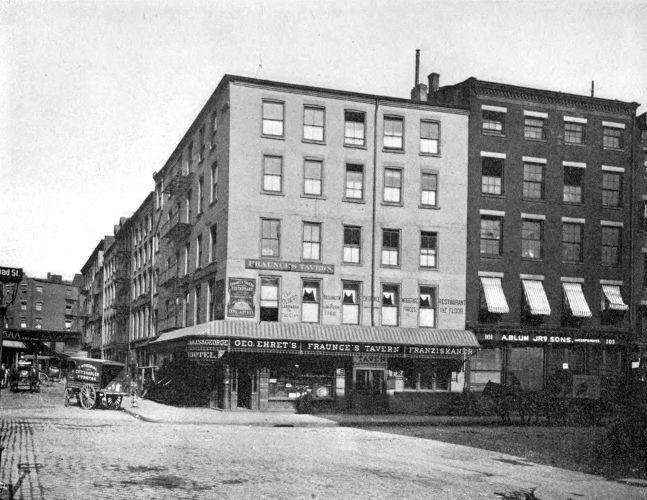
FRAUNCES’ TAVERN, NEW YORK
The first notice of Sam that we have been able to discover, is an advertisement in Parker’s Post Boy, February 5, 1761, by which it appears that he not only acted as landlord but did considerable business as a dealer in different kinds of preserves. Here is the advertisement:
“To be sold at a very reasonable rate, by Samuel Francis, at the Sign of the Masons’ Arms near the Green, New York, a small quantity of portable soup, catchup, bottled gooseberries, pickled walnuts, pickled or fryed oisters, fit to go to the West Indias, pickled mushrooms, a large assortment of sweetmeats, such as currant jelly, marmalade, quinces, grapes, strawberries and sundry other sorts.”
The Masons’ Arms was very popular under the management of Sam as a Mead and Tea Garden, places much frequented by both sexes on pleasant afternoons. On purchasing the Broad Street house, Sam sold out this, and it is thus announced in the same paper:
“May 13, 1762, John Jones—Begs leave to acquaint the publick, That he has removed to the house formerly kept by Samuel Francis, at the Sign of the Masons’ Arms, next to Mr. Degrusia, in the Fields, where he intends to give the same entertainment as formerly given by Mr. Francis, and that in the best manner. Those Gentlemen and Ladies that please to favour him with their company, may depend on the best usage from their humble servant, John Jones.” He threw open Vauxhall Gardens, which formerly stood in Greenwich Street, near the site afterwards occupied by Stuart’s Sugar Refinery—but which he again resold in 1771, and opened the much more celebrated tavern in Broad Street.
During the troubles which preceded the Revolution, Fraunces Tavern seems to have been the resort of both Whig and Loyalist, political affairs not having sufficient power to sever the social ties of those whose custom it was to assemble there and discuss his Madeira, a wine, the excellent quality of which Sam’s cellar stood proverbial. It must not be presumed that Sam was an idle spectator of the events then passing around him: his sympathies were with the Whigs, and he became one of Washington’s most faithful friends and followers. It was through the instrumentality of his daughter that the attempt to poison Washington was frustrated, she being at that time housekeeper at Richmond Hill, his quarters. This house was one of those which suffered some injury from the broadside of the Asia when she fired upon the city. Freneau in one of his poems, thus speaks of it:
“Scarce a broadside was ended, till another began again— By Jove! it was nothing but Fire away Flannagan! Some thought him saluting his Sally’s and Nancy’s Till he drove a round shot thro’ the roof of Sam Francis.”
Notwithstanding this belligerent demonstration, the social club still continued its weekly meetings for some time. A list of the members of this club was found among the papers of the late John Moore, one of the members and presented to the New York Historical Society, by his son, Thos. W. C. Moore, which contains some very curious remarks which we here insert in full.
“List of Members of the Social Club, which passed Saturday evenings at Sam Francis’s corner of Broad and Dock Street, in winter, and in summer at Kip’s Bay, where they built a neat, large room for the Club House. The British landed at this spot the day they took the city, 15th September, 1776.”
Members of this Club dispersed in December, 1775, and never afterwards assembled.
John Jay (Disaffected) Became Member of Congress, a Resident Minister to Spain, Commissioner to make peace, Chief Justice, Minister to England, and on his return, Governor of New York—a good and amiable man.
Gouveneur Morris „ Member of Congress, Minister to France, etc.
Robt. R. Livingston „ Minister to France, Chancellor of New York, etc.
Egbert Benson „ District Judge, New York, and in the Legislature. Good man.
Morgan Lewis „ Governor of New York and a General in the war of 1812.
Gulian Verplanck „ but in Europe till 1783—President of New York Bank.
John Livingston and „ but of no political importance.
his brother Henry James Seagrove „ went to the southward as a merchant.
Francis Lewis „ but of no political importance.
John Watts „ doubtful—during the war Recorder of New York.
Leonard Lispenard and his brother Anthony „ but remained quiet at New York.
Rich’d Harrison (Loyal) but has since been Recorder of New York.
John Hay „ an officer in the British Army. Killed in West Indies.
Peter Van Schaack „ a lawyer, remained quiet at Kinderhook.
Daniel Ludlow „ during the war—since President of Manhattan Bank.
Dr. S. Bard „ though in 1775 doubtful, remained in New York—a good man.
George Ludlow „ remained on Long Island in quiet. A good man.
William his brother „ or supposed so—remained on Long Island. Inoffensive man.
William Imlay „ at first, but doubtful after 1777.
Edward Goold „ at New York all the war—a merchant.
John Reade (Pro and Con) would have proved loyal, no doubt, had not his wife’s family been otherwise.
J. Stevens (Disaffected)
Henry Kelly, (Loyal) went to England and did not return.
Stephen Rapelye turned out bad—died in the New York Hospital.
John Moore Loyal —in public life all the war and from year, 1765.
While the city was in possession of the British nothing of interest seems to have transpired within the house. The 25th day of November, 1783, being the time fixed upon for the exodus of the British troops, arrangements were made for the triumphal entry of Washington and the American army to take possession of the city. On the morning of that day,—a cold, frosty, but clear and brilliant morning—the troops under General Knox encamped at Harlem, marched to the Bowery lane, and halted at the present junction of Third Avenue and the Bowery. There they remained until about one o’clock in the afternoon when the British left their posts in that vicinity and marched to Whitehall. The American troops followed, and before three o’clock General Knox took formal possession of Fort George, amid the acclamations of thousands of emancipated freemen and the roar of artillery upon the Battery. Washington repaired to his quarters at Fraunces Tavern, and there, during the afternoon, Governor Clinton gave a public dinner to the officers of the army, and in the evening the town was brilliantly illuminated. But the most remarkable event connected with the history of the house and which has rendered it the greatest monument to perpetuate the virtues and patriotism of Washington, is the fact that in it he virtually resigned the charge which he had assumed on taking command of the army. In the room on the second story occurred the scene of his taking leave of his officers,—men who had suffered with him in all the dangers and privations of that protracted struggle which brought us liberty, devoted and ready to follow his lead in any enterprise. What a noble spectacle does that scene present to the mind for contemplation—how unlike other leaders in similar movements, who, after having successfully obtained their purposes, seize the reins of government, assisted by a victorious army and elevate themselves to the supreme power by trampling upon the liberties of the people.
At this time great discontent existed throughout the army occasioned by the coldness of Congress to the numerous petitions which had been presented to obtain relief. The Newburgh letters proceeded from that cause. Many of the best friends of America began to entertain doubts as to the States being able to sustain themselves, and that anarchy would rule. In view of this state of affairs, overtures had been made to the chief to elect him king, but virtue was stronger than power; he declined the proffer, with an admonition to those who offered it which they could never forget.
The City of New York has made many futile attempts to erect to the memory of Washington a suitable monument. It has already been done. The preservation of Fraunces Tavern is the greatest monument that can be conceived or erected. Let the demagogue who would barter the liberties of his country for his personal aggrandizement visit it, and stand within that room where the greatest of men resigned his power and became a simple farmer again; and will not that bright example bring him back to his duty again? It may become a second Mecca to bring the faithful to behold the room in which occurred the scene of his greatness and magnanimity.
On Thursday, December 4, 1783, the principal officers of the army assembled at Fraunces’s to take a final leave of their beloved chief. The scene is described as one of great tenderness. Washington entered the room where they were all waiting, and, taking a glass of wine in his hand, he said: “With a heart full of love and gratitude, I now take leave of you. I most devoutly wish that your latter days may be as prosperous and happy as your former ones have been glorious and honourable.” Having drank, he continued: “I cannot come to each of you to take my leave, but shall be obliged to you if each will come and take me by the hand.” Knox, who stood nearest to him, turned and grasped his hand, and, while the tears flowed down the cheeks of each, the commander-in-chief kissed him. This he did to each of his officers, while tears and sobs stifled utterance. Washington soon left the room, and passing through a corps of light infantry, he walked in silence to Whitehall, followed by a vast procession, and at two o’clock entered a barge to proceed to Paulus Hook, on his way to Mount Vernon.
Sam Fraunces kept the house until 1785, when he sold it.
On the election of Washington to the Presidency, Sam was appointed steward to his establishment. An anecdote is related of Sam, who was always anxious to provide the first dainties of the season for the General’s table. It appears that Sam, on making his purchases at the old Fly Market, observed a fine shad, the first of the season; he was not long in making the bargain, and it was sent home with his other purchases. Next morning it was duly served up in Sam’s best style for the General’s breakfast. The General on sitting down to the table observed the fish and asked Sam what it was. He replied “that it was a fine shad.” “It is very early in the season for them,” rejoined the General, “how much did you pay for it?” “Two dollars,” said Sam. “Two dollars! I can never encourage this extravagance at my table,” replied Washington, “take it away—I will not touch it.” The shad was accordingly removed, and Sam, who had no such economical scruples, made a hearty meal on the fish at his own table.