CASTLE GARDEN, NEW YORK ESTHER SINGLETON
Reading edition
In 1814, an important mass meeting was held at the City Hall to consider the best means of defending New York in case the British army came northward; and in this year among the other defences erected was that of Fort Clinton. The construction of this fort out on the rocks beyond the Battery was watched with much patriotic interest, and it is said that one New York lady of high social position became so enthusiastic that she trundled a wheelbarrow full of earth with her own fair hands from Trinity Churchyard to the Battery. Whether or not she despoiled the grave of one of her forefathers for this purpose, tradition is silent.
There had been, however, a fort here long before this date. During the administration of Governor Cosby, the Capsey Battery was erected in 1735, when a tragedy occurred which is thus described in the paper of July 21: “On Wednesday last the first stone of the platform of the new Battery on Whitehall Rocks was laid by his Excellency, our Governor, and it was called George Augustus’s Royal Battery. As his Excellency was returning and the last round was firing, the last piece of the Cannon (being very much Honey-Comb’d and eaten almost through, as it afterwards appeared by the pieces) burst and the pieces flying different ways killed three persons; viz., John Symes, Esq., High Sheriff for the City and County of New York; Miss Courtlandt, only daughter to the Hon. Col. Courtlandt, a member of His Majesty’s Council in this Province; and a son-in-law of Alderman Romur.”
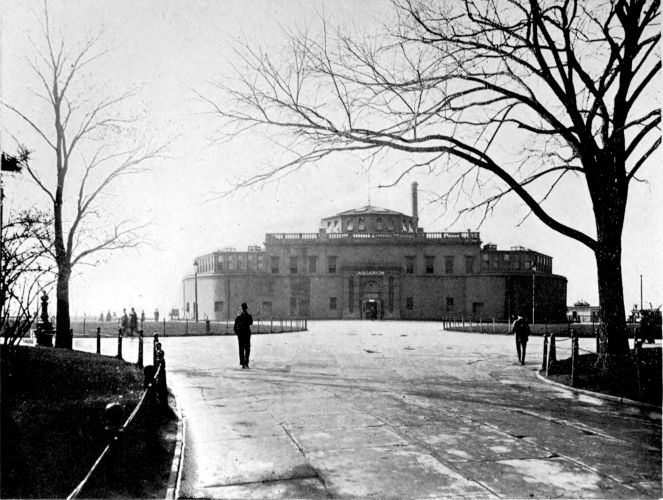
CASTLE GARDEN, NEW YORK
A rip-rap wall lay between the Battery and Fort Clinton, which were connected by a bridge of about two hundred feet long, and off this bridge there was excellent fishing for bass, drum and weak-fish.
In 1822, when the property was ceded back to the city by the Federal Government and the military headquarters removed to Governor’s Island, it was determined to convert Castle Garden into a place of public entertainment. The old fort was then leased to a Mr. Marsh, who made a popular resort of it. Among other improvements, he floored the top of the parapet and covered it with awnings; and the New Yorkers of that day considered it a most delightful place to while away the summer hours.
On August 16, 1824, the Cadmus landed the Marquis de Lafayette, “the guest of the nation,” at Castle Garden, where the military force of the city and an immense concourse of people were gathered to receive him; and on September 14, a great fête was held in his honour at Castle Garden, which was, perhaps, the most brilliant entertainment ever given in the city up to that time.
Castle Garden was the scene of large political meetings at which Daniel Webster and other notable orators, statesmen and citizens appeared; and in 1847, a great memorial concert for Mendelssohn was given there.
This year brings us to the period when Castle Garden became one of the most important play-houses of New York. It was opened by Messrs. French and Heiser on the 28th of June, 1847, with the popular actors and actresses Holland, Walcot, Arnold, Herr Cline, Miss Clarke, Miss M. Phillips, Mrs. W. Isherwood, etc., etc., and on the 18th of August of that year the Havana Opera Company, with Luigi Arditi, who is still remembered by many old opera-goers, as the conductor. The singers included Signorina Tedesco and Perelli, Vita, Novelli, and Candi. The first opera presented was Ernani, followed by Norma, La Sonnambula and Saffo.
About this time Castle Garden is described by Philip Hone as “the most splendid and largest theatre I ever saw—a place capable of seating comfortably about six or eight thousand persons. The pit or area of the pavilion is provided with some hundred small white tables and movable chairs, by which people are enabled to congregate into little squads and take their ices between the acts. In front of the stage is a beautiful fountain which plays when the performers do not. The whole of this large area is surmounted by circular benches above and below, from every point of which the view is enchanting.”
On June 5, 1848, George Holland, as director, opened with popular farces such as Old Honesty, in which he played the part of Tom Perch, Box and Cox, etc. Cline gave performances on the tight-rope and several notable benefits were given,—one for Arditi and the great contra-bassist, Botesini, in which Truffi, Pico, Vietti, Beneventano, Rapetti and Caffi appeared. On August 3d, there was also a great benefit performance for the suffering volunteers returning from the Mexican War.
From June 8th to September 7, 1850, the Havana Opera Company gave a splendid series of performances under Arditi’s bâton, beginning with Norma. The company was composed of Marini, Salvi, Lorini, Vietti, C. Badiali, Luigi Vita, Elsa Costini, Arditi and Botesini, which, to quote a contemporary, “formed, perhaps the finest musical combination ever heard in New York, and succeeded with the aid of moonlight and sea-breezes, notwithstanding the smallness of the stage and utter deficiency of acoustic requirements, in attracting immense audiences.”
On September 11th, a very interesting event occurred,—the début of Jenny Lind under Barnum’s management. The clever showman had advertised his song-bird so successfully that the tickets were sold at auction (one Mr. Genin, a hatter, bought the first ticket for $225.00), and those, not fortunate enough to obtain admission, hired row boats and hovered around Castle Garden during the performance.
Max Maretzek now appears on the scene to give a series of operas during the summer of 1851, for an admission of fifty cents. Marini, Lorini, Forti, Beneventano, and Signoras Benedetti, Bosio, Truffi, Clotilda Barili, Mme. De Vries and Mme. Maretzek formed a strong company, which was so successful that in the next year Maretzek repeated his venture, with such great singers as Sontag, Steffanone, Vietti, Salvi, Marini, Rossi, Strakosch and Badiali.
Immense audiences gathered at Castle Garden to hear Jullien’s wonderful orchestra,—the biggest and most extraordinary band that had ever visited New York. The eccentric French leader made his first appearance on July 29, 1852.
In 1852, the Rousset sisters appeared and French opera and comedy were played by Mme. Fleury-Jolly and Mlle. d’ Armont. The Ravel family and Blondin also appeared in this year.
There were many attractions at Castle Garden, besides the music and drama. There were shows of various kinds and plenty of food and drink. One chronicler speaks of “the fountain of real champagne, falling over the rocks of a mimic grotto from which the people dipped the sparkling fluid in amazed bewilderment.”
Maretzek had another season in the summer of 1854, and in that year another great event occurred at Castle Garden,—under Mr. Hackett’s management, while the Academy of Music on Irving Place (opened Oct. 2, 1854), was being made ready, the famous Grisi and Mario were introduced to the New York public in Lucrezia Borgia on September 4. The seats cost from $3.00 to $5.00.
One of the important performances during this decade was one in commemoration of the introduction of the drama at Williamsburg, Va., in 1752, by the Hallam Company from London. On this occasion The Merchant of Venice and Garrick’s Lethe were given.
Laurence Hutton’s memories in Plays and Players (New York, 1875) are worth quoting: “At Castle Garden too were held the fairs of the American Institute, with their countless delights to the boy of that period; their models of full-rigged yachts, their wonderful glass blowers and the marvellous machines to pare apples and to wring clothes, which were to revolutionize our entire domestic economy and which never worked when we got them home.... To Castle Garden also came the first and only Chinese Junk, and to Castle Garden, to see it and wonder at it, down Broadway came all the good people of Gotham.
“At Castle Garden, too, best of all were those peep-holes in the gallery, which we can remember so long ago that we had to be lifted up by paternal arms to look into them. Cosmorama, or diorama, were they called? and what pictures were revealed of impossible deluges, with pre-Raphaelite waters, and a pink-coloured Duke of Wellington at a very blood-red battle of Waterloo! The cyclorama of Paris by Night, or London by Day, is nothing to these battle scenes of Castle Garden, as real to us in those days as war itself. The exercise of a very little ‘make believe’ invested in the old fort a personal interest in all of its battles and the peep-holes became portholes to us, through which many a time and oft, with General Taylor, we have bombarded Monterey, or have died on the Plains of Abraham with General Wolfe.
“Of Castle Garden, hardly can we speak without some mention of the promenade on the outer balcony, so popular on fine nights when the moon, the inconstant moon, shone on the sparkling river and the Jersey shore; and the music of the orchestra, with its voluptuous swell, mingling so harmoniously with the melodious ‘clink, clink’ of the ice in the julep glasses, added such charms to the opera.”
Among the important receptions held in Castle Garden were those to Louis Kossuth in 1849, and to the Prince of Wales in 1860.
After having served as an immigrant dépôt for many years, Castle Garden was turned into an Aquarium, that attracts many visitors who are unaware of the interesting history that the curiously shaped old brown building in Battery Park has to tell.