THE MISSION DOLORES, SAN FRANCISCO LADY HARDY
Reading edition
We enter the Golden Gate Park, where, a few years ago, the Pacific waves were rolling; but these hundreds of acres have been reclaimed from the sea, and are planted with rare shrubs, young trees, evergreens and blooming flowers. It is tastefully laid out, a landscape garden and park in one; there are picturesque winding paths and shady nooks and corners where you can hide from the sun’s searching rays, and, while you listen to the singing birds overhead, hear the boom of the breakers on the shore below. We pass through this paradise of green and reach a silent sea of yellow sandhills, smooth and soft as velvet, billowing round in graceful, undulating waves as far as the eye can reach; there is a sudden curve, and the wide Pacific Sea, in all its glory, lies before us clothed in the sunshine, its white foam lips kissing the golden shore; its long level line stretched against the distant skies. We drove down to it; nay, drove into it, and watched its tiny waves dimpling into a thousand welcomes beneath our wheels. The sun and sea conspired together to fill the air with balmy breezes. We felt the soft spray blowing in our faces, stirring our blood, and setting our cheeks aglow, and as we breathed the crisp, soft air, laden with three thousand miles of iodine, we seemed to be taking a draught of the elixir of life.
On our way home we passed the old Mission; at least, all that is left of it, which is not much—the mere remnants of some redwood houses and the ancient church, a quaint-looking low-roofed home of desolation, with its adobe walls of sun-baked clay about four feet thick, which promise to withstand the encroaches of time a century longer. A chime of three bells still hangs in three square portholes; their long tongues red with rust, droop dumb and motionless from their silent mouths. Only a hundred years ago they were brought from Castile, blessed by the holy fathers, and brought here to the edge of the wild Western world to ring out and summon the heathen and the wanderer to worship the one true God.
You enter the ruined church through a low, arched doorway. The broken font is still there, but the last drop of holy water was spilled from it long ago. The mullioned windows are of a quaint fan-like shape and the genial sun tries to pierce through the grime and dust and send its beams dancing over the crumbled ruin within. The painted wooden shrines of St. Joseph and St. Francis (who gave the settlement of Yerba Buena the name of San Francisco) are still there. Near by are the Madonna and Child, but the paint has worn off and they are all discoloured and stained with the damp wind and the rain which drips, in the rainy season, from the dilapidated roof. The crumbling decorations, though they are of a rough, rude workmanship, still bear the stamp of artistic design, though crudely executed by unaccustomed hands, who laboured for the love of God. It is about a hundred feet from the threshold to the altar. Give reins to your imagination, set it galloping back a hundred years, and see the priests, the white nuns, and hooded friars clustered round the empty altar busy in the service of the Lord; the aisles filled with kneeling Indians, who know little of the faith they have adopted except that there is an unknown God somewhere who makes their corn grow, watches over their lives here, with a promise of a life hereafter; men from Mexico, Peru, and Spain, and wanderers from all along the wild Pacific coast are standing reverently round; censers are swinging, lights are burning, and a choir of voices chant the Ave Marias. A Christian host gathered in that wilderness by the sea. Where are they all now? Vanished like the children of a dream.
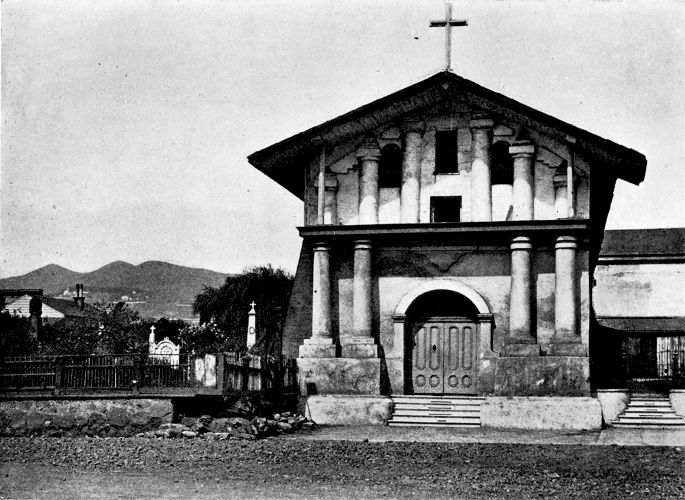
THE MISSION DOLORES, SAN FRANCISCO
A mouldy, funereal odour clings about the ruined walls, and we are glad to step out into the little graveyard outside, where the English hawthorn and white winter roses are blooming and the grass growing rich and luxuriant above the moss-grown graves. Whole tribes of Indians lie buried in the dust below our feet. There is no more desolate spot in the world than a disused graveyard. We read strange unfamiliar names upon the broken, half-buried stones, and crumbling urns, dilapidated angels and crippled cherubs are tottering round us. Here and there we decipher an English name, and, beneath, the information: “Died by the hands of the V. C.”; “In mercy we slay the enemies of the Lord.” The V. C. means the Vigilance Committee, who, in the early lawless days, executed justice swift and sure upon proven criminals. The strict justice of their decisions was never called in question. A certain number of men of known integrity were invested with supreme power of life or death, and the guilt of a man being once fully assured, he had a brief trial and swift execution. There was no legal quibbling, which often lets loose some atrocious criminal to prey upon the world again until, at the end, he is launched out of it. Near the low arched gateway stands the dilapidated figure of a woman, her sightless eyes and lifted hands pointing upwards—mute significance of one hope for all the miscellaneous dead.
A fresh breeze was blowing outside, but here it seemed to hang heavy and still, laden with the damp odour of mouldering graves, which mingled with and destroyed the sweet scent of the flowers that are flourishing so luxuriantly above the dead. This was the first we had seen of the many remnants of the old mission days, when the Spanish Fathers first came to the wilderness to sow the good seed and reap the harvest in their Lord’s name.
About the year 1820 the mission began to decay, the soldiers were recalled from the Presidio, where they had been stationed for the protection of the friars and their property, and from that time the missions dwindled, till the Fathers were recalled to Spain. They carried with them all their cattle and movable goods, and left their buildings to decay. These are scattered throughout the State of California, wherever the Fathers held temporary sway. Still, though they and their labours have passed away, and are well-nigh forgotten, they have left their traces behind them: throughout the country we find the old Spanish names still clinging to the soil, such as Santa Clara, Santa Rosa, Santa Barbara, San Rafael, San José, Los Angeles, Monterey, Carmelo, etc. Mr. John S. Hittell has given in his history of California a most interesting and graphic account of these missions, their people, their work, and the effect upon the country from their first establishment to their decline.
The city has grown out of the wilderness, and crowded so close to the crumbling walls of the ruined mission that as we leave the gloomy precincts we step out into the populous streets, which are full of hurry, bustle and vigorous young life. It is like stepping from the old century into the new. Gaily painted cars and omnibuses are dashing up and down the wide Mission Street, each following the other so quickly that before you can step into one, another is on its heels.