ST. MICHAEL’S CHURCH, CHARLESTON WILLIAM GILMORE SIMMS
Reading edition
Cities, like men, and because they are the work of men, have each, necessarily, marked features of individuality, and these will be found to illustrate in some degree, the characteristics of the people by whom they have been founded, and by whom they are maintained. All of our American cities may thus be distinguished, each having its local atmosphere and aspect. Charleston is confessedly one of the favourite cities of the South, if not of the Union, and is commended to our regards by a thousand special considerations. She has been distinguished by her early and active share in our Revolution—in the formation of the Confederacy and the Constitution—in the noble contributions of intellect and valour which she has made to the common capital of the country—in her generous sacrifices at all times in the common cause—by the refinements of her society—by the polish of her people—the general propriety of her tastes—her lofty morals and warm hospitality.
Founded under peculiar circumstances, at a juncture of marked transition in European affairs, under the direct patronage of the most eminent among the British nobility, and subsequently taken under the immediate protection of the Crown, the colony of South Carolina—of which Charleston was at that period the very soul—was always a much favoured province of the mother country. The richness and value of her products furnished substantial reasons why she should be a favourite. Her merchants were mostly British; her native sons of family were sent to Britain for education; and the affinities between the parent state and the colony were thus rendered doubly tenacious, making the struggle of the Revolution a much severer one in this than in any other colony of the whole continent.
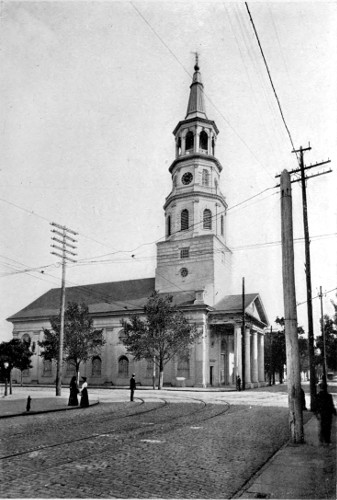
ST. MICHAEL’S CHURCH, CHARLESTON
The Palmetto City is happily placed within two spacious rivers, the Cooper and Ashley—the Etiwan and Keawah of the Red Men. These unite to form the harbour, which is ample and attractive to the eye, in high degree, forming a beautiful ensemble, not less sweet than spacious. As you enter from the sea, between the Islands of Sullivan and Morris, the city opens before you in the foreground, five miles distant—rising, like another Venice from the ocean. It is built, like Venice, upon flats and shoals of sand and mud. So low is the land, that the illusion that it is built directly in the sea, continues till you approach quite near it. This illusion is productive of a picturesque effect, but not sufficient to compensate you for the relief which would be yielded by an elevated background, or by lofty eminences of land on either side. As you advance, the bay expands, wide and majestic, forming a harbourage to which there can be no objection, were it not for the embarrassments of the bar at the entrance, which forbids the admission of ships of very heavy draught of water. In front of you, commanding the channel is Fort Sumter, a formidable pile of fortress, with double tier of heavy cannon rising upon a mole at the head of a sand-bar. In passing Sullivan’s Island the eye readily distinguishes the famous fortress which bears the name of Moultrie, distinguished in American history as the scene of one of the first and best fought battles of the Revolution, when a few hundred native riflemen, who had never fired a cannon before, beat off and nearly destroyed a formidable British fleet, making such slaughter among them as, in proportion to the numbers engaged, was not even reached by that of Trafalgar and the Nile. On the right you see Haddrill’s—Mount Pleasant village—which also constituted one of the fortresses of ’76. On the left are the shores of James and Morris Islands, the latter bearing the lighthouse of the port; the former the site of old Fort Johnson, which was wrested from the British, prior to the battle of Fort Moultrie by the enterprise of a small body of citizen soldiery. Here at the very portals of the city, you encounter Castle Pinckney, covering an ancient mud reef; and here we propose to give you a bird’s eye view of the city itself—the Palmetto City. You see the tout ensemble at a glance, and perceive its two most prominent characteristics—the verandahs, balconies, piazzas, with the ample gardens and their foliage, which isolate every dwelling-house, and form a substitute for public squares, in which Charleston is lamentably deficient. But for the largeness of the several lots and the taste of the people for shade trees, the deficiency would be fatal at once to the health and beauty of the place.
On the south-east corner of Broad and Meeting Street is an antique of the old Colonial period, the sight of which always rouses the pride of the Palmetto citizen. This is St. Michael’s Church (Episcopalian), a fine old fabric, and one of the best specimens of the British architectural talent of its day, at least as this was exhibited in its American production.
This fine church was first opened for worship in 1761. Its tower is supposed to be one of the noblest ornaments of the city. The proportions are good; the effect is graceful and imposing. The extreme elevation is 168 feet; no great elevation, perhaps, except in a city so little above the sea as Charleston. It is here even now overtopped by others. But it is not a mere spire. It is a series of ornamented chambers, gradually rising from each other; and involves dimensions of greater bulk and weight than any other of the city towers, St. Philip’s alone excepted. The church of St. Michael’s seems to be deficient in relation with the tower, and the effect is not good. It is too squat for the steeple. The extreme length of the body of the church is 130 feet, its width 60. As a whole the structure is in good taste, simple and proper; while this steeple, from its proportions, and an air of grace and lightness, which lessens greatly your idea of its bulk and weight, is in the highest degree pleasing and impressive.
This tower constituted, until a comparatively recent period, the great landmark of the city from the sea. It was the chief, or only beacon in the period of the Revolution, and was painted black when the assailing British fleet was anticipated, in order to prevent their use of it as a guide to the harbour. But this was a mistake. Black against a light-blue sky was a more certain landmark than white. It has a very musical chime of eight bells, none sweeter in the country. In the humid climate of Charleston the bells acquire a rare sweetness of tone, and those of St. Michael’s are especially musical. Of these bells there is a curious history. They were taken down and sent, as a portion of the spolia opima of the captured city, to London for sale. They were bought by London merchants, and restored by them to the church, whether as a gift or by purchase we are not able to say.[9]
During the Civil War the bells of St. Michael’s were sent to Columbia to be cast into cannon, but General Beauregard pronounced them unfit for the purpose and had them preserved in the capital with other relics of value.