THE MORRIS-JUMEL HOUSE, NEW YORK
Reading edition
Commanding an extensive view, or “prospect,” as they would have said in Colonial days, of the Harlem River and Long Island Sound, there stands a dwelling of the Georgian period famous under two names,—the “Morris House” and the “Jumel Mansion.” The house was built by Colonel Roger Morris, an English officer who came to this country with General Braddock and was wounded in the ill-fated expedition to Fort Du Quesne. He also served under General Wolfe at Quebec and left the army in 1764 to settle in New York, where he became a member of the King’s Council. He bought the property on Harlem Heights and erected the house now standing as a present for his wife, Mary Philipse, daughter of Frederick Philipse, whom he married in 1758. The Morrises made a charming home here and entertained with lavish hospitality the most distinguished guests until the beginning of the Revolution, when, being Tories, they were forced to leave their house. Eventually, included in the bill of attainder, they went to England, and their house and property in Harlem Heights were confiscated and sold.
Immediately after the battle of Long Island, August 27, 1776, General Washington retreated with his army to Harlem and selected the Morris House for his headquarters. Here Aaron Burr, associated with the later destinies of the house, served as secretary to Washington.
One day, after nearly three months’ residence, Washington started out on a reconnoitering expedition and about fifteen minutes after he had left, the British troops under Sir Thomas Stirling took possession of this desirable place; and from that moment until the evacuation of New York in 1783, the “Morris House” was the headquarters of General Knyphausen and his Hessian soldiers.
In 1785, the house became a tavern and was used as such for several years. It next looms into importance in 1810, when it was purchased by Stephen Jumel, whose handsome and clever American wife and the society that she gathered around her brought it once more into notoriety.
There have been several conflicting stories regarding Madame Jumel’s parentage; but Mr. Josiah Collins Pumpelly in an article published in the New England Genealogical and Biographical Record (1903) obtained the following statement from a relative: “Eliza (Bowen) Jumel was born, April 2, 1777, in Providence, R. I., but not in a poor-house, as was asserted by her enemies during the lawsuit. The statement made in Appleton’s Cyclopædia of National Biography that the lady’s name was Capet, and that she was born at sea, is not sustained by reliable history. Eliza Jumel was the daughter of Phœbe and John Bowen. Her father was a sea-captain and owned his own vessels; her brother and father were drowned together.”
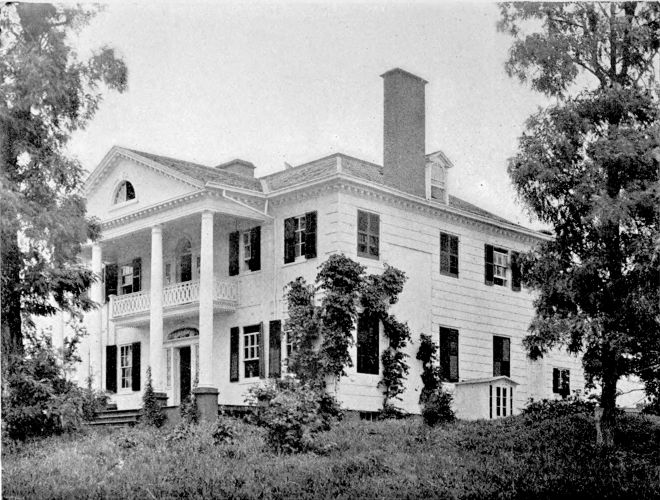
THE MORRIS-JUMEL HOUSE, NEW YORK
In 1804, she was married to Stephen Jumel, a rich coffee planter of San Domingo, who, during an insurrection on the island and massacre of the French, escaped to New York about 1790. He was much older than his beautiful bride; for at the time of his marriage he was nearly fifty and she twenty-seven. In 1810, they purchased the “Morris House” on Harlem Heights where they lived in great style. Subsequently the Jumels had a home in Paris, where they also entertained sumptuously until M. Jumel’s large fortune melted away. In 1821, Madame Jumel returned to her New York home. It seems that Madame Jumel immediately disposed of her rich furniture and other treasures, for in 1821 the following advertisement appears in the New York newspapers: “On Monday, the 16th of April next, at the Mansion House of Mrs. Jumel, Harlem Heights, the whole of her Furniture and Gallery of original Paintings, together with Kitchen Furniture, Carriages, Horses, and other implements on the premises. Any attempt to describe those superb and elegant articles would hardly convey an idea of what they are; and as people will be at liberty to go and see them one week previous to the sale, it is deemed sufficient to say that such a collection has never been offered to the public and connoisseurs in this country; being a careful selection made in Paris by the best judges from the museum and palace of the late Emperor.”
M. Jumel returned to New York in 1828 and recovered his lost fortune. From that date till his death in 1832, the house again witnessed scenes of gay society. Among the distinguished visitors at this period were Joseph Bonaparte and Louis Napoleon.
Again to quote from Mr. Pumpelly:
“After the death of her husband Madame Jumel carried on her business affairs by herself. She displayed in them excellent judgment and ability. The varied experiences of her life had sharpened her faculties, and the poor Rhode Island girl, with whom scandal had made free, had developed into a woman of culture, tact and superior powers. She furnished her mansion with somewhat of its former splendour. It displayed abundant souvenirs of the First Empire and its renowned master. There were eight chairs which had belonged to the First Consul, a table, the marble top of which had been brought to her from Egypt, a clock which the Emperor had used in the Tuilleries, a chandelier that he had once given to Moreau, tapestries and paintings which had been collected by Josephine; also a set of drawing-room furniture which had once been owned by Charles X.; a bedstead upon which Napoleon had slept for many months and his army chest. Visitors also told of a stand that was said to have belonged to Voltaire, a black leather trunk which was supposed to have been used by Napoleon on the march to Moscow, and an elaborate embroidery of flowers surrounded by a golden chain, which had been made by the Empress. On the furniture was emblazoned the symbolic ‘N’ of the Empire in commemoration of its great chief.”
In 1833, Madame Jumel was married in the drawing-room of this historic house to Aaron Burr. After her death in 1865, the house became the property of Mr. Nelson Chase, whose first wife was Madame Jumel’s niece. It now belongs to the Daughters of the American Revolution.