SOME BUILDINGS IN HAVANA RICHARD DAVEY
Reading edition
Notwithstanding the mosquito nuisance and bad drainage, the traveller’s first impression of Havana is distinctly agreeable, and the pleasing illusion is never completely destroyed. The harbour is wonderfully picturesque. Opposite the entrance stands the Moro Castle, almost a facsimile of that curious little castellated Moorish fortress which faces the beautiful monastery and Church of Belem, at Lisbon. To the left are two rather sharp promontories, crested by several fine churches, on Los Angeles, fully two hundred years old—an age in the New World, corresponding to hoar antiquity in the Old,—beyond these, upon a number of low-lying hills, rises the city, an irregular mass of one-storied dwellings, painted a vivid ochre, and interspersed with church domes and towers—with here and there tall, lank cocoa palms, or a tuft of banana leaves waving over some garden wall. Vessels from every part of the world, feluccas, with their swallow-shaped sails, some dazzling white, others a deep-red brown, fill up the foreground—whilst canoe-like market boats laden with tropical fruits, fish, vegetables and flowers, and rowed by negroes naked to the waist, scud in all directions over the deep blue waters.
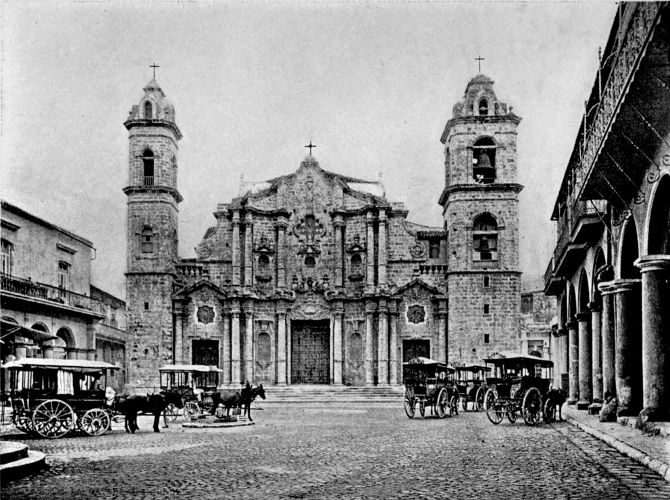
THE CATHEDRAL, HAVANA
Arriving, as I did, from New York, which I had left deep in snow, this summer scene was most exhilarating, and the exceeding transparency of the Cuban atmosphere added considerably to its beauty. Everything seemed unusual, novel, and, above all, utterly unlike what I had expected. The impress of the mother-country, Spain, is felt and seen everywhere, and modern American influences are barely perceptible, as yet. From the sea Havana might be Malaga or Cadiz, but when you land, memories of Pompeii immediately crowd upon you. What we should call the city proper, the commercial quarter of the Cuban capital, consists of a labyrinth of narrow lanes, traversed by one or two broadish streets, the principal of which, known all over Southern America and the West Indies as Calle O’Reilly, runs from the Governor’s Palace, right out to the walls of the city. Few of the houses which line these lanes and alleys are more than one story high, but that one story so exceedingly lofty, that it would make three in an average London dwelling. The lower half of every house is painted either a deep darkish blue, a deep Egyptian red, or a vivid yellow ochre; the upper part is always a dazzling white. As in Pompeii you notice rows of stucco columns, painted half one colour, half another. Peeping through the ever-open doorways, you may, as you pass along, obtain something more than a mere casual glimpse of the interior of the dwellings. If you are early enough, you may behold the family at its toilet, for there is very little privacy anywhere in Cuba, every act, from entry into life to its final exit, from baptism to burial, being serenely performed in the utmost publicity. The lower windows, overlooking the street, are protected by heavy iron bars, and behind these you may, in certain quarters of the town, see lively groups of Havanese Geishas, their faces thickly powdered with rice flour, their long black hair plaited, and their opulent charms displayed to liberal advantage—“sono donn che fano all’ amore!” These same curious overhanging windows, with their iron bars, would give the place a prison-like appearance, were they not painted in the most brilliant colours,—orange, scarlet, and pea-green.
There is no West End, so to speak, in Havana, the mansions of the wealthy being scattered through every part of the city. Some of the finer houses are exceedingly handsome, but they are all built on one plan, in the classical style, with an inner courtyard, surrounded by handsome marble or stucco columns. I imagine them to be designed much on the same plan as the villas of ancient Rome. In the centre of the Pateo, there is generally a garden, rich in tropical vegetation, shading either a fountain or a large gilded aviary full of brilliant parrots and parrakeets. In some houses there is a picture or statue of the Virgin, or some Saint, with a silver lamp burning before it day and night. In the Pateo the family assembles of an evening, the ladies in full dress—and as it is generally brilliantly illuminated, the pleasant domestic scene adds greatly to the gay appearance of the streets, which fill with loungers in the cool of the evening.
The handsomest street in Havana is the Cerro, a long thoroughfare running up a hill at the back of the town, bordered on either side by enormous old villas, in the midst of magnificent gardens. The finest of these mansions belongs to the very old Hernandez family, and is built of white marble in the usual classical style. The adjacent villa, Santo Veneo has a lovely garden, and used to be famous for its collection of orchids, the late Countess de Santo Veneo, a very wealthy lady, being a great collector. She was a clever, agreeable woman, well-known in Paris where she usually spent the summer and autumn. In the midst of a perfect forest of cocoa-palms stands the former summer villa of the Bishops of Havana, now a private residence.
Then, one after the other, follow the handsome dwellings of the Havanese Sangre Azul, of the Marquese dos Hermanos, of the Conde Penalver, of the Marqueza de Rio Palma, etc. The cacti in these villa gardens are of amazing size and shape, some showing leaves thick enough to bear the weight of a full grown man. Unfortunately, these Havana Edens are infested all the year round by swarms of mosquitos. The residents seem skin proof, and do not appear to suffer from the insects’ attacks. But woe waits on the unwary newcomer who tempts fate by lingering in these lovely gardens!
Although an eminently Catholic city, Havana cannot be said to be rich in churches. A goodly number have been destroyed during the various rebellions, especially those of the middle of the century, when the religious orders were suppressed. The largest church is the Mercede, a fine building in the rococo style with handsome marble altars and some good pictures. It is crowded on Sundays and holidays by the fashionable world of the place, the young men forming up in rows outside the church as soon as Mass is over, to gaze at the senoritas and their chaperons.
The Cathedral is the chief architectural monument of interest in Havana. It was erected for the Jesuits in 1704, and was converted into a Cathedral in the course of the Nineteenth Century. It is built in the usual Hispano-American style with a big dome and two stumpy towers on either side of the centre. Internally the effect is rather heavy, owing to the dark colour of the marbles which cover the walls, but compared with most churches in these latitudes, the edifice is in exceptionally good taste, with a remarkable absence of the tawdry images and wonderful collections of trumpery, artificial flowers and glass shades, which, as a rule, disfigure South American churches. The choir would be considered handsome even in Rome, and the stalls are beautifully carved in mahogany. Almost all the columns in the church are also mahogany, highly polished, producing the effect of a deep red marble, most striking when relieved, as in this case, by gilt bronze capitals. In the choir is the tomb of Columbus. The great navigator died, as most of my readers will doubtless be aware, at Valladolid, in Spain, on Ascension Day, 1506, and his body was at first deposited, after the most pompous obsequies, in the Church of San Francisco, in that city.
In 1513, the remains were conveyed to the Carthusian monastery of La Quabas, at Seville, where Ferdinand and Isabella erected a monument over them, bearing the simple but appropriate inscription:
“A Castile y Leon Nuevo Mundo Dio Colon.”
Twenty-three years later, the body of Columbus, with that of his son Diego, was removed to the island of San Domingo or Hayti, and interred in the principal church of the capital; but when that island was ceded to the French, the Spaniards claimed the ashes of the Discoverer, and they were carried to Havana and solemnly interred in the Cathedral, on the 15th January, 1796. The remains, which, by this time, it seems, were scanty enough, were placed in a small urn, deposited in a niche in the left wall of the chancel, and sealed up with a marble slab, surmounted by an excellent bust of the bold explorer, wreathed with laurel. The inscription, a very poor one, excited considerable ridicule, and a pasquinade was circulated, lamenting the absence of the nine Muses on the occasion of its composition.
Of late years, however, the inhabitants of San Domingo have set up a protest in favour of certain bones which have been discovered in their own Cathedral, and declare by their gods or by their saints, that never a bone of Columbus left their island, and that the relics of the great Christopher in the Cathedral of Havana, unto which so many pilgrimages have been made, are as apocryphal as were those of certain saints mentioned by the learned Erasmus.
Of the other numerous Havanese churches there is not much to be said, except that nearly all have remarkable ceilings, decorated in a sort of mosaic work in rare woods, often very artistic in design. Columns of mahogany are frequently seen, and nearly all the churches are lined with very old Spanish or Dutch tiles. The Church of Santa Clara, attached to a very large nunnery, is a favourite place of devotion with the fashionable ladies, who squat on a piece of carpet in front of the Madonna, with their negro attendant kneeling a few feet behind them. When the lady has performed her devotions, the sable footman takes up her carpet, and follows her out of the church, walking solemnly a few feet behind her. In the Church of the Mercede, there is a very curious picture representing a group of Indians being slaughtered by a number of Spaniards. In the centre is a wooden cross, upon the transverse portions of which Our Lady is seated, holding the infant Jesus in her arms. In the corner is a long inscription of some historical importance. It runs thus:
“The Admiral, Don Christopher Columbus and the Spanish Army, being possessed of the ‘Cerro de la Vaga,’ a place in the Spanish island, erected on it a cross, on whose right arm, the 2d of May, 1492, in the night, there appeared, with her most precious Son, the Virgin, Our Lady of Mercy. The Indians, who occupied the island, as soon as they saw Her, drew their arrows and fired at Her, but, as the arrows could not pierce the sacred wood, the Spaniards took courage, and, falling upon the said Indians, killed a great number of them. And the person who saw this wonderful prodigy was the V. P. F. Juan.”
The Jesuits have an important college for boys in Havana. Annexed to it is an observatory, said to be the best organized in South America. The church is handsome, and over the high altar hangs a famous Holy Family by Ribera. In connection with this college, there is also a museum and library, especially rich in drawings and prints, illustrating Cuban life and scenery, from the Sixteenth Century down to our own times.
The Tacon opera-house, which can accommodate 5,000 persons, is, in its way, a very fine theatre, built in the Italian fashion, with tiers of boxes, one above another. They are separated by gilded lattices, so as to afford every possible means of ventilation. Round each tier of boxes is a sort of ambulatory or verandah, overlooking the great Square. The upper gallery is exclusively devoted to the coloured people, who, on a Sunday, fill it to suffocation. They are considered the most critical part of the audience, and their appreciation or disapproval is generally well founded and liberally demonstrated. The first two rows of boxes belong to the aristocracy and wealthy merchants, and the display of jewelry on a gala night used to be quite amazing. The lower part of the house is divided into a pit and orchestra-stalls. When crowded the Tacon presents a really fine appearance. The stage is, I should say, as large as that at Covent Garden and the operas are perfectly mounted and staged.
According to the best authorities, Diego Velasquez, the Conqueror of Cuba, founded the famous city of San Christobal de la Habana in 1508, and being immensely impressed by the width and depth of the harbour, and its generally favourable position for trade purposes, he called it la Have del Nuevo Mondo, the key to the New World. So far he was right, and until quite recently Havana stood forth among the richest cities in Southern America. The early history of Cuba, like that of all the West Indian Islands, consists of a series of attacks by Spanish, English, French and Dutch buccaneers and privateers. In 1528, these adventurers burnt the new city to the ground, but, Phœnix-like, it soon rose above its ashes, and was eventually protected by a chain of fortifications of sufficient importance to resist a siege by the Dutch in 1628. From 1762 until February, 1763, the English, under Sir George Pickock, held the place. It was finally restored to the Spaniards; and the evacuation, on July 10th of the same year, was celebrated with great rejoicing; Britain being, at that date, distinctly unpopular in Cuba. In 1768, France having ceded Louisiana to Spain, Don Antonio Alloa sailed for New Orleans, to take possession in the name of Their Catholic Majesties. He was so ill received as to be obliged to return forthwith to Havana, where Marshal O’Reilly, an Irish exile, organized an expedition to Louisiana, and seized the capital, which was not held for very long. In 1802, Havana was partly burnt to the ground and some ten thousand persons were left homeless. Under the Governorship of the celebrated Tacon, Havana soon resumed its foremost position, and was almost entirely rebuilt in stone and masonry, whereas, hitherto, most of the houses had been of wood thatched with straw. If you ask, “Who built that fine edifice?” the answer is invariably “Tacon.” “Yon theatre?” “Tacon.” It is literally a case of “Tacon qui, Tacon su e Tacon giù.” He is the benevolent Figaro of the place. The wonders which he performed in a short time prove clearly that when the island is energetically governed, it flourishes marvellously.