THE JAMESTOWN TOWER CHARLES FREDERICK STANSBURY
Reading edition
Since the last decade of the Seventeenth Century a dismantled church tower has stood on Jamestown Island in Virginia, a relic of the settlement which defined the destiny of our country and a remnant of the first Episcopal church in America. Fire, the destruction of the elements, and decay have removed all that was James’ Fort save this remnant to liberty and religion. Only students of history knew this tower a year ago—now it has been brought into the prominence it deserves.
Having decided that the three hundredth anniversary of the real birth of the nation deserved adequate commemoration, the United States has invited all the world to share in a celebration to be held in 1907 on Hampton Roads and its shores—an apotheosis of the small but determining village which was thirty miles distant and now is represented only by a mouldy tower.
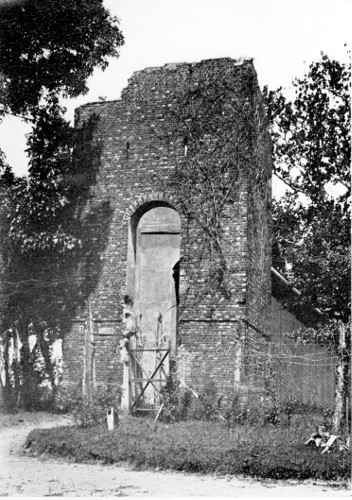
THE JAMESTOWN TOWER, JAMESTOWN, VIRGINIA
Speaking eloquently of the period which marked the inception of this historic building, former Governor of Virginia, William E. Cameron said: “The vista of years which stretches backwards into the dim distance of the Sixteenth Century presents an imposing avenue of events and deeds. Momentous occurrences loom up as era markers in the country’s progress some of which are spectacularly brilliant, and yet there is perhaps no event of all the long line which completely ranks with the first act in the country’s drama.”
At the farther end of the avenue one may see the ruined and dismantled tower of the Jamestown church, all that is left to mark the spot where sufferings were endured and deeds performed outranking the wildest imaginings of poet or romancer.
Although the Jamestown tower is the pathetic ruin of Columbia’s oldest church, it does not represent the earliest effort by English speaking people to plant Christianity in this part of the world. We read that in the year 1588, Sir Walter Raleigh gave 100 Pounds for the propagation of Christianity in Virginia, “the glorie of God, and the saving of the soules of the poor and blinded infidels.” Yet it was not until 1607 that the first church was erected at Jamestown. Its humble beginning has been nowhere better described than by Captain John Smith in a pamphlet published in 1631, some years after his history of Virginia, in which he says:
“When I first went to Virginia, I well remember, we did hang an awning (which is an old sail) to three or four trees, to shadow us from the sun; our walls were rails of wood, our seats unhewed trees, till we cut planks, our pulpit a bar of wood nailed to two neighbouring trees; in foul weather we shifted into an old rotten tent, for we had few better, and this came by way of adventure for new. This was our church till we built a homely thing like a barn, set upon crotchetts, covered with rafts, sedge and earth, so was also the walls. The best of our houses were of the like curiosity but the most part far much worse workmanship, that could neither well defend wind nor rain, yet we held daily Common Prayer morning and evening, every Sunday two sermons, and every three months the holy communion till our minister died, (the Rev. Mr. Hunt) but (after that) our prayers daily with a homily on Sundays, we continued two or three years after, till more preachers came.”
Captain Smith says further that the log church first erected was burned down the following winter with many other houses. Mr. Hunt lost all his books and everything else but the clothes on his back. This first Episcopal minister in the new world appears to have been a man of noble character and fine attainments. Although his sufferings were almost incredible, “yet none ever saw him repine; upon any alarm he was as ready at defense as any, and till he could not speak he never ceased to his utmost to animate us constantly to persist,—whose soul, questionless, is with God.”
Nor must we forget that the first legislative body in America, to which eleven boroughs sent burgesses, was opened in the Jamestown church with prayer by Mr. Bucke who succeeded Mr. Hunt. Laws were now superseded by others of a different character and the church of England more formally established than ever before. From Hening’s statutes at large we learn that there was enacted by the General Assembly in 1623, 1. That there shall be in every plantation where the people use to meete for the worship of God, a house or roome sequestered for that purpose and not to be for any temporal use whatsoever, and a place empaled in, sequestered only to the buryal of the dead.
2. That whosoever shall absent himselfe from divine service any Sunday without an allowable excuse shall forfeit a pound of tobacco, and he that absenteth himselfe a month shall forfeit 50 pounds of tobacco.
3. That there be an uniformity in our church as neere as may be to the cannons in England; both in substance and circumstances, and that all persons yield readie obedience unto them under paine of censure.
The fourth statute refers to holidays and the fifth to a subject that has been often discussed, namely: that no minister be absent from his church above two months in all the yeare upon penalty of forfeiting halfe his means, and whosoever shall absent above fowre months in the year shall forfeit his whole means and cure.
The sixth statute refers to slander and provides
That whosoever shall disparage a minister without bringing sufficient proofe to justify his reports whereby the minds of his parishioners may be alienated from him, and his ministry prove the less effectual by their prejudication, shall not only pay 500 lb. weight of tobacco but also aske the minister so wronged forgiveness publicly in the congregation.
In the Jamestown church of her period Pocahontas was doubtless baptized in the Christian faith, taking the name of Rebecca. Here, also the famous Indian girl was married to John Rolfe before proceeding to England where her too early death occurred.
There is some conflict of opinion concerning the date of the erection of the church now represented by the picturesque tower of Jamestown. It has been affirmed that the ruined tower is what is left of the church that was destroyed in Bacon’s rebellion in 1676. Bishop Meade of Virginia, who visited the ruins in 1856, gives the history of the succession of the Jamestown churches as follows:—The first as described by Captain Smith, was made of the awning or old sails, taken from vessels, and fastened to trees. The second was a very plain log building, which was burned down in the second or third year of the colony during the ministry of Mr. Hunt. The third was larger and better, probably of wood, built during the presidency of Captain Smith, repaired and adorned by Lord De la War when he arrived in 1611. The dimensions were twenty-four feet by sixty. The chancel or quoir was large enough to hold the Governor, the council and other officers of state. In this structure, doubtless, was held the first legislative session in 1619. Bishop Meade is of the opinion that this was the structure that was burned down during the Bacon rebellion. In opposition to the theory that the present are the ruins of the old church which was burned in the rebellion, he places the fact that the dimensions of the church which Smith built and Lord De la War repaired were different from the one whose ruins are now seen. The dimensions of the former were twenty-four by sixty; of the latter twenty-eight by fifty-six feet. He claims that other circumstances render it almost certain that another church had been built since the destruction of the one by Bacon. He points out the fact that in 1733 a silver font, still in existence was presented to it by two members of the Ambler family and adds that it surely would not have been presented to the ruins of a deserted church. He concludes, therefore, that the ruined tower which we now behold represents the remains of a church put up since the rebellion and his contention is certainly logical. Howe’s outline history of Virginia takes the ground that previous to 1617, or ten years after the first settlement of Jamestown there were two churches destroyed. The tower now standing may have belonged to the second church and survived its destruction. It could not have been part of the first, for that “cost no more than 50 Pounds”; or it may have been the tower of a third. We can only surmise that the tower has been standing upwards of three hundred years.
Bishop Meade has alluded to the fact that for several years after the death of Mr. Hunt the colony was without a minister. This is referred to in “A True Declaration of the Estate of the Colony in Virginia,” etc., published by the council in England in 1610 as one of the causes which had provoked God to visit the plantation with those dire calamities that beset it at the time that Lord De la War was first sent out as Governor for life.
An ardent task must have been that of the first ministers of the Jamestown church. A part of the religious services enjoined were as follows: On week days, early in the morning, the captain sent for tools, in the place of arms where “the sergeant-major, or captain of the watch, upon their knees made public and faithful prayers to Almighty God for his blessing and protection to attend them in their business for the whole day after succeeding.” The men were divided into gangs who worked on alternate days. The gang for the day was then delivered to the maisters and overseers of the work appointed, who kept them at labour until nine or ten o’clock; then, at the beat of the drum, they were marched to the church to hear divine service. After dinner, and rest till two or three o’clock, at the beat of the drum the captain drew them forth to the place of arms, to be thence taken to their work till five or six o’clock, when, at beat of drum, they were again marched to the church to evening prayer: they were then dismissed.
The ruined graveyard, or “place impaled in, sequestered only to the buryal of the dead,” at base of the Jamestown tower is not without interest. An inscription records the fact that “Here lyeth the body of the Rev. John Gough, late minister of this place, who departed this life, January 15, 1683–4, and waits in hopes of a joyful reunion.” There are tombstones and fragments of such, that record the deaths of Philip Ludwell and Sarah his wife, of Ursula Beverly, wife of Robert Beverly and daughter of William Byrd. There are likewise the tombs of Edward Jacqueline, Jacqueline Ambler, B. Harrison and Mrs. Edwards. There were in addition two tombs interestingly described by Bishop Meade as he saw them in 1856. They were those of Commissary Blair and Mrs. Blair. The tombs were placed side by side and were very heavy and strong. The platform, sides, and ends were of white freestone and the interior filled with bricks, well cemented. The top slab, on which the inscriptions were made, were of thick dark iron stone, or black marble. A sycamore-shoot sprung up between the graves and grew to be a large tree. In its growth it embraced, on one end and on the top the tomb of Mrs. Blair, one third of which lay embedded in the body of the tree and held immovable. All the interior, consisting of brick, and two of the side stones, had been entirely forced out of their places by the tree and lay scattered around while the dark iron-stone slab was held in the air three feet above the surface of the earth, fast bound by the embrace of the body of the tree into which it had sunk between one and two feet, the inscription being only partially legible. On the other side the whole tomb of Commissary Blair had been forced away from its place by the roots and body of the tree and was broken to pieces in all its parts.
Three hundred years have come and gone since the seed from which has grown English speaking America was planted on the spot where stands the old Jamestown tower.
The page in our History relating to it is fraught with perennial interest. In picturesqueness it is unsurpassed. The romantic story of Pocohontas, the grandeur of the character and attainments of Captain John Smith which grows brighter with the passing centuries and the almost incredible sufferings of the early settlers, combine to make a story the fascination of which is not decreased by its sadness. The crumbling tower makes a powerful appeal to the imagination such as inspired the British Spy to exclaim:
“Whence arises the irrepressible reverence and tender affection with which I look at this broken steeple? Is it that my soul, by a secret, subtle process, invests the mouldering ruin with her own powers; imagines it a fellow being; a venerable old man, a Nestor or an Ossian, who has witnessed and survived the ravages of successive generations, the companion of his youth and of his maturity, and now mourns his own solitary and desolate condition, and hails their spirits in every passing cloud? Whatever may be the cause, as I look at it, I feel my soul drawn forward as by the cords of gentlest sympathy and involuntarily open my lips to offer consolation to the drooping pile.”
It seems almost anti-climatic to be obliged to record the fact that the Society for the Preservation of Virginia Antiquities is arresting the hand of Time and taking measures to preserve this famous ruin for future generations. In the process of so doing the Society has unearthed much that is of interest to the historian of the subject. It is not therefore as literally true as it appeared to be when John Esten Cooke said that at present nothing remains of this famous settlement “but the ruins of a church tower covered with ivy and some old tombstones. The tower is crumbling year by year and the roots of trees have cracked the slabs making great rifts across the names of the old Armingers and Honourables. The place is desolate with its washing waves and flitting sea fowl, but possesses a singular attraction. It is one of the few localities which recall the first years of American history: but it will not recall them much longer. Every distinctive feature of the spot is slowly disappearing. The river encroaches year by year, and the ground occupied by the original huts is already submerged.”
Three hundred years, as pointed out by Congressman Towne, seems a long time as we speak the words; yet in the life of nations it is but a little while. There are while this is being written five members of the House of Representatives that could clasp hands and unite the settlement of Jamestown with its proposed celebration in 1907. The present Senators from two of the states in the Union could compass the interval with ten years to spare.
Brief period through three centuries appear on the page of history, the disintegrating ruin standing on Jamestown Island as the isolated emblem of the nation’s birth, accentuates the immutable law of material change whereby both humble and gorgeous monuments reared by the hand of man
“Shall dissolve, And like this insubstantial pageant faded, Leave not a wrack behind.”