LIBERTY ENLIGHTENING THE WORLD ESTHER SINGLETON
Reading edition
On Bedloe’s Island, a mile and a half below the Battery, on the site formerly occupied by Fort Wood, the most famous statue in America greets and welcomes every ship that enters the beautiful harbour of New York.
Just as soon as you leave the lower New York Bay and note the Brooklyn Bridge—which at this distance and in the twilight appears like a filmy cobweb, so airily suspended above the East River that it seems as if the lightest breeze might blow it away—the eye is fascinated by the sparkling, bluish light from Liberty’s uplifted torch. Ever larger and brighter it grows, as your boat speeds through the dying tints of sunset, more brilliant than the silver stars in the sky, the red and green lights of the river craft, and the golden beads that now begin to outline the fairy bridge.
On entering the Harbour in the daytime, the tall, graceful figure silhouetted against the sky soon attracts your attention; and if you are approaching New York from the south, long before you reach the city, long before the sharp, salt, invigorating air from the sea—sweet to smell and sweet to taste—strikes nostril and lip, across the flat meadows of Jersey, you see the great effulgent Star of Liberty shining like Rigel, Sirius, or Arcturus.
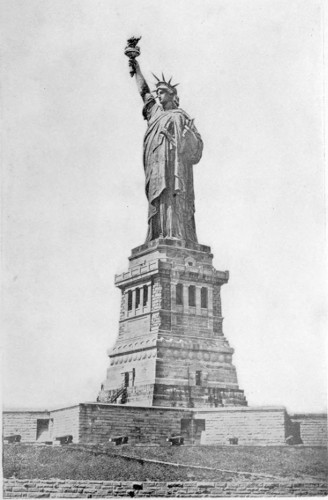
STATUE OF LIBERTY, NEW YORK
The island on which the colossal statue stands was called Minnisais in the Indian language, meaning “small island.” In Colonial days it was the summer home of Captain Kennedy, of the Royal Navy, afterwards the Earl or Cassilis. In 1753, it is described in an advertisement as follows: “To be Let. Bedloe’s Island, alias Love Island, together with the dwelling-house and lighthouse being finely situated for a tavern, where all kinds of garden stuff, poultry, etc., may be easily raised for the shipping outward bound, and from where any quantity of pickled oysters may be transported; it abounds with English rabbits.”
In 1758, Bedloe’s Island became a quarantine station, and during the War of the Revolution, it was chosen as an asylum for Tory refugees; but the buildings prepared for their reception were burned on the night of April 2, 1776.
A strong star fort was erected here in 1814 when the defences of New York were strengthened; and it is on the site of Fort Wood that the great pedestal rests.
The idea of this colossal statue originated with the French Sculptor, Bartholdi, in 1871, while on a visit to New York, and it was first discussed in the house of M. Laboulaye at Glavigny, near Versailles. In 1875, M. Bartholdi submitted his design to the Union Franco-Americaine, which had been formed in France for the purpose of presenting the people of the United States with a gift in honour of the country’s celebration of its hundred years of independence. When the design was accepted, the French society poetically expressed its intention as follows:
“We desire to erect in the unequalled harbour of New York a gigantic statue on the threshold of the New World, to rise from the bosom of the waves and represent Liberty enlightening the World.”
The French people subscribed enough to pay for the cost of the work—more than $250,000, and the wrist and hand with the torch were sent to the Centennial Exhibition of 1876 held at Philadelphia. In 1877, the citizens of New York held a meeting and appointed a committee to raise the necessary funds and procure the necessary legislation for the erection of this gift to the nation. Congress authorized its acceptance and passed a resolution to provide for its erection on Bedloe’s Island and also for its care. The public subscriptions were devoted to the foundation and the pedestal. In 1884, the statue was finished and presented to the United States Minister in Paris and in the following year it was taken to pieces and shipped in the French man-of-war, Isère. The statue arrived in New York Harbour on June 17, 1885, and two days later it was taken to Bedloe’s Island. It was dedicated on October 28, 1886, with much ceremony. The day was unfortunately misty and foggy. President Cleveland was present and many distinguished French guests, among whom was M. de Lesseps. The ceremony is thus described:
“After a prayer by the Rev. Dr. Storrs, the Comte de Lesseps was introduced and made a brief speech on the part of France, and then Senator William M. Evarts in an extended address, delivered the statue to the people of the United States through the President. M. Bartholdi himself with trembling hand pulled the covering from the face of the great statue, and when the roar of the answering cannons had in a measure subsided, President Cleveland, in a few words, accepted the gift. M. W. A. Lefaivre as the accredited representative of the French nation, made a short address, and the ceremonies were brought to an end by an eloquent oration from Mr. Chauncey M. Depew.”
The ideal significance of the statue was thus happily expressed: “We dedicate this statue to the friendship of nations and the peace of the world; the spirit of Liberty embraces all races in common brotherhood, it voices in all languages the same needs and aspirations.”
Figures are rarely interesting; but as Liberty Enlightening the World is the highest statue in the world, its dimensions are worth noting. The figure itself is 111 feet high, and to the extremity of the torch 151–41 feet. The head is 13½ feet high, the thumb is 12 feet in circumference, and the forefinger is 7 feet 11 inches long. The extremity of the torch is 305 feet 11 inches above mean tide. The statue may be ascended by means of stairways within; a stairway leads into the head, which can accommodate forty persons at a time, and a stairway also leads into the extended arm. The pedestal also contains stairways and balconies near the top.
The foundation for the pedestal, which is 89 feet high and built of cut stone, was made within the walls of the old fort. The dimensions of the pedestal are 63 feet square at the base and 43½ at the top. The torch and diadem are lighted by electricity. The statue is composed of 300 bronze plates and weighs 220 tons. General Charles P. Stone was the engineer of the pedestal and Mr. Richard M. Hunt, its architect.