WILLIAM AND MARY COLLEGE JOHN FISKE[4]
Reading edition
WILLIAM AND MARY COLLEGE JOHN FISKE[4]
This college was established in 1693, with Blair for its president. Governor Nicholson, with seventeen other persons appointed by the assembly, formed the board of trustees. From the outset Nicholson was warmly in sympathy with the enterprise, but now this friend was called away for a time. In the anti-Catholic fervour which attended the accession of King William and Queen Mary, the palatinate government in Maryland had been overturned and the new Royal Governor Sir Lionel Copley, died in 1693. Nicholson was then promoted from Deputy-Governor of Virginia to be Governor of Maryland. About the same time Lord Howard of Effingham resigned or was removed, and Sir Edmund Andros was sent out to Virginia as Governor. It may seem a strange appointment in view of the obloquy which Andros had incurred at the north. But in all these appointments William III. seems to have acted upon a consistent policy of not disturbing, except in cases of necessity, the state of things which he found. As a rule he retained in his service the old officials against whom no grave charges were brought; and while the personality of Andros was not prepossessing, there can be no doubt as to his integrity.
Nicholson’s career as Royal Governor of Maryland lasted until 1698, while Andros was having a hard time in Virginia trying to enforce with rigour the Navigation Act and to make life miserable for Dr. Blair. His conduct was far more moderate than it had been in New England, but he had his full share of trouble in Virginia. The moving cause of his hostility to the College of William and Mary is not distinctly assigned, but he is not unlikely to have believed, like many a dullard of his stripe, that education is apt to encourage a seditious and forward spirit. He did everything he could think of to thwart and annoy President Blair. At the election of burgesses he predicted that the establishment of a college would be sure to result in a terrible increase of taxes. He tried to persuade subscribers to withhold the payment of their subscriptions. He sought to arouse an absurd prejudice against Scotchmen, for which it was rather late in the day. Finally he connived at gross insults to the president and friends of the college. Among the young men to whom Andros showed especial favour was Daniel Parke, whose grandson, Daniel Parke Custis, is now remembered as the first husband of Martha Washington. This young Daniel did some things to which posterity could hardly point with pride. He is described as a “sparkish gentleman,” or as some would say, a slashing blade. He was an expert with the rapier, and anxious to thrust it between the ribs of people who supported the college. His challenges were numerous, but clergymen could not be reached in such a way. So “he set up a claim to the pew in church in which Mrs. Blair sat, and one Sunday,” as we are told, “with fury and violence he pulled her out of it in the presence of the minister and congregation, who were greatly scandalized at this ruffian and profane action.”[5]
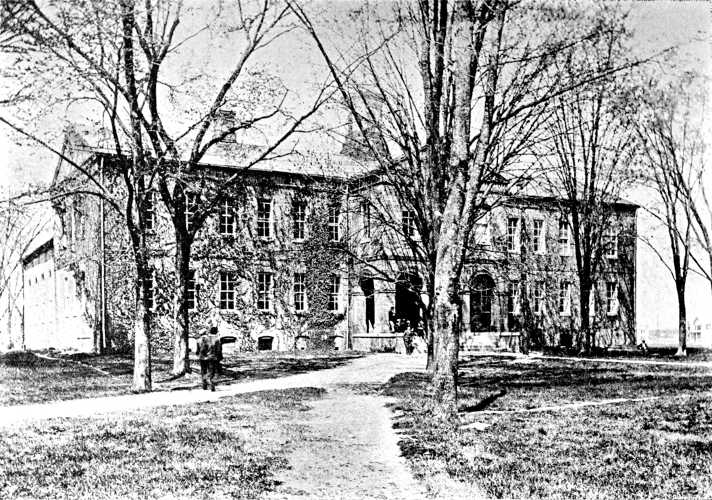
WILLIAM AND MARY COLLEGE, WILLIAMSBURG, VA.
This was going too far. The stout Scotchman had powerful friends in London; the outrage was discussed in Lambeth Palace; and Sir Edmund Andros, for winking at such behaviour, was removed. He was evidently a slow-witted official. His experiences in Boston, with Parson Willard of the Old South, ought to have cured him of his propensity to quarrel with aggressive and resolute clergymen. For two or three years after going home, Sir Edmund governed the little channel island of Jersey, and the rest of his days were spent in retirement, until his death in 1714.
The system of absentee Governors occasionally exemplified in such cases as those of Lord Delaware and Lord Howard, was now to be permanently adopted. A great favourite with William III. was George Hamilton Douglas, whose distinguished gallantry at the Battle of the Boyne and other occasions had been rewarded with the earldom of Orkney. In 1697 he was appointed governor-in-chief of Virginia, and for the next forty years he drew his annual salary of £1,200 without ever crossing the ocean. Henceforth the official who represented him in Virginia was entitled Lieutenant-Governor, and the first was Francis Nicholson, who was brought back from Maryland in 1698.
One of Nicholson’s achievements in Maryland had been the change of seat of government from St. Mary’s to Annapolis. He now proceeded to make a similar change in Virginia. After perishing in Bacon’s rebellion, Jamestown was rebuilt by Lord Culpepper, but in the last decade of the century it was again destroyed by an accidental fire, and has never since risen from its ashes. Of that sacred spot, the first abiding-place of Englishmen in America, nothing now is left but the ivy-mantled ruins of the church-tower and a few cracked and crumbling tombstones.
Jamestown had always a bad reputation for malaria, and after its second burning people were not eager to restore it. Plans for moving the government elsewhere had been considered on more than one occasion. In 1699 the choice fell upon the site of Middle Plantation, half-way between James and York Rivers, with its salubrious air and wholesome water. It had already, in 1693, been selected as the site of the new college. Nicholson called the place Williamsburg, and began building a town there with streets so laid out as to make W and M, the initials of the king and queen, a plan soon abandoned as inconvenient. The town thus founded by Nicholson remained the capital of Virginia until 1780, when it was superseded by Richmond.
Nicholson was in full sympathy with President Blair as regarded the college, but occasions for disagreement between them were at hand. On the Lieutenant-Governor’s arrival the wise parson read him a lesson upon the need for moderation in the display of his powers. The career of his predecessor Andros, in more than one Colony, furnished abundant examples of the need for such moderation. Blair offered him some good advice tendered by the Bishop of Lincoln, whereupon Nicholson exclaimed, with a big round oath: “I know how to govern Virginia and Maryland better than all the bishops in England. If I had not hampered them in Maryland and kept them under, I should never have been able to govern them.” The doctor replied: “Sir, I do not pretend to [speak for] Maryland, but if I know anything of Virginia, they are a good-natured [and] tractable people as any in the world, and you may do anything with them by way of civility, but you will never be able to manage them in that way you speak of, by hampering and keeping them under.” The eccentric governor did not profit by this advice....
Nicholson was recalled to England in 1705. Afterwards we find him commanding the expedition which in 1710 captured the Acadian Port Royal from the French. He then served as Governor of the newly conquered Nova Scotia and afterwards of South Carolina, was knighted, rose to the rank of Lieutenant-General and died in 1728.
Meanwhile the College of William and Mary, in which Nicholson felt so much interest, was flourishing. Unfortunately its first hall, designed by Sir Christopher Wren, was destroyed by fire in 1705, but it was before long replaced by another. Until 1712, the faculty consisted of the president, a grammar-master, writing-master and an usher; in that year a professor of mathematics was added. In 1729, there were six professors. Fifty years later the departments of law and medicine were added, and the name “College” was replaced by “University.”
As in the case of Harvard, it was hoped that this college might prove effective in converting and educating Indians. In 1723, Brafferton Hall was built for their use, from a fund given by Robert Boyle, the famous chemist. It is still standing and used as a dormitory. We are told that the “Queen of Pamunkey” sent her son to college with a boy to wait upon him, and likewise two chief’s sons, “all handsomely cloathed after the Indian fashion”; but as to any effects wrought upon the barbarian mind by this Christian institution of learning, there is nothing to which we can point.
The first Commencement exercises were held in the year 1700, and it is said that not only were Virginians and Indians present on that gala day, but so great was the fame of it that people came in sloops from Maryland and Pennsylvania and even from New York. The journals of what we may call the “faculty meetings” throw light upon the manner of living at the college. There is a matron or housekeeper, who is thus carefully instructed: “1. That you never concern yourself with any of the Boys only when you have a Complaint against any of them, and then that you make it to his or their proper Master.—2. That there be always both fresh and salt Meat for Dinner; and twice in the Week, as well as on Sunday in particular, that there be either Puddings or Pies besides; that there be always Plenty of Victuals; that Breakfast, Dinner and Supper be serv’d up in the cleanest and neatest manner possible; and for this Reason the Society not only allow but desire you to get a Cook; that the Boy’s Suppers be not as usual made up of different Scraps, but that there be at each Table the same Sort: and when there is cold fresh Meat enough, that it be often hashed for them; and that when they are sick, you yourself see their Victuals before it be carried to them, that it be clean, decent and fit for them; that the Person appointed to take Care of them be constantly with them, and give their Medicine regularly. The general Complaints of the Visitors and other Gentlemen throughout the whole Colony, plainly shew the Necessity of a strict and regular Compliance with the above Directions.... 4. That a proper Stocking-mender be procured to live in or near the college, and as both Masters and Boys complain of losing their Stockings, you are desired to look over their Notes given with their Linnen to the Wash, both at the Delivery and return of them.... 5. That the Negroes be trusted with no keys; ... that fresh Butter be look’d out for in Time, that the Boys may not be forced to eat salt in Summer.—6. As we all know that Negroes will not perform their Duties without the Mistress’ constant Eye, especially in so large a Family as the College, and as we all observe You going abroad more frequently then even the Mistress of a private Family can do without the affairs of her province greatly suffering, We particularly request it of you, that your visits for the future in Town and Country may not be so frequent, by which Means we doubt not but Complaints will be greatly lessened.”[6]
At another meeting it is ordered that “yt no scholar belonging to any school in the College of wt Age, Rank, or Quality, soever, do keep any race Horse at ye College, in ye Town—or anywhere in the neighbourhood—yt they be not any way concerned in making races, or in backing, or abetting, those made by others, and yt all Race Horses, kept in ye neighbourhood of ye College, etc., belonging to any of ye scholars, be immediately dispatched and sent off and never again brought back, and all of this under Pain of ye severest Animadversion and Punishment.”
There is a stress in the wording of this order which makes one suspect that the faculty had encountered difficulty in suppressing horse-racing. Similar orders forbid students to take part in cock-fighting, to frequent “ye Ordinaries,” to bet, to play at billiards, or to bring cards or dice into the college. Punishment is most emphatically threatened for any student who may “presume to go out of ye Bounds of ye College, particularly towards the mill-pond” without express leave; but why the mill-pond was to be so sedulously shunned we are left to conjecture. Finally, “to ye End yt no Person may pretend Ignorance of ye foregoing ... Regulations, ... it is Ordered ... yt a clear and legible copy of ym be posted up in every School of ye College.”[7]
One of the brightest traditions in the history of the college is that which tells of the wooing and wedding of Parson Camm, a gentleman famous once, whose fame deserves to be revived. John Camm was born in 1718 and educated at Trinity College, Cambridge. He was a man of good scholarship and sturdy character, an uncompromising Tory, one of the leaders in that “Parsons’ Cause,” which made Patrick Henry famous. He lived to be the last president of William and Mary before the Revolution. After he had attained middle age, but while he was as yet only a preacher and professor, and like all professors in those days at William and Mary a bachelor, there came to him the romance which brightened his life. Among those who listened to his preaching was Miss Betsy Hansford, of the family of Hansford, the rebel and martyr. A young friend, who had wooed Miss Betsy without success, persuaded the worthy parson to aid him with his eloquence. But it was in vain that Mr. Camm besieged the young lady with texts from the Bible enjoining matrimony as a duty. She proved herself able to beat him at his own game when she suggested that if the parson would go home and look at 2 Samuel xii. 7, he might be able to define the reason of her obduracy. When Mr. Camm proceeded to search the Scriptures, he found these significant words staring him in the face: “And Nathan said to David, Thou art the man!” The sequel is told in an item of the Virginia Gazette, announcing the marriage of Rev. John Camm and Miss Betsy Hansford.
So, Virginia, too, had its Priscilla! In the words of the sweet mediæval poem:
“El fait que dame, et si fait bien, Car sos ciel n’a si france rien Com est dame qui violt amer, Quant Deus la violt à ço torner: Deus totes dames beneie.”[8]
But this marriage was an infringement of the customs of the college, and was rebuked in an order that hereafter the marriage of a professor should ipso facto vacate his office.
The college founded by James Blair was a most valuable centre for culture in Virginia, and has been remarkable in many ways. It was the first college in America to introduce teaching by lectures, and the elective system of study; it was the first to unite a group of faculties into a university; it was the second in the English world to have a chair of Municipal Law, George Wythe coming to such a professorship a few years after Sir William Blackstone; it was the first in America to establish a chair of History and Political Science; and it was one of the first to pursue a thoroughly secular and unsectarian policy. Though until lately its number of students at any one time had never reached one hundred and fifty, it has given to our country fifteen senators and seventy representatives in Congress; seventeen Governors of States, and thirty-seven judges; three Presidents of the United States,—Jefferson, Monroe and Tyler; and the great Chief Justice Marshall. It was a noble work for America that was done by the Scotch parson, James Blair.