SHRINE OF GUADALUPE THOMAS UNETT BROCKLEHURST
Reading edition
One day I took a car to pay a visit to the shrine of Guadalupe, which is situated three miles from the city (Mexico), and is a great point of attraction both to residents and visitors.
The old road from the city to Guadalupe, with its handsome wayside shrines, was given up to the Vera Cruz Railway, and a new road for tramcars and traffic has been made alongside of it. As soon as we had passed the gates and the aduna, “crack, crack, hi, hi, hi!” and off we went at a hand gallop past adobe houses and pulquerias, the snow-capped giant Popocatapetl lifting his white head to the azure on the right, and soon, through the avenue of trees, the little church on the hill Tepeyac, erected where the Virgin appeared to the peasant Juan Diego, and the Cathedral at its foot, with its flat façade flanked by low towers, were both visible in the distance.
The cars came to a standstill in front of the Cathedral, and a motley crowd of loungers watched us alight.
The houses are one-storied and old, the windows barred after the fashion introduced by the Moors into Spain; behind the bars stood village maidens and matrons who signalled and saluted their male acquaintances by holding up the left hand, the fingers extended, which they wiggled to and fro about half-a-dozen times; this is their mode of salutation, possibly it means we have fruit and entertainment to offer.
The church of Nuestra Señora de Guadalupe is the most famous of all the churches in the country, owing its notoriety to the legend that, on the 12th of December, 1531, the Virgin Mary appeared to a poor Mexican shepherd in that neighbourhood; he reported the vision to the priests, who asked him to substantiate his statement by proofs. The Virgin showed herself to him on five different occasions, and finally stamped her image on his blanket; this mark was accepted; Our Lady of Guadalupe was officially proclaimed the patron saint of Mexico by the authority of Pope Clement VII., and thereby the influence of the Catholic religion was greatly extended, it being asserted that, by her graciously appearing to a native, all natives were taken under her special protection. A shrine was erected on the top of the hill where the vision appeared. At its foot rose a magnificent Cathedral, which at one time was very rich in gold and silver ornaments, the offerings of the faithful; but many of these were confiscated and coined into money by order of President Benito Juarez in 1860, and have since been replaced by inferior metal.
The name of Guadalupe was combined with that of Hidalgo, the Mexican priest who in 1810 raised the cry of independence from the Spanish yoke. He had painted on his standard the image of the Virgin of Guadalupe which greatly helped to excite the patriotism of the natives; more than 100,000 of them rallied round him; but they were so badly armed that they could not compete with the Spanish forces, who, curious to say, fought under the banner of the Virgin Los Remedios.
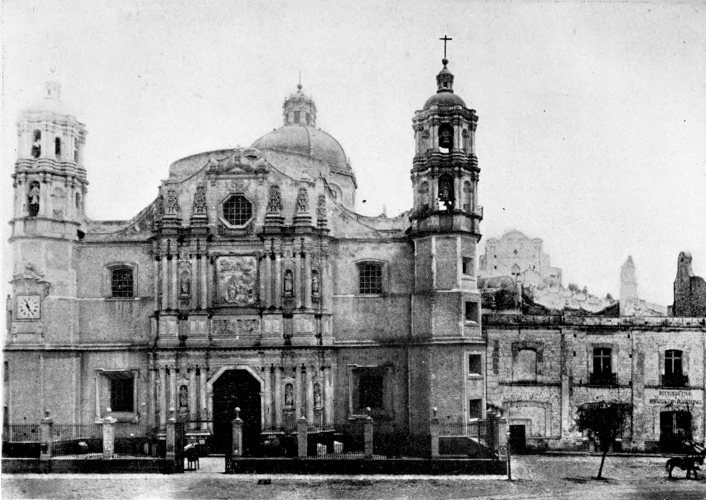
CHURCH OF GUADALOUPE, MEXICO
Poor Hidalgo was captured by the Spaniards and shot in 1811; but his followers in whom he had aroused much enthusiasm, continued the war, and, after eleven years’ hard fighting, independence was accomplished, in 1821, under Iturbide; and Spanish Viceroys and their rule were abolished. Mexican presidents, nominated every four years by the plebiscite of the nation, took their place.
There is not much to see in the Cathedral, which has been despoiled of its silver and valuables (the golden frame of the Virgin was taken, but returned); so I made the ascent by a zigzag road to the shrine at the top of the hill.
Before entering the chapel, stop to look at the view; it will repay any amount of trouble taken in mounting the steep steps. The city, the lake and Chapultepec are within the range of a camera, if it could be so fixed as to avoid the roof of the Cathedral below you. Turn and enter the shrine: at a little altar on the right are rude daubs of pictures representing miracles worked through the intervention of the Virgin—pious offerings in commemoration of a child saved from fire, a husband from lightning, a wife from a runaway train, a lady and gentleman from an overturn of a carriage, people rising from a bed of sickness, and such like—some of them with the paint hardly dry.
The altar railing is of solid silver; this railing was, of all the sumptuous church fixtures throughout the land, alone spared by the Liberals. Its value must be immense; pious Mexicans do not like to appraise it, for reasons best known to themselves. The great gem, however, of this church is the image of the Virgin of Guadalupe, which she herself imprinted—according to the legend—upon the tilma, or garment, of Juan Diego, the poor peasant, as a proof that she had appeared to him; this relic is hung over the high altar in a wrought-iron case and is only exposed on rare holidays. By especial grace I obtained a view of it. The tilma is a very coarse piece of woollen fabric; the colouring of the image is distinct, and may have been touched up from time to time. On a table at the door are copies of the picture in all sizes, and you see them in every Indian hut, every wayside shrine, in all the public offices, in every church—indeed in every place in the land, appropriate or inappropriate, as the case may be.
In an adjoining churchyard are some pretty tombs, and great prices are paid for interment in this sacred spot. Santa Anna rests here, and the names of the leading families of Mexico could be read on the marble on all directions.
After descending from the hill I visited the miraculous sulphur spring, said to cure everything; the church or dome which covers it was being redecorated at great expense at the time of my visit. The legend says that this spring of sulphur hydrogen gushed forth from a spot touched by one of the Virgin’s feet. On the 12th of December every year (the anniversary of the apparition), thousands of natives from all parts of the country visit this shrine and the Church of Guadalupe. The name is familiar to many people as that of a town between Toledo and Trujillo in Spain, where there is a famous shrine to the Virgin. There is always a longing in the minds of colonists to perpetuate the names of the country of their birth, and Guadalupe is no doubt an instance of this patriotic feeling on the part of the Spaniards; the Geronomite convent in Spain was at the time of the Conquest the richest and most venerated shrine in the old country, its celebrated figure of the Virgin, being believed to have been carved by St. Luke himself, and it was given by St. Gregory the Great to San Leandro for putting down Arianism. The figure was hidden and miraculously preserved during six centuries of Moorish invasion, and when brought to light was so venerated by the whole Spanish nation that the settlers in New Spain would delight in perpetuating the name of the shrine in their new home.