THE CASTLE OF CHAPULTEPEC THOMAS UNETT BROCKLEHURST
Reading edition
A clear, unclouded atmosphere at an elevation of 8,000 feet above the level of the sea in the tropics puts everything couleur de rose. There is no heat, no cold; the average temperature is about 60°, and the atmosphere is so clear that when you see the mountains at the ends of the streets they appear close at hand, instead of being from twenty to forty miles distant.
All the houses in the city have a gay appearance; such as are not white or light yellow or green are tinted with various shades of red, and many of the churches may be pronounced pink; three or four hundred yards of a street in pink has a pretty effect, especially if continued in pale green; a house in grey stone adjoining another faced with blue encaustic tiles is, to say the least, pleasing to the eye of any one who for months past has only gazed upon dwellings of dull red brick. As you get into the outskirts of the city, the houses are meaner, but many of them are festooned with flowers and wreaths, so the appearance of beauty is maintained, even if on close inspection it is found delusive.
One of the three principal rides out of the city is the Paséo de la Reforma, three miles in length, leading to the Castle of Chapultepec; here the gay world disports itself from seven to nine in the morning on horseback, and from six to seven in the evening in carriages; but it is deserted during Lent for the Paséo de la Viga, where three or four military bands discourse excellent music.
The principal ride is to the Castle of Chapultepec, and as it is the first ride every visitor is sure to take, he will be interested to learn that the building on the summit of the porphyry rock, visible from all parts of the valley, stands on the site of the Palace of Montezuma;[12] it is known as the Hill of the Grasshopper in old Aztec charts, and is always drawn on their hieroglyphics as a mound, with a grasshopper as large as the mound itself on the top of it.
Nothing remains of the grandeur which marked the place in Montezuma’s time except the avenues of enormous Cyprus trees (Cupressus distica) beneath whose shades were the gardens where he loved to wander, even after his beloved capital had fallen into the rude hands of the invading Spaniards.
I measured the girth of several of these trees, and found three or four of the largest to vary from thirty-five to forty feet above the ground. Their height was proportionately grand, 100 to 120 feet and the trees are well shaped. Long festoons of a greyish Spanish moss hang from their branches; this moss is supposed to add to the beauty of the groves, but it gives me an idea of decay.
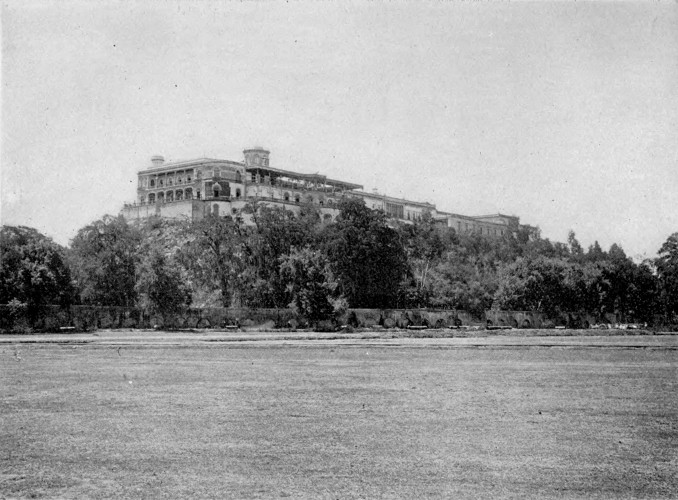
CASTLE OF CHAPULTEPEC, MEXICO
In Prescott’s fourth book there is a graphic account of Montezuma’s town and country palaces of barbaric splendour; his armouries, his granaries, his strange collection of human monsters and dwarfs, his menageries and the aviary, which alone required three hundred attendants; the royal household is described, and in proof of the luxury of the royal table, it is mentioned that there were runners stationed every twenty miles the whole distance from Vera Cruz to Mexico, that the red mullets might be placed fresh and sweet upon his table; it is said that the runners brought up these delicacies from the coast in quicker time than the present railway can accomplish. No one can doubt the truth of the description of his magnificence who has beheld the trees that are still standing along the avenues of what was once his royal garden. From the terrace in front of his palace, he saw the snow-capped mountains Popocatepetl and Ixtaccihuatl and the City of Mexico, entirely surrounded by the waters of Lake Texcoco, glittering at his feet; the Pinion de los Baños, Pinion del Marques, Santa Catharina and San Nicholas, all small craters or volcanic cones; and to the right the hill called Estrella, on which the sacred fire was always burning, until the 26th of December, every fifty-second year.
At these intervals, the fire of every temple and house was extinguished, and the people abandoning themselves to despair, tore their garments and destroyed their furniture, as their priests taught them it was probable that the world would be destroyed. The ceremony was terrible; a noble victim was sacrificed, and it was not till after midnight, when the constellation Pleiades had passed the zenith, that the priests announced that the world was again saved. The sacred fire kindled by the friction of sticks placed in the wounded breast of the victim was conveyed to the altar, when the blaze of the funeral pyre announced the glad tidings of joy to the countless multitudes looking on from every part of the valley; these thereupon gave themselves up to transports of delight, and kept the Carnival or national jubilee, which lasted twelve or thirteen days. New fire was then carried by fleet runners from the altar of Estrella to every part of the kingdom.
There is an idea of stability in the Scriptural phrase “everlasting hills.” The “everlasting hills” are before me; the aspect of the valley has been changed. Lake Texcoco has been withdrawn a mile or two from the city; the domes and spires of the city are different from the Teocalli and Palace of Montezuma; and the Palace of Chapultepec, in front of which I am standing, has been rebuilt several times by Spanish Viceroys. The present building was erected so lately as 1785; it is a kind of gilt pagoda on a castellated battlement, and the rooms were decorated by Maximilian, its last occupant, with coarse Pompeiian arabesques. These are changes, but Popocatepetl and Ixtaccihuatl rear their snow-capped heads as they did before man counted time.
At the back of the Castle, looking over the large cypress-trees on the pleasaunce below, is seen the high ground on which the Battle of Molino del Rey (the King’s mill) was fought in August, 1847, between the American army under General Scott and the Mexican army under General Santa Anna. The large flour mill and other buildings bear marks of shot and shell, and the centre of the battlefield is indicated by a square marble pedestal, on which are inscribed the names of the Mexican officers who fell on the field.
This was the last battle of the war which arose out of the secession of the territory of Texas from Mexico in order to become one of the North American States. General Scott being victorious over the Mexicans, the treaty of peace—known as the Treaty of Guadalupe Hidalgo—was ratified in the early part of 1848, by which the Americans obtained the territories of Texas, New Mexico, and upper California. Arizona was subsequently bought from Santa Anna by the Treaty of Messilla for $10,000,000.