THE CARLYLE HOUSE, ALEXANDRIA
Reading edition
In the quiet little town of Alexandria, whose large and grass-grown cobble-stones are rarely disturbed by vehicles or pedestrians, there are many old houses of distinguished, if somewhat decayed, appearance. They date from the period when the town, known as Belle Haven, had every prospect of becoming an important centre of trade and society. It was a mart for the famous “Oronoko tobacco” and a warehouse for this commodity established about 1720 brought prosperity to the settlement on the Potomac, whose name was soon changed to honour James Alexander, the Earl of Stirling. Many ships docked in the harbour to land merchandise, soldiers, sailors, officers and distinguished foreigners on diplomatic missions; and from the Royal George, the northern mail coach left every day connecting Alexandria with the world. In this period of prosperity, many handsome houses were built and furnished with every comfort and luxury known to this country.
Among the typical examples of domestic architecture of Colonial days is one that amply repays a visit,—not merely on account of its historical associations, but because it is one of the best specimens of Eighteenth Century architecture existing in this country.
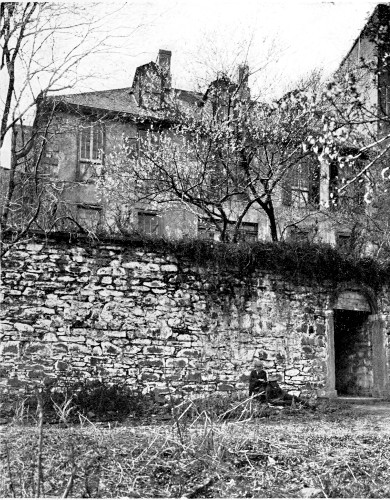
THE CARLYSLE HOUSE, ALEXANDRIA, VA.
Completely hidden by a modern hotel of unprepossessing appearance, few tourists who pause on their way from Washington to Mount Vernon to see the town that Washington visited so frequently, are aware of its existence.
Passing through the hotel into the back court, the visitor is suddenly confronted by this noble old house, now deserted and forlorn, with no hints of its days of gaiety and splendour. The house is extremely large and of fine proportions, and when surrounded by its trees and gardens must have presented an appearance of great dignity and charm. Architects, however, delight even more in the interior decorations,—the beautifully carved chimney-pieces, doors and other woodwork and the fine stairway. When this house was built by Major John Carlyle in 1752, it was considered one of the three handsomest homes in the vicinity, the others being Mount Vernon, the home of the Washingtons, and Belvoir, the home of the Fairfaxes.
One curious feature of the Carlyle House is that it is built upon an old fort, whose massive grass-grown walls are still to be seen, as well as the subterranean passage that leads from the house through the fort to the Potomac.
The following description by a nameless writer describes the house as it was about forty years ago:
“It is built of cut stone, quite large, being about fifty feet square, the doors and windows ornamented with carved caps. A massive porch is built on the west front and the east is occupied by a long verandah. A wide hall runs entirely through the house, in each story, and opening into them are spacious rooms. These, as well as the hall on the first story, are wainscoted to the ceiling and ornamented with carved wood, after the style of the period in which the house was built.
“Formerly, fine grounds surrounded the house; on the east side a garden extended to the river, which, at that time, was about three hundred yards distant. This inlet has long been filled in, and its site is now occupied by streets and buildings. A broad walk, bordered on either side with trees and shrubs extended from the house to the river. Being considerably above the grade of the surrounding streets, the garden was entirely cut away except a small portion near the house, which was walled in. The garden on the west front extended from the mansion to the street and fronted directly on the public square, which at that time was occupied by the town jail and pillory. In the garden were a number of tall Lombardy poplars, and at each corner a lodge was built, which was used as servants’ quarters. These have all been removed and their site is occupied by a large building. This prevents a front view of the mansion, except from the interior point of the hotel.”
Another excellent description by Alexander Cameron, in the New England Magazine for 1902, reads as follows:
“The most imposing residence the town possessed was, of course, the one John S. Carlyle had erected in 1752, constructed of Portland stone, shipped from the Isle of Wight in exchange for the famous Oronoko tobacco. The house was well situated,—in the rear the lawn sloped down to the Potomac and on the portico one could sit and watch the vessels from over the seas glide into the haven that ever appeared most beautiful, and in front like watchful sentinels, a double row of Lombardy poplars kept guard over the stately home, where hospitality was offered with a lavish hand and where good cheer and kindliness were ever to be found. The woodwork of the interior of the house is regarded as the best specimen of Colonial style; the windows, doorways, mantels, the primitive cupboards, the heavy carved frieze, even the chairboard are all in exquisite taste. Here in the great drawing-room of gold and white, Washington was often to be seen, taking part in the minuet and one could catch a glimpse of the dainty room in blue and white across the hall. But there was another side to all this brightness and gaiety, as the dungeons of the house could testify, where in times of attack by the Indians, the household sought protection, or by means of the subterranean passage, as at Mount Vernon, an escape was offered by way of the Potomac and the happy youths in powdered wigs, beruffled shirts, knee breeches, and silk hose, who could step with so light a heart in the dance, could also draw their swords and fight for the protection of their homes and for the honour of their King.”
The French and Indians were a menace to the prosperity of Alexandria; those living without the town found it difficult to bring their produce to market without fearing an attack; therefore in 1754 Washington, then but twenty-two, led a small company of Alexandria soldiers against the enemy. This was unsuccessful and Washington was compelled to surrender. In the following year, England took extreme measures.
It was the period when England and France were contending for power on this continent. France, with her allies, the Indians, held the Lakes and many strong forts in the interior, while England held the Atlantic seaboard peopled by loyal colonists. The English ministry having decided to attack the French on the Lakes and in Ohio, despatched General Braddock to Virginia in 1755, with instructions to proceed to Fort Duquesne, the site of the present city of Pittsburg.
On his arrival in Alexandria, General Braddock became the guest of Major Carlyle, while doubtless the soldiers were put up at the Royal George.
We can imagine that the entertainment offered to the gallant, gay and eccentric General by a wealthy colonist did not shame the famed Virginia hospitality; and that when the Governors of New York, Massachusetts, Maryland, Virginia, Pennsylvania and North Carolina arrived, there were dances, dinners, cards, toasts and wines, and scenes of gaiety, as well as the discussion of vital questions. A Conference of six Governors and noted army officers was not an everyday occurrence, and the old house held a very brilliant gathering.
The Conference ended and the plan of action determined upon, Braddock and his little company of red-coated soldiers, set out from Alexandria.
They took the road across the mountains, still a wilderness, although the Indian no longer lurks behind the trees and rocks. Here the traveller is shown various paths called “Braddock’s Road,” and springs and stones called “Braddock’s Well” and “Braddock’s Stone,” all of which are associated, or supposed to be associated, with the memorable “Braddock’s Defeat.”
Braddock’s story is very well told by John Esten Cooke, who writes: “He went from Williamsburg to Alexandria to consult with the governors of the more prominent colonies; and one morning there appeared at his headquarters a young gentleman of some reputation as a soldier—Colonel George Washington of Mount Vernon. As Washington had already smelled gunpowder and knew the wilderness, Braddock gave him a position on his staff, and informally consulted with him, but exhibited ill-conditioned disdain when the young ‘buckskin’ hinted that ‘regulars’ would not accomplish much in the woods when matched against Indians firing from behind the trees. The idea that British regular troops would not sweep such hornets from their path, struck Braddock evidently in the light of an exquisite absurdity; and, paying no attention to Washington’s warnings, he hurried forward his preparations, set out for the frontier, passing through Frederick City, Maryland, and Winchester, Virginia, and entered Fort Cumberland, where his troops were to rendezvous amid a thundering salute of thirteen cannon, the drums beating the ‘Grenadier’s March’ as he flashed by in his chariot, his staff galloping beside it. So went upon his way the brave and unlucky Englishman who was not destined to return....
“The tragic sequel of the drama we need not describe. Braddock had acted like the brave man he was in the battle and defeat that ensued, and, seeing all things crumbling around him, seemed anxious to die. He rode into the hottest of the fire, a conspicuous figure in his splendid uniform—shouting orders, storming at the troops, waving his sword—exposing himself recklessly in every part of the field. Five horses had been killed under him. As one fell, he seized and mounted a fresh one. At last his fate came. A bullet traversed his right arm and buried itself in his lungs. He fell—was caught by Captain Stewart of the Virginia light-horse, and there was scarcely time to hurry him off the fateful field, when the English troops broke on all sides and retreated in wild disorder, pursued by the French and Indians.
“The shattered army were now in full flight across the Monongahela; and then they hastened back through the wilderness, scarcely pausing before they reached Fort Cumberland. Tradition relates that Braddock was so painfully wounded that he could not be carried off even in a spring vehicle, and was swung at full length in a large silken sash which he had worn, the extremities of which were affixed to two horses moving abreast. This sash is said to be still in existence. He could be carried no further than the Great Meadows, where he died on the night of July 13th, Washington reading the funeral service over his body, which was there interred. Savages lurked around—all was done in silence. Not even a volley was fired in honour of the brave soldier who had come to this wilderness to find a grave.”
The report to the home government gave the Colonial soldiers their due. It read: “The Virginia officers and troops behaved like men and died like soldiers.” Washington was the only officer who survived. He wrote: “I had four bullets through my coat, and two horses shot under me, yet escaped unhurt although death was levelling my companions on every side of me.”
On his return, Washington entered into all the gaieties of Alexandria, balls and dances at the Carlyle House, balls and dances at the Royal George, and balls and dances at the tavern called Gadsby’s. He notes in his Diary of 1760 the description of a ball in Alexandria, ending: “We lodged at Col. Carlyle’s.”
During the Civil War, this old house was used as headquarters for the medical directors of the hospitals in the vicinity.