THE WILLIAM PENN HOUSE, PHILADELPHIA JOHN F. WATSON
Reading edition
It is a matter of inquiry and doubt at this day (1828) which has been the house in Letitia Court, wherein William Penn, the founder and Colonel Markham, the Lieutenant-Governor, dwelt.[15] The popular opinion now is, that the inn at the head of the court, occupied as the Leopard Inn and since Penn Hall is the identical house alluded to. The cause of this modern confidence is ascribable (even if there were no better ground of assurance) to the fact, that this building, since they built the additional end to the westward, of about eighteen to twenty feet, presents such an imposing front towards High Street, and so entirely closes the court at that end (formerly open as a cart passage) that from that cause alone, to those not well-informed it looks as the principal house, and may have therefore been regarded by transient passengers as Penn’s house.
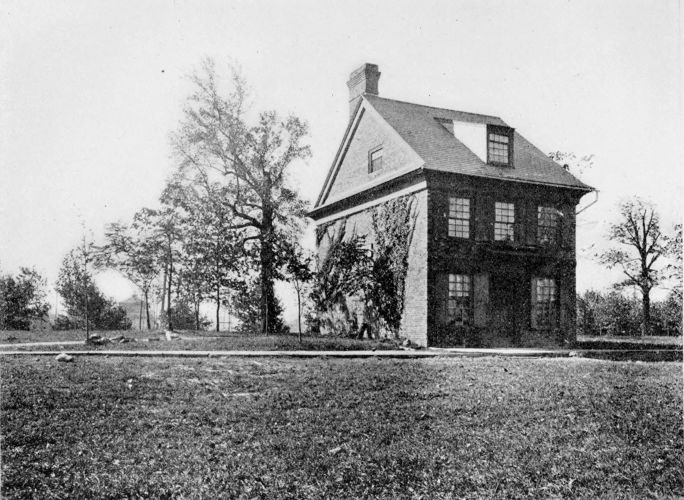
THE WILLIAM PENN HOUSE, PHILADELPHIA
The truth is that for many years the great mass of the population had dropt or lost the tradition about Penn’s house in the court; and it is only of later years, antiquities beginning to excite some attention, that the more intelligent citizens have revived some of their former hearings about the court. During all the earlier years of my life, I never heard of Penn living there at all; but of later years I have. I have been, therefore, diligent to ask old men about it. Several said it never used to be spoken of in their youth. John Warder, an intelligent merchant, now above seventy-three years of age, was born at the corner house of the alley on High Street, and has told me he never was told of Penn’s living there, when a boy. On the other hand, a few old men have told me, at every period of their life the tradition (though known to but few) was, that it was one of two houses, to wit—either Doyle’s Inn, or the old Rising Sun Inn on the western side of the alley. Joseph Sansom, Esq., about sixty, told me he heard and believed it was the house at the head of the court, and so also some few others; but more persons, of more weight in due knowledge of the subject, have told me they had been always satisfied it was the old Rising Sun Inn on the western side of the court. Timothy Matlack, aged ninety-two, who was very inquisitive, and knew it from fourteen years of age, said it was then the chief house in the court as to character; it was a very popular inn for many years (whereas Doyle’s house was not an inn till many years afterwards), that it then had an alley on its northern side for a cart way running out to Second Street, and agreeing with “Penn’s gate over against Friends’ Meeting,” etc., at which place his Council, 1685, required King James’s proclamation to be read.
This name Letitia house I found was a name which even those who thought the house at the head of the court was Penn’s, granted that Letitia Penn dwelt in, even while the father may have occupied the other. In this they were certainly in some error; Letitia being an unmarried girl, could never have had a separate house; she was not with her father till his second visit in 1700. It was in Penn’s first visit only, in 1682, that he could have dwelt there.
I infer from the facts that Penn had “his cottage” built there before his landing by Colonel Markham; that some of the finer work was imported for it with the first vessels; that he used it as often as not at his “palace” at Pennsbury. After him, it was used by Colonel Markham, his Deputy Governor; and afterwards for public offices. That in 1700, when he used the Slate-house, corner of Second Street and Norris Alley, having a mind to confer something upon his daughter, then with him, he gave her a deed, 1 mo. 29th, 1701, for all that half square lying on High Street and including said house. Several years after this event, the people, as was their custom, when the court began to be built up on each side of a “36 feet alley,” having no name for it, they, in reference to the last conspicuous owner, called it Letitia Court, in reference to the then most conspicuous house; the same house so given to Penn by his daughter.
If we would contemplate this Letitia house in its first relations, we should consider it as having an open area to the river the whole width of the half square, with here and there retained an ornamental clump of forest trees and shrubbery on either side of an avenue leading out to the Front Street; having a garden of fruit trees on the Second Street side and on Second Street “the Governor’s Gate,” so called “opposite to the lot of the Friends’ Great Meeting.” By this gate the carriages entered and rode along the avenue by the north side of the house to the east front of the premises.
This general rural appearance was in all accordance with Penn’s known taste, and was doubtless so continued until the ground was apportioned out in thirty city lots, as expressed by James Logan in a letter to Letitia Aubrey, in the year 1737.
The following facts present scraps of information which may tend still further to illustrate the proper history of the premises, to wit: “Pitch upon the very middle of the platt of the towne, to be laid facing the harbour, for the situation of the house.” Thus intimating, as I conceive, the choice of Letitia Court, and intimating his desire to have it facing the river, “as the line of houses of the towne should be.”
The Slate-Roof house still standing at the south-east corner of Norris Alley and Second Street, and now reduced to a lowly appearance, derives its chief interest from having been the residence of William Penn. The peculiarity of its original construction, and the character of several of its successive inmates, will enhance its interest to the modern reader. The facts concerning the premises, so far as may now be known, are generally these, to wit:
The house was originally built, in the early origin of the city, for Samuel Carpenter—certainly one of the earliest and greatest improvers of the primitive city. It was probably designed for his own residence, although he had other houses on the same square, nearer to the river.
It was occupied as the city residence of William Penn and family, while in Philadelphia on his second visit in 1700;[16] in which house was born, in one month after their arrival, John Penn, “the American”—the only one of the race ever born in the country. To that house, therefore, humble, degenerated, and altered in aspect as it now is, we are to appropriate all our conceptions of Penn’s employments, meditations, hopes, fears, etc., while acting as Governor and proprietary among us. In those doors he went in and out—up and down those stairs he passed—in those chambers he reposed—in those parlours he dined or regaled his friends—through those garden grounds he sauntered. His wife, his daughter Letitia, his family and his servants were there. In short, to those who can think and feel, the place is filled with local impressions. Such a house should be rescued from its present forlorn neglect; it ought to be bought and consecrated to some lasting memorial of its former character, by restoring its bastions and salient angles, etc. It would be to the character of such Societies as the Historical and Penn Association, etc., to club their means to preserve it for their chambers, etc., as long as themselves and the city may endure.
After William Penn had left this house, on his intended return with his family to England, he, while aboard his return ship the Messenger (an appropriate name for the message and business he was purposing!) writes on the 3d of September, 1701, to James Logan, saying: “Thou may continue in the house I lived in till the year is up.”
James Logan in reply, in 1702, says: “I am forced to keep this house still, there being no accommodation to be had elsewhere for public business.” In fact, he retained it as a government house till 1704, when he and his coadjutors moved to Clark’s Hall in Chestnut Street, afterwards Pemberton’s great house.
James Logan, in a letter to William Penn of 5th December, 1703, says Samuel Carpenter “has sold the house thou lived in” to William Trent (the founder of Trenton in 1719) for £850.
At this house Lord Cornbury, then Governor of New York and New Jersey (son of Lord Clarenden, cousin of Queen Anne), was banqueted in great style in 1702, on the occasion of his being invited by James Logan, from Burlington, where he had gone to proclaim the Queen. Logan’s letter, speaking of the event, says he was dined “equal, as he said, to anything he had seen in America.” At night he was invited to Edward Shippen’s (great house in south Second Street) where he was lodged and dined with all his company, making a retinue of nearly thirty persons. He went back well pleased with his reception, via Burlington, in the Governor’s barge, and was again banqueted at Pennsbury by James Logan, who had preceded him for that purpose. Lord Cornbury there had a retinue of about fifty persons, which accompanied him thither in four boats. His wife was once with him in Philadelphia, in 1703. Penn, on one occasion, calls him a man of luxury and poverty. He was at first very popular; and having made many fine promises to Penn, it was probably deemed good policy to cheer his vanity by striking public entertainments. In time, however, his extravagant living and consequent extortion, divested him of all respect among the people.
In 1709, “the slated-roof house of William Trent” is thus commended by James Logan as a suitable residence for him as Governor, saying: “William Trent, designing for England, is about selling his house (that he bought of Samuel Carpenter) which thou lived in, with the improvement of a beautiful garden,”—then extending half-way to Front Street and on Second Street nearly down to Walnut Street. “I wish it could be made thine, as nothing in this town is so well fitting a Governor. His price is £900 of our money, which it is hard thou canst not spare. I would give £20 to £30 out of my own pocket that it were thine—nobody’s but thine.”
The house, however, was sold to Isaac Norris, who devised it to his son, Isaac, through whom it has descended down to the present proprietor, Sarah Norris Dickinson, his grand-daughter (1828).
It was occupied at one period, it is said, by Governor Hamilton, and, for many years preceding the war of Independence, it was deemed a superior boarding house. While it held its rank as such, it was honoured with the company, and, finally, with the funeral honours of General Forbes (successor to General Braddock), who died in that house in 1759. The pomp of his funeral from that house surpassed all the simple inhabitants had before seen in their lives. His horse was led before the procession, richly caparisoned,—the whole conducted in all “the pomp of war,” with funeral dirges, and a military array with arms reversed, etc.[17]
In 1764, it was rented to be occupied as a distinguished boarding-house by the widow Graydon, mother of Captain Graydon of Carlisle, who has left us his amusing Memoirs of Sixty Years’ Life in Pennsylvania. There his mother, as he informs us, had a great many gentry as lodgers. He describes the old house as very much of a castle in construction, although built originally for a Friend. “It was a singular, old-fashioned structure, laid out in the style of a fortification, with abundance of angles, both salient and re-entering. Its two wings projected to the street in the manner of bastions, to which the main building, retreating from sixteen to eighteen feet, served for a curtain.[18]... It had a spacious yard, half way to Front Street, and ornamented with a double row of venerable lofty pines, which afforded a very agreeable rus in urbe.” She continued there till 1768–1769, when she removed to Drinker’s big house, up Front Street, near to Race Street. Graydon’s anecdotes of distinguished persons, especially of British officers and gentry who were inmates, are interesting. John Adams and other members of the First Congress had their lodgings in the “Slate-House.”