ARLINGTON IZA DUFFUS HARDY
Reading edition
The next day we decided to improve the shining hours—truly and literally shining in this radiant spring weather of blue heavens and balmy sunshine—by paying a brief visit to the Capitol in the morning, and taking a drive to Arlington in the afternoon. It takes a good many brief visits to see the Washington Capitol thoroughly; but one appreciates and enjoys it so far better than by “doing” it in one long visitation, as we see so many tourists “doing” it, with red guide-books in their hands, or bulging from their pockets. (I must conscientiously confess, in parenthesis, that we ourselves also carry a Guide to Washington, and, during the inspection of the Capitol, are apt to refer to it pretty often.) In the endeavour to take it all in on one day, the eye gets surfeited with pictures and statues, mouldings and frescoes; the soul sickens at the further contemplation of busts and bas-reliefs, bronze-panellings and marble pillars; Pocahontas and Washington dance together dizzily in the confused brain; and Presidents and Puritan Fathers, William Penn and Miles Standish, allegorical figures of Freedom and Victory, the Declaration of Independence, the Landing of Columbus and the Sword of Bunker’s Hill all mingle in a kaleidoscopic jumble in the wearied mind.
In the afternoon, we take a carriage to Arlington, a beautiful drive of only about four miles. All the way the great white dome of the Capitol dominates the landscape. Across the Potomac, from Arlington Heights, beyond river, wood, winding road and city, we see it soaring into the intense blue of the sky like an Alpine peak.
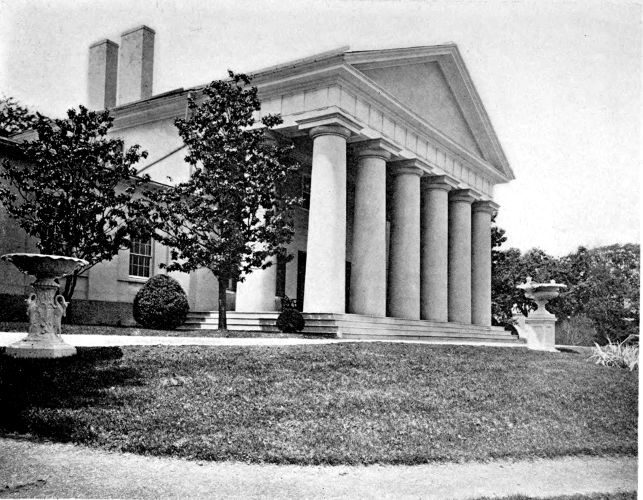
ARLINGTON, VA.
The Arlington Mansion was built by George Washington Parke Custis (grandson of Martha and adopted son of George Washington). His daughter married Robert E. Lee, and here the Lees kept hospitable house and happy home until the disastrous days of war. During the long struggle the estate was confiscated, and, having been employed as headquarters for the Federal troops, was eventually turned into a “national cemetery,” where over fifteen thousand soldiers lie buried.
The beautiful park-like grounds are now a field of the dead. Up the hillside by thousands and tens of thousands, stretch the long regular serried lines of tombstones. Here, line by line, in rank and file, at peace beyond the battle, lies the silent army now. It is so hard to realize, looking on these squadrons of the dead, still seeming drawn up in battle array, that every one of those cold white stones strikes down to the dust that was once a human heart, that throbbed with the passionate pain of parting at leaving home and love, that thrilled at the trumpet’s call, that beat high with hope and valour and gave its life-blood for the victorious cause that it held dear!
One massive granite tomb covers a vault where lie the remains of more than two thousand of the unknown dead. But the deserted mansion itself is as sad as any of the tombs that surround it. The grand old house is empty and ungarnished; its bare floors echo mournfully to our footfalls; the hall door (the “classic portal, resting on eight massive Doric columns,” as the guide-book describes it), stands drearily open; all the world is welcome to enter there. It is not in the least like a haunted house; there are no corners whence bats might flit at night; no thick curtain of dust coats the walls, nor dark banners of spider’s web veil the windows. The lofty rooms are spotless, speckless, carefully kept and unutterably forlorn. We wander from room to room through a desolate silence only broken by our own steps; the conservatories are barren of flowers; the only living thing we come upon is a dog sleeping in a patch of sunlight. More mournful a memorial than granite slab or marble cross, more eloquent than inscription carved in stone, the forsaken mansion stands, a silent monument to the Lost Cause.
As we descend the great staircase, a mighty clatter and babble wake the hollow echoes, and we meet a gay and rather noisy party, led by our brisk young New Yorker of yesterday’s Mount Vernon excursion, swarming, chattering and laughing across the hall. Their happy, ringing voices strike a jarring note here. Well, we have done with Arlington Heights, and these joyous ones may ransack the lonely corners of the deserted chambers at their own sweet will. As we turn for a last look, we hear the youngest, liveliest and prettiest of the party exclaim, as she trips lightly into the bare drawing-room:
“Oh, my! here’s a room for a hop!”
We drive back to Washington and return to our hotel in good time for dinner, to which we sit down, a company of some three hundred, round tables loaded with every delicacy of the season, and dine to music, a band playing in the gallery overlooking the dining-room, exhilarating the spirits and stimulating the appetites of the assembled Sybarites by stirring strains.
Assassins may shoot and presidents may fall. After a splashing and a circling in the waves, the current flows on much the same.
“Le roi est mort! Vive le roi!”