THE WHITE HOUSE
Reading edition
The long low white mansion with its white colonnades surrounded by green lawns and tall shade trees standing some little distance from Pennsylvania Avenue is familiar to every one in the United States. Even those who have not visited the house—and these are few in number—know it well by means of pictures. Perhaps the prettiest view of the building is the less familiar one of the South Portico, below which the greensward stretches down almost to the Potomac and is broken by fountains and flower beds. The view is very pretty, too, from the Portico itself, embracing the shining river and the tall Monument on the right.
We cannot help regretting that the first President of the United States was never an occupant of the White House and that he did not know it would be popularly called by a name associated with his wife. He took the greatest interest in the architectural plans for it, and with Mrs. Washington visited the mansion just before the arrival of Mr. and Mrs. Adams.
The story of the White House is as follows:—In 1792, the United States Government offered a prize of five hundred dollars for the best plan for the official residence of the President. The fortunate architect was James Hoban, an Irishman by birth, but at this time a resident of South Carolina. Hoban selected for his model the Duke of Leinster’s new house in Dublin, built in the fashionable classic style of the day. The original plan for the Presidential mansion called for three stories, and Hoban suggested that wings adorned with colonnades should be added as need for extension arose. Public opinion, however, was aghast at such magnificence, and, although Washington liked the plan, the architect was obliged to modify it.
The stone of which it is built was quarried at Rock Creek, near Washington. The corner-stone was laid by General Washington in 1792; but the house was not finished until 1799. By this time John Adams had become President of the United States and he and Mrs. Adams were the first occupants. Mrs. Adams’s description shows very plainly that the Mansion was not, in any sense, palatial. She says in one of her chatty letters:
“The house is upon a grand and superb scale, requiring about thirty servants to attend and keep the apartments in proper order, and perform the ordinary business of the house and stables—an establishment very well proportioned to the President’s salary. The lighting the apartments from the kitchen to parlours and chambers is a tax indeed, and the fires we are obliged to keep to secure us from daily agues is another very cheering comfort! To assist us in this castle, and render less attendance necessary, bells are wholly wanting, not one single one being hung through the whole house, and promises are all you can obtain. This is so great an inconvenience that I know not how to do, or what to do.... We have not the least fence, yard or other conveniences without, and the great unfinished audience-room [the East Room] I make a drying-room of to hang my clothes in. Six chambers are made comfortable; two lower rooms, one for a parlour and one for a ballroom.”
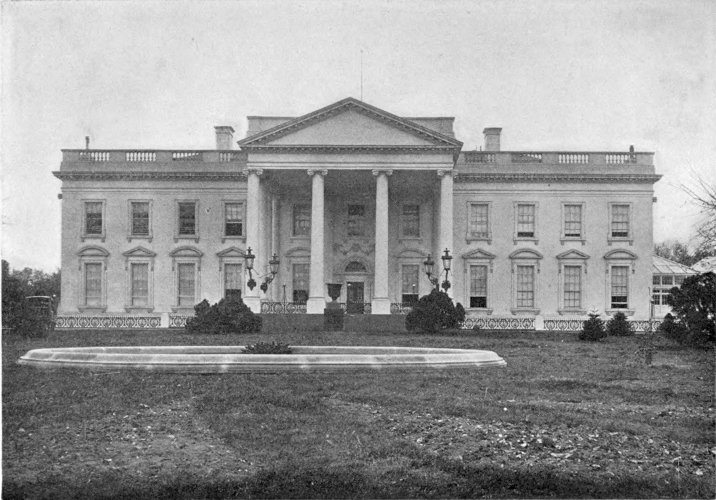
THE WHITE HOUSE, WASHINGTON
Little or nothing was done to make the Executive Mansion more sumptuous during either Jefferson’s or Madison’s administrations; and it must have been a surprise to visitors from other parts of the world to see such a simple dwelling. Writing home in 1804, Thomas Moore says: “The President’s house is encircled by a very rude pale, through which a common rustic stile introduced visitors.”
The Madisons, whose home it became in 1809, were noted for the old-fashioned Virginia hospitality that they extended to those invited to both public and private entertainments. The famous Dolly Madison was a gracious hostess, and her abundant table did not escape criticism.
The Madisons were compelled to flee from the house on the approach of the British troops in 1814. Many stories are told of how Mrs. Madison saved the valued portrait of Washington that had been hanging in the State Dining-Room since 1800; but her own is the best. Mrs. Madison did not cut the picture from the frame as the legend has it, but ordered this to be done. Just before her flight, she writes to her sister on the 23d of August, 1814:
“My husband left me yesterday morning to join General Winder. He inquired anxiously whether I had courage or firmness to remain in the President’s House until his return on the morrow, or succeeding day, and on my assurance that I had no fear but for him, and the success of our army, he left, beseeching me to take care of myself, and of the Cabinet papers, public and private. I have since received two despatches from him written with a pencil. The last is alarming, because he desires I should be ready at a moment’s warning to enter my carriage and leave the city; that the enemy seemed stronger than had at first been reported, and it might happen that they would reach the city with the intention of destroying it. I am accordingly ready; I have pressed as many Cabinet papers into trunks as to fill one carriage; our private property must be sacrificed, as it is impossible to procure wagons for its transportation. I am determined not to go myself until I see Mr. Madison safe so that he can accompany me, as I hear of much hostility towards him.”
After the Battle of Bladensburg, she continues:
“Our kind friend Mr. Carroll has come to hasten my departure, and in a very bad humour with me, because I insist on waiting until the large picture of General Washington is secured, and it requires to be unscrewed from the wall. The process was found too tedious for these perilous moments; I have ordered the frame to be broken and the canvas taken out. It is done! and the precious portrait placed in the hands of two gentlemen from New York for safe keeping. And now, dear sister, I must leave the house, or the retreating army will make me a prisoner in it by filling up the road I am directed to take. Where I shall again write to you, or where I shall be to-morrow I cannot tell!
Dolly.”
The British troops entered the Mansion and set fire to it. “I have indeed to this hour,” wrote an eye-witness in 1855, “the vivid impression upon my eye of columns of smoke and flame ascending all through the night of August 24, 1814, from the Capitol, President’s house and other public buildings, as if the whole were on fire, some burning slowly others with bursts of flames, and sparks mounting high in the dark heavens.”
This spectator was with President Madison, the Secretary of the Navy and others across the river, watching the spectacle.
After the fire of 1814, the Madisons lived in rented houses in Washington.
When the Mansion was partially restored and again made habitable, the blackened exterior was painted white and the building received the name White House in honour of Mrs. Washington’s early home in Virginia. President and Mrs. Monroe held the first public reception in 1818, on New Year’s Day.
The White House was refurnished in 1825, for the visit of General Lafayette. Congress allowed John Quincy Adams $14,000 for this purpose. Another allowance of $13,000 was made to Martin Van Buren for further decorations and furnishings, and President Johnson was allowed $30,000 to repair the building after the Civil War.
The portico on the North Side was added in President Jackson’s time.
The most important changes, however, have taken place during President Roosevelt’s administration. About half a million dollars have been spent in making architectural improvements, both within and without. A terrace has been added on the west side, leading to the executive offices, and by the removal of the conservatory, the state dining-room has been enlarged. This room has also been refurnished with panels, tapestries and trophies of the chase.
The historical rooms are the great “East Room,” where the public receptions are held and where the brilliant marriages of Nelly Grant and Alice Roosevelt took place; the “State-Dining-room”; the “Red Room,” the “Blue Room” and the “Green Room”; and although the furniture and draperies of these rooms have been changed from time to time, the colours have been rigidly adhered to.
The “Blue Room,” of which Jefferson was particularly fond, is the President’s reception-room. It is oval in shape. At present the walls are covered with blue silk and the window curtains are blue sprinkled with golden stars.
Scattered through the various rooms are many portraits of the Presidents and their wives.
The conservatory of the White House, which owes much to President Grant, has always been noted, and supplies choice flowers and plants for the state dinners and other important entertainments.
The White House is full of memories and associations of the public and private life of the Presidents. Weddings, funerals, and births have occurred here. Within its walls President Lincoln signed the Proclamation of Emancipation. Here Garfield languished for weeks after his assassination. The last notable event was the wedding of Miss Alice Roosevelt, the President’s daughter, to Mr. Nicholas Longworth,—the most brilliant entertainment that the White House has ever seen.