THE OLD STATE HOUSE, BOSTON[23] EDWARD G. PORTER
Reading edition
THE OLD STATE HOUSE, BOSTON[23] EDWARD G. PORTER
The Old State House stands upon the site of the original market-place, opposite the first meeting-house in which, for a quarter of a century, the town-meetings were held, according to the custom of the time.
In the year 1656 Captain Robert Keayne, one of the founders of the Ancient and Honourable Artillery Company, left, in his voluminous and eccentric will, “the sum of three hundred pounds, current money,” for a Town House, which was to furnish room for the market, as well as for the courts, a library, an exchange, an armoury, etc. An equal amount was contributed by citizens, and a wooden structure was erected on this spot which served the purposes of the town until it was destroyed in the great fire of 1711. There are good descriptions extant of this first building, but no pictures or plans. It was the scene of the administration of Endicott, Bellingham, Leverett, Bradstreet, Andros, Phips, Stoughton, Bellomont, and Joseph Dudley. By this time the Town House had become such a necessity that its successor was immediately provided for, one-half the expenses being borne by the Province, and the other half by the Town and the Country in equal proportion.
The first Governor who presided in this building was Joseph Dudley, and after him came Tailer, Shute, Dummer, Burnet, Belcher, and Shirley. It was during the latter’s brilliant administration that the famous expedition against Louisburg was planned and successfully carried out in 1746 under General (afterwards Sir William Pepperell) and Commodore Warren.
The following year the Town House (at that time commonly called the Court House) was seriously injured by fire, which began in the second story and destroyed much of the interior, and nearly all the records, pictures and furniture. The building, however, was reconstructed very much as before; and from that day to this, no essential changes have taken place in its appearance.
An interesting description of it is found in a journal dated 1750:—
“They have also a Town House, built of brick, situated in King’s Street. It’s a very Grand Brick Building, Arch’d all Round and Two Storie Heigh, Sash’d above; its Lower Part is always open, design’d as a Change, tho the Merchants in Fair Weather make their Change in the Open Street, at the eastermost end. In the Upper Story are the Council and Assembly Chambers. It has a neat Capulo, Sash’d all Round, which on rejoycing days is Elluminated.”
The administrations of Pownall, Bernard, and Hutchinson bring us to the stirring events immediately preceding the Revolutionary War. At that time many eyes were turned to this building in hope or fear, as the scene of the royal authority in the Council Chamber, and of the popular demands for Liberty in the Hall of Representatives. The obnoxious measures of the Crown, which followed so rapidly upon the accession of George III. in 1760, were here officially promulgated by the Governors, and vehemently denounced by the patriots.
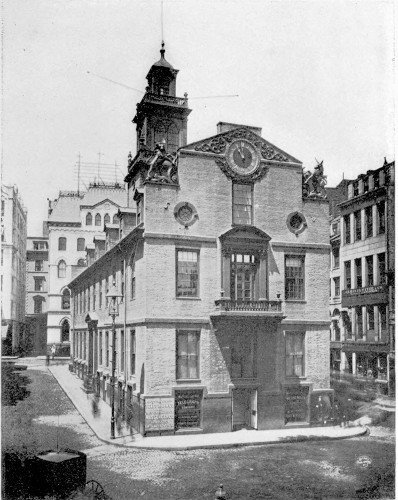
OLD STATE HOUSE, BOSTON
The collision which finally came in 1775, was foreshadowed in the speeches of James Otis and Samuel Adams, in the protests of the Legislature against the unjust imposition of taxes, in the arrival of the British regiments, and in the massacre of March 5, 1770, which occurred almost under the windows of the Council Chamber.
The quartering of troops in the Town House and the planting of cannon at its doors gave great offence to the people, and served only to increase the difficulty. Under General Gage, the last of the Royal Governors, were developed those military movements which made Lexington, Concord and Bunker Hill immortal, and which led to the organization of an American army, by whose achievements the British were compelled to evacuate Boston on the 17th of March, 1776.
In July of the same year, the Declaration of Independence was read to the citizens of Boston from the famous east window of the Council Chamber, where in the earlier time the Royal succession had been in three instances proclaimed “with Beat of Drum and Blast of Trumpet,” and where also had been announced in turn the appointment of eight governors of Massachusetts under the Crown, and where at last, in 1783, the Proclamation of Peace was read by the Sheriff of Suffolk, amid the grateful shouts of the multitude and the salutes of thirteen cannon at the forts.
In this building John Hancock was inaugurated the first Governor under the Commonwealth; and here presided his successors, James Bowdoin, Samuel Adams, and Increase Sumner. In 1789, General Washington, during his last visit to Boston, reviewed the procession from a temporary balcony erected at the west end of the Hall of Representatives.
Here the Legislature of Massachusetts met for the last time in 1798, and then marched in a body to the more imposing structure which had just been completed on Beacon Hill.
The old building has since then been given up to business purposes, except during an interval of ten years, 1830–1839, when it was occupied by the municipality as a City Hall.
In 1882, it was carefully restored and formally re-dedicated to the public use as a memorial hall. The second floor, containing the ancient Council Chamber and Representatives Hall, has been confided to the custody of the Bostonian Society for a term of years. Valuable portraits, engravings, documents, and other historical relics may here be inspected daily by the public without charge. The tower, the quaint roof, the lion and unicorn, the central stairway, and, in fact, all the details of the building, present with almost absolute accuracy the characteristic features of the old Town House of the fathers. And it is confidently believed that the venerable structure will continue to grow more and more in the affections of the people of Boston, because it was here that “the child Independence was born.”