CHRIST CHURCH, ALEXANDRIA BISHOP MEADE
Reading edition
The town of Alexandria was at first called Hunting Creek Warehouse, sometimes Belle Haven, and consisted of a small establishment at that place. Its growth was encouraged by successive acts of the Legislature, establishing semi-annual fairs and granting certain privileges to those who attended them. In the year 1762, it was enlarged by the laying off of numerous lots on the higher ground, belonging to Dade, West and the Alexanders, after which it improved rapidly, so that at the close of the Eighteenth or beginning of the Nineteenth Century its population was ten thousand, and its commerce greater than it now is. So promising was it at the close of the war, that its claims were weighed in the balance with those of Washington as the seat of National Government. It is thought that, but for the unwillingness of Washington to seem partial to Virginia, Alexandria would have been the chosen spot, and that on the first range of hills overlooking the town the public buildings would have been erected. Whether there had been any public worship or church at Alexandria previous to this enlargement of it, and the great impulse thus given to it, does not appear from the vestry-book, though it is believed that there was. But soon after this, in the year 1764, Fairfax parish is established, and measures taken for the promotion of the Church in this place. The vestry book commences in 1765. At one time there were two churches in the new parish of Fairfax—one at the Falls, called, as the present one is Little Falls Church; the position of the other—the Lower Church—is not known. It may have been an old one at Alexandria.
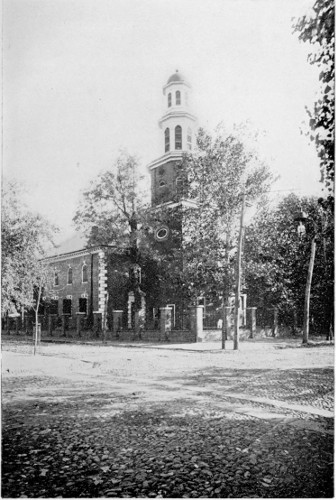
OLD CHRIST CHURCH, ALEXANDRIA, VA.
Among the first acts of the vestry was the repairing of the two old churches in the parish, at a cost of more than thirty-two thousand pounds of tobacco. In the year 1766, it is determined to build two new churches,—one at the Little Falls, very near the old one, and one in Alexandria, to contain twenty-four hundred square feet and to be high-pitched so as to admit of galleries. Mr. James Wrenn agrees to build the former, and Mr. James Parsons the other, for about six hundred pounds each. A most particular contract is made for them. The mortar is to have two-thirds of lime and one of sand,—the very reverse of the proportion at this day, and which accounts for the greater durability of ancient walls. The shingles were to be of the best cypress or juniper, and three-quarters of an inch thick, instead of our present half-inch ones. Mr. Parsons was allowed to add ten feet to the upper part of the church on his own account, and to pay himself by their sale, on certain conditions. He commenced his work, but was unable to finish it. It lingered for some years, until in 1772, Mr. John Carlisle undertakes it, and completes it in 1773. The ten pews are now sold, and General Washington, though having just been engaged in the erection of Mount Vernon Church, which was finished the same year, and having a pew therein, gives the highest price for one in Christ Church, which was occupied by him and his family during his life, and has been by some of his name ever since. The gallery was not put up until the year 1787, at which time the pews were balloted for. The steeple is of modern construction.
Christ Church stands on Cameron and Washington Streets in a pretty green churchyard, where in 1774, Washington addressed the citizens advocating resistance to Great Britain; and it was on the spot also that General Lee agreed to take command of the Virginia forces at the beginning of the Civil War in 1861.
Washington attended Christ Church regularly, and his pew is still shown. Unfortunately, the old high backed pews were cut down a few years ago at the instance of the rector of an important church in Washington. Washington always drove from Mount Vernon to Alexandria in a handsome cream-coloured coach, the body of which was suspended by heavy leather straps. The sides and front were shaded with green blinds and black leather outside curtains. The lining of the coach was black leather; the Washington arms were painted on the doors and a picture of the seasons was also painted on each of the four panels. Four horses were ordinarily harnessed to this coach except when six were required for long journeys. What became of this coach we learn from Bishop Meade, who says:
“There was one object of interest belonging to General Washington, concerning which I have a special right to speak,—viz.: his old English coach, in which himself and Mrs. Washington not only rode in Fairfax County, but travelled through the length and breadth of our land. So faithfully was it executed that, at the conclusion of this long journey, its builder, who came over with it and settled in Alexandria, was proud to be told by the General that not a nail or screw had failed. It so happened, in a way I need not state, that this coach came into my hands about fifteen years after the death of General Washington. In the course of time, from disuse, it being too heavy for these latter days, it began to decay and give way. Becoming an object of desire to those who delight in relics, I caused it to be taken to pieces and distributed among the admiring friends of Washington who visited my house, and also among a number of female associations for benevolent and religious objects, which associations, at their fairs and other occasions, made a large profit by converting the fragments into walking-sticks, picture-frames, and snuff-boxes. About two-thirds of one of the wheels thus produced one hundred and forty dollars. There can be no doubt but that at its dissolution it yielded more to the cause of charity than it did to its builder at its first erection. Besides other mementos of it, I have in my study, in the form of a sofa, the hind-seat, on which the General and his lady were wont to sit.”—E. S.