THE OLD WITCH HOUSE, SALEM ESTHER SINGLETON
Reading edition
On the corner of Essex and North Streets, in Salem, there stands a house that attracts many visitors, although it is neither picturesque nor impressive. “The Old Witch House,” however, appeals to the imagination, recalling one of the darkest chapters in the history of this country,—the witchcraft mania of the Seventeenth Century.
This belief, transplanted from the Old Country, flourished luxuriantly under the dark shadow of Puritanism. Although witchcraft was believed in throughout the Middle Ages, the witch-mania proper begins in 1484 when Innocent VIII. gave the sanction of the Church to the prosecution of all who were believed to practice sorcery; and soon after this the famous Malleus Maleficarum, or Hammer for Witches was drawn up by two German inquisitors and a clergyman of Constance. In this book witchcraft is described and a code for the trial of witches systematized. Fires for burning witches blazed in nearly every town on the Continent for nearly four centuries. In Germany the persecutions were frightful, and in Geneva five hundred persons were burned in three months in 1515–1516! The witch-mania was rampant in England and Scotland, where in the Seventeenth Century a horrible class called “witch finders” went from town to town, where, for the small fee of twenty shillings, they discovered witches, subjecting innocent persons—the old, the young, the attractive and unattractive, the infirm and the ill, as well as the hale and hearty—to most inane tests and cruel tortures till they confessed themselves bewitched. It is said that the greatest number of legal executions in England took place during the sitting of the Long Parliament (1640–1660), when three thousand persons were put to death. This figure, however, does not include those poor creatures who suffered death at the hands of the mob.
This witch-mania had, in great measure, abated at home when it broke out in the British Colonies in America. A few trials occurred in Maryland and Virginia and a few persons were hung in Connecticut; but Massachusetts was the soil most favourable to the growth of this terrible delusion. Salem has the distinction of having sent the greatest number of victims to their unjust doom. The town became panic-stricken and no one was safe. An historian writes:
“So violent was the popular prejudice against every appearance of witchcraft, that it was deemed meritorious to denounce all that gave the least reason for suspicion. Every child and every gossip was prepared to recognize a witch, and no one could be certain of personal safety. As the infatuation increased, many of the most reputable females, and several males also, were apprehended and committed to prison. There is good reason to believe that, in some instances, the vicious and abandoned availed themselves of gratifying their corrupt passions of envy, malice and revenge.”
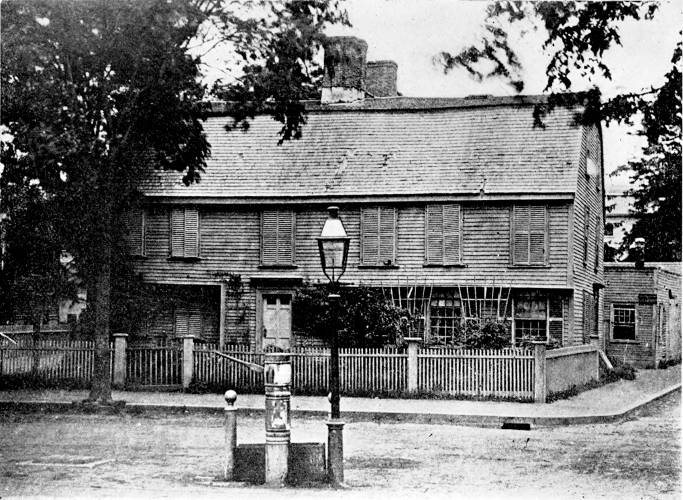
THE OLD WITCH HOUSE, SALEM
A graphic description of the Salem horrors is given in Old Naumkeag, by Webber and Nevins (Salem, 1877):
“Salem witchcraft commenced during the month of February, 1692, at the house of the Rev. Samuel Parris, in that part of the original town, which is now Danvers. The daughter of Mr. Parris and his niece Abigail Williams, aged nine and twelve years respectively, began to act ‘in a strange and unusual manner.’ They would utter loud and piteous cries, creep into holes, hide under benches and put themselves into odd postures. The physicians pronounced them bewitched, and all the ministers were invited to meet at Mr. Parris’s house, and unite with him in solemn religious services. As the interest in their actions increased, they became more violent, and accused Tituba, a South American slave in the Parris family, of having bewitched them. Mr. Parris beat Tituba and compelled her to acknowledge herself guilty. These children next complained of Sarah Goode and Sarah Osborne, and then of two other women of excellent character, Corey and Nurse. All were thrown into prison. John, Tituba’s husband, for his own safety, accused others. The demon was thus let loose in the midst of the people, but it was the demon of superstition rather than the demon of witchery.”
The following list of those who were executed is also taken from the same authorities:
“Rev. Geo. Burroughs, of Wells, Maine; Wilmot Reed, of Marblehead; Margaret Scot, of Rowley; Susanna Martin, of Amesbury; Elizabeth Howe, of Ipswich; Sarah Wildes and Mary Estes, of Topsfield; Samuel Wardwell, Martha Currier and Mary Parker, of Andover; John Proctor, Geo. Jacobs, Sen., John Willard, Sarah Goode, Rebecca Nurse, Giles Corey and Martha Corey of Salem Village, Ann Pudeater, Bridget Bishop and Alice Parker, of Salem.
“Corey was pressed to death, because he refused to speak, knowing that speech would avail him nothing. His tongue was pressed out of his mouth, but was forced in again by the sheriff with his cane. About 150 persons in all were accused of witchcraft, including nine children varying from five to fourteen years.
“Various were the accusations brought against them, such as having familiarity with ‘the black man,’ who it was claimed was ever by their side whispering in their ear; holding days of hellish fasts and thanksgivings; eating red bread and drinking blood; transforming themselves and their victims into various forms; signing contracts with Satan; entering his employ and yielding to his commands; afflicting others by pinching, pricking with pins, striking, etc., while many miles distant; and divers other accusations that would be laughed to scorn at the present day. All matters of affliction or of discord among the people, such as a controversy respecting the settlement of a minister, which had for a time been going on; also the death of some of the most influential of the citizens, were attributed to Satanic influences. With such inflammable matter, in an age of superstition, the result is not to be wondered at.
“Cotton Mather, one of the most learned ministers of that time, led in the preaching to the people of sermons designed to inflame rather than abate the panic. He adopted the doctrine of demons, and was exceedingly energetic in endeavouring to spread the delusion into other parts of the Colony. To him is largely ascribed the extent of the calamity.”
Victims were quickly dragged to “Witch Hill,” after being quickly convicted. It is said that many speedy and informal trials took place in the “Witch House,” which was in 1692 the residence of the intolerant Judge Corwin.
Dr. Bentley says:
“From March to August, 1692, was the most distressing time Salem ever knew: business was interrupted, the town deserted, terror was in every countenance and distress in every heart. Every place was the subject of some direful tale, fear haunted every street, melancholy dwelt in silence in every place after the sun retired. The population was diminished, business could not for some time recover its former channels, and the innocent suffered with the guilty. But as soon as the judges ceased to condemn, the people ceased to accuse. Terror at the violence and the guilt of the proceedings, succeeded instantly to the conviction of blind zeal, and what every man had encouraged, all now professed to abhor. Every expression of sorrow was found in Salem. The church erased all the ignominy they had attached to the dead, by recording a most humble acknowledgment of their error. But a diminished population, the injury done to religion and the distress of the aggrieved were seen and felt with the greatest sorrow.”
When the authorities finally realized their error, all the victims locked up in the Salem prison were discharged without trial, and those suspected persons who had fled to other towns for safety were permitted to return to their homes without fear of being molested.
Regarding this outbreak in Salem, James Russell Lowell writes:
“Credulity, as a mental and moral phenomenon, manifests itself in widely different ways, according as it chances to be the daughter of fancy or terror. The one lies warm about the heart as Folk-lore, fills moonlit dells with dancing fairies, sets out a meal for the Brownie, hears the tinkle of airy bridle-bells as Tamlane rides away with the Queen of Dreams, changes Pluto and Proserpine into Oberon and Titania, and makes friends with unseen powers as Good Folk; the other is a bird of night, whose shadow sends a chill among the roots of the hair; it sucks with the vampire, gorges with the ghoul, is choked by the night-hag, pines away under the witches’ charm, and commits uncleanness with the embodied Principle of Evil, giving up the fair realm of innocent belief to a murky throng from the slums and stews of the debauched brain....
“The Puritan emigration to New England took place at a time when the belief in diabolic agency had been hardly called in question, much less shaken. They brought it with them to a country in every way fitted, not only to keep it alive, but to feed it into greater vigour. The solitude of the wilderness (and solitude alone by dis-furnishing the brain of its commonplace associations, makes it an apt theatre for the delusions of imagination), the nightly forest noises, the glimpse, perhaps, through the leaves, of a painted savage face, uncertain whether of redman or Devil, but more likely of the latter, above all, that measureless mystery of the unknown and conjectural stretching away illimitable on all sides and vexing the mind, somewhat as physical darkness does, with intimation and misgiving,—under all these influences, whatever seeds of superstition had in any way got over from the Old World would find an only too congenial soil in the New. The leaders of that emigration believed and taught that demons loved to dwell in waste and wooded places, that the Indians did homage to the bodily presence of the Devil, and that he was especially enraged against those who had planted an outpost of the true faith upon this continent hitherto all his own. In the third generation of the settlement, in proportion as living faith decayed, the clergy insisted all the more strongly on the traditions of the elders, and as they all placed the sources of goodness and religion in some inaccessible Other World rather than in the soul of man himself, they clung to every shred of the supernatural as proof of the existence of that Other World, and of its interest in the affairs of this. They had the countenance of all the great theologians, Catholic as well as Protestant, of the leaders of the Reformation, and in their own day of such men as More and Glanvil and Baxter. If to these causes, more or less operative in 1692, we add the harassing excitement of an Indian war (urged on by Satan in his hatred of the churches), with its daily and nightly apprehensions and alarms, we shall be less astonished that the delusion in Salem Village rose so high than that it subsided so soon.”
The “Old Witch House” that forms the subject of our sketch was originally the home of Roger Williams while he was preaching in Salem in 1635–1636. From it he fled to the shores of Narraganset Bay, where he founded the Colony of Rhode Island. Its next occupant was Captain Richard Davenport who cut the cross from the King’s colours because “it savoured of Popery.” In 1674 or 1675, Judge Corwin of witchcraft fame took possession and made many alterations. Before his day the old house presented a more attractive appearance, resembling many houses of this period still standing in England. In its original state, it was composed of several overhanging stories, each larger than the one below and the roof was broken into several peaked gables, each of which was ornamented with a pineapple of carved wood. Narrow windows with lozenge-shaped panes added to its quaintness. More alterations were made in 1746 and 1772, and all feeling of picturesqueness has vanished completely.