MONTICELLO[14] EDWARD C. MEAD
Reading edition
MONTICELLO[14] EDWARD C. MEAD
Next to Mount Vernon, doubtless there is no place in the Union that has been more written of or more visited than Monticello, the beautiful home of President Jefferson; and yet of the many who have visited this historic spot and the much that has been said of it, few are aware of the true story connected with the building of this celebrated mansion.
Many legends and marvellous tales are told the stranger who treads its portals, few of which are based upon fact; yet there remain many incidents untold which would add an interesting page to its history, which we propose to gather up and trace the true story of its erection from its inception to its completion.
Colonel Peter Jefferson, the father of Thomas Jefferson, and William Randolph, both of Goochland County, Virginia, were very close friends and neighbours. In 1735 both obtained “patents” for large grants of land lying contiguous to each other, and ever since their descendants have intermarried and maintained this juxtaposition.
Colonel Peter Jefferson had thus obtained by grant one thousand acres lying on each side of the Rivanna River, where it intersects the South-West range of mountains; to this he added by purchase nine hundred acres, making a total of nineteen hundred acres of land on each side of the river, which embraced the little towns of Shadwell on the north and Milton on the south.
In 1770, Mr. Jefferson, who was then a young practising lawyer, first began to clear the summit of Monticello (Italian for “little mountain”), with a view of building. It was then merely a wild, tangled forest, but he had often looked upon this elevated spot with peculiar attraction, and had frequently rambled over its steep, craggy sides, or clambered to its summit, there to gaze upon the grand panoramic view spread out before him with feelings of sublime admiration and intense delight; it was such a picture as he wished always before him, and thus it was he decided here to build his home.
After the destruction by fire of the paternal roof at Shadwell, Mr. Jefferson began in earnest to build upon this almost inaccessible spot, and in the fall of that year (1770) had erected a small one-and-a-half story brick building, containing one good-sized room, which is the same portion of the present building forming the south-east “pavilion” at the extremity of the south “terrace”; this room was the only part of the house habitable when he took his young bride there in 1772.
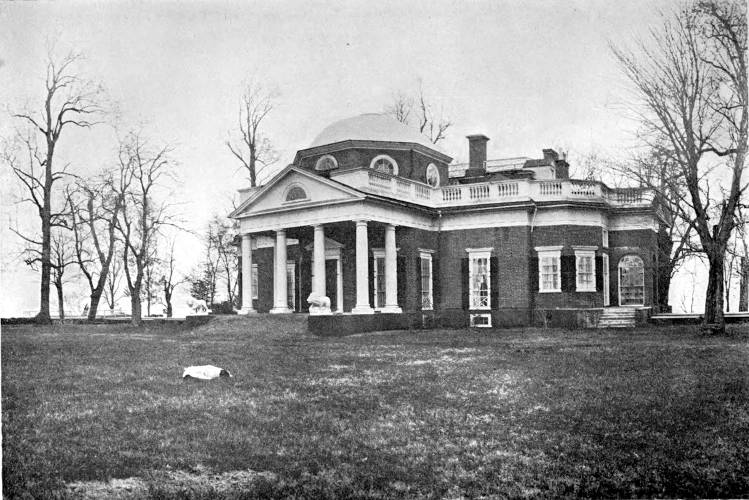
MONTICELLO, VIRGINIA
Mr. Jefferson’s conception and designs for building his new home were not so elaborate or extensive as were afterwards carried out upon his return from Europe. He was very conventional in his style and manner of living, not wishing to go beyond the simplicity of his neighbours, even in his plan of building, and yet there was at that time not another brick building outside the town of Charlottesville, and though of quite moderate proportions compared to its ultimate appearance, it was then considered the most imposing building in the county.
The belief that Mr. Jefferson imported from England most of the brick used for his building is quite erroneous; all these were made upon the spot by his slaves, and the site of their manufacture is still pointed out; but in after years, when completing the north end and adding many embellishments to his original design, some of the finest brick and ornamental material were procured in Philadelphia and sent around by water to Richmond, and thence to the little town of Milton.
In the autumn of 1775, still further additions were made, and the grounds greatly improved and enlarged, Mr. Jefferson planting with his own hands many fruit and ornamental trees, the trunks of which still remain.
During the sessions of Congress, while Mr. Jefferson would be absent from Monticello for months at a time, the work of completion would be necessarily slow, and even up to the year 1782 the house was but partially completed. Still more did that part which had already been built suffer much from delay during his sojourn in France as ambassador. It was not until Mr. Jefferson’s return in 1794, that real active work was resumed, and he applied himself enthusiastically once more to the early completion of his design.
His intention now was to build another wing, one story and a half high, both to be united and crowned with a balustrade, having a dome between them, the apartments to be large and convenient, the decorations within and without to be simple, yet regular and elegant.
Mr. Jefferson had already erected a saw-mill, a grist-mill and a nail-factory, where every nail for the building was hand-forged by his coloured boys. Many of his artisans had been brought with him from Europe, and with all the material at hand the work now progressed rapidly.
The story that Mr. Jefferson laboured upon the building and laid many of the brick with his own hand is erroneous. He was always fond of working in his “shop,” where in this “mechanical retreat,” which stood at the rear of the house, he would put to a practical test his theories and exercising his inventive genius; but he never laboured in the real sense of the word except for his own gratification and pleasure, or to set an example of industry to those around him.
In 1802, the Monticello mansion was considered completed. The expense had been very great for those times, which, Mr. Jefferson states, was exactly two thousand and seventy-six dollars and twenty-nine cents, while he was away at Washington, besides the large sums he had previously spent upon it.
Thus it had taken nearly thirty years to build this historic old edifice, a building which could now be erected in six months under our present rapid mode of construction.
Let us glance for a moment at this curious structure as it then stood, fresh from the hands of the illustrious architect, for Mr. Jefferson had designed each part most minutely himself.
Entering from the eastern portico with its lofty Corinthian pillars and arched door, over which is still seen the old English clock which marked the hours, the visitor is here met and ushered through large, double glass doors into a spacious semi-octagonal hall with its wide fireplace at one end, as is usually found in old English mansions. Opposite the door is a small gallery, while on one side of it stood a fine marble bust of the patriot himself, and on the other one of Washington, both by the celebrated Italian artist Carracci. Along each side of the hall were many Indian relics which Mr. Jefferson had collected.
From this hall opens another glass door leading into the drawing-room or salon being the largest and most handsome room in the house, and situated immediately under the dome. This room is also octagonal, its floor being laid in parquetry of octagonal blocks of different coloured wood, which were cut and fitted by his own coloured workmen, giving it a most unique and pleasing effect and which for skill challenges the genius of a more intelligent race. The walls of this stately room were adorned with portraits of Columbus, Vespucius, Andrew Doria, Castruccio-Castracani, Raleigh, Cortez, Bacon, Newton, Locke, Washington, Adams, Madison and Monroe, while on either side of the door stood the busts of Alexander and Napoleon.
Leading from this room on the west side was the dining-room, and beyond this the octagonal tea-room. Here were to be seen busts of Franklin, Voltaire, Lafayette and Paul Jones. Adjoining this were the bedrooms for guests, while on the east of the entrance hall was the bedroom of Mrs. Martha Randolph, who resided there permanently after the death of Mrs. Jefferson.
Mr. Jefferson’s bedroom was next to that of Mrs. Randolph, beyond which was his library, which extended to the west side of the house, and from which led into an arched conservatory; beyond this was Mr. Jefferson’s celebrated workshop.
The upper part of the house was gained by a very narrow, tortuous stairway; the rooms above were quite small, of low pitch, and badly lighted, or ventilated; all of them were of many shapes, in conformity to the octagonal design of the house; alcoves let into the wall served in the place of bedsteads, their small dimensions being hardly suited to the comfortable repose of an ordinary-sized person.
The dome over the parlour was covered with thick glass; this was called the “ladies’ drawing-room,” which at one time was used as a billiard-room until the laws of Virginia prohibited the game. It was also said to have been used as a “ballroom”; but it is safe to say that Mr. Jefferson never had a dancing-party in his house, though extremely fond of music and even had his daughter taught the graceful art.
The furniture throughout was very handsome, most of which was purchased in France and used while living in Philadelphia. The beautiful marble and brazier tables, French mirrors and elegant sofas of the court style of Louis XVI. gave a charming and effective contrast to the artistic finish of the interior; while the many rich paintings, statuary and works of art gave a sense of regal splendour which amazed the many plain and simple Virginians who thronged the mansion.
Governor Gilmer of Georgia, who was a frequent and familiar visitor, thus describes Monticello during Mr. Jefferson’s last term of office:
“Three rooms of the house were left open for visitors. I saw statuary, fine paintings and a collection of Indian relics. The statuary was very beautiful; I could not be satisfied with looking at it. Mr. Jefferson’s library door was locked, but the window-blinds were thrown back, so that I could see several books turned open upon the table, the inkstand, paper and pens as they had been used when Mr. Jefferson quitted home.”
On top of the dome, Mr. Jefferson had his observatory, being a simple platform surrounded by a balustrade. Here he would often sit, night and day, surveying the heavens or the vast expanse of scenery before him with his telescope.
The famous mill-factory, machine-shops and weaving rooms were to the south-east of the house, beyond which was the terraced garden in which he delighted to exhibit his horticultural products. The farm itself had not been cleared to any great extent around the mansion, most of the crops being raised on the north side of the river at Shadwell and upon the Tufton farm near Milton.
Thus we find the farm and mansion of Monticello in 1809, upon the retirement of Mr. Jefferson from the Presidency. But it was not to gain repose, for he was followed to his beautiful mountain home by a host of admirers and visitors, and but for the records left us, it was scarcely possible to believe the extent to which the imposition upon his privacy by friends, kindred and the public generally was carried at this time. They would come singly and in families, bringing babies, nurses, drivers and horses, spending weeks and even months at a time, giving the place an appearance of some noted watering rendezvous. Here would be gathered students, savants, musicians, clergymen, members of Congress, foreign travellers, artists and men of every faith and political creed to gratify their curiosity and say that they had seen and heard Mr. Jefferson. In one instance a family of six from Europe remained ten months; on another occasion a lady broke a pane of glass with her parasol in her eagerness to get a glimpse of the President. Crowds would stand about the house for hours watching for his exit, until Mr. Jefferson in desperation would fly to his farm, Poplar Forest, in Bedford County, for repose, expressing truly his feelings when he said: “Political honours are but splendid torments.”
At various times there were also many celebrated visitors to Monticello, who have left their record of the place as it then appeared; among these were the Duke de Liancourt, a distinguished French traveller, who, in 1796, remained several days; the Marquis de Chastellux, aide to General Lafayette; Lieutenant Hall of the English army in 1816; and William Wirt, the historian, the friend and frequent visitor of Jefferson. All these have given graphic descriptions of this celebrated spot, some in language most illusive, for it is hardly possible for the eye to reach the Chesapeake Bay, the Atlantic Ocean, or even to the James River, nor can the lofty hills of Maryland or the Peaks of Otter be seen, yet the view is grand, majestic and inspiring,—the same which Mr. Jefferson gazed upon with delight, and which has been the theme of poets and historians since, and ever more to be the admiration of thousands who make their pilgrimage to this shrine of America’s freedom.
Thus stood Monticello at the close of Mr. Jefferson’s life in 1826. It was known at this time that he was deeply involved in debt,—one partially made in entertaining his numerous guests,—in consequence of which his entire estate was soon afterwards offered for sale by his grandson and executor, Colonel Thomas Jefferson Randolph, of Edgehill. Mr. Jefferson had truly rendered himself poor when he built Monticello. The Italians brought over to do the ornamental work proved most expensive, and his friends had literally “ate him out of house and home”; so of his once large estate of ten thousand acres very little remained besides the mansion and its contents, he having previously sold, in 1776, lands to the amount of twenty thousand dollars in the hope of stemming the incoming tide of insolvency.
About the year 1828, Commodore Uriah P. Levy, of the United States Navy, who had known and greatly admired Jefferson, secured the mansion with four hundred acres of the Monticello tract. In purchasing the place he designed to preserve it in the same condition, and carry out the plans of the great patriot himself for its adornment; and still further, in honour of his memory, he erected a handsome statue to him in the City Hall at New York.
Commodore Levy presided most gracefully over the halls of Monticello, and fittingly maintained its just celebrity for hospitality. After the death of Commodore Levy the estate descended to his nephew, the Hon. Jefferson M. Levy, of New York, its present owner.
During the Civil War it was confiscated by the Confederate Government and fell into rapid decay; at one time being used as a hospital, after which it was rented to unscrupulous parties, who allowed it to be sadly pillaged. After the war it was not difficult for Mr. Levy to regain possession, who at once began its restoration and to-day it stands complete, and perhaps far more beautiful than even in Jefferson’s time.
Let us picture Monticello as it now stands, after a lapse of nearly seventy years, still sitting in all its majestic pride and grandeur upon its lofty eminence, while so many of the great, the good and the gifted who once graced its halls have passed away forever.
Instead of a steep rough road, filled with rocks and gullies, upon which vehicles would once frequently stall, the visitor can now drive from the city of Charlottesville over a smooth and easily graded road, which winds gracefully around Carter’s Mountain, bringing the traveller to the “Notch,” or first summit, almost before he realizes it. Here stands the porter’s lodge, with artistic double gate, through which vehicles enter upon the Monticello domain proper, and begin to ascend the Little Mountain, upon which the mansion sits a mile above. The same smooth road, bordered by a stone wall, winds along its rugged sides until the cemetery is reached, which stands midway to the summit.
This is the spot chosen by Jefferson, in 1782, after the death of his wife, Martha Wayles Jefferson, where he wished himself and family to be laid. It is on a gentle slope of the mountain, to the right of the road, surrounded by lofty oaks and pines, with all the solemn beauty and stillness of the primeval forest.
A few hundred yards from the cemetery the entrance to the lawn is reached, and a glimpse of the grand scenery spread below is seen. Keeping to the right, we pass the ruins of the celebrated “nail-factory,” with its solitary chimney festooned with ivy. Farther on, a solitary grave surrounded by a stone wall, marks the resting-place of the mother of Commodore Levy, who died here. Next we come to the “weaving-room,” which is now the manager’s house. Here we are met by a coloured porter, who, though looking quite venerable, does not lay claim to being Mr. Jefferson’s body-servant, though for a few pennies he will tell you some wonderful stories of him, and point out with pride the many objects of interest. Approaching the mansion up the east lawn, the visitor will stand for a moment and glance at the clock over the door and the weather-vane overhead, which had so often been scanned by the great philosopher. Then reverently entering the double glass doors, he will find himself in the famous hall where Jefferson was wont to meet and greet his visitors.
On the right hangs a full-length portrait of Commodore Levy in full naval uniform; it is a majestic and striking picture of this noted officer; while opposite is a model of the Vandalia, the flag-ship in which he sailed around the world. Many other paintings adorn the room which will claim a close and special notice. In the large parlour or salon hangs a full-size portrait of Madam Rachel Levy, the mother of Commodore Levy, who was styled the “American Beauty” while in Europe, a term not inappropriately given if we may judge by the beautiful features before us. The furniture in this room is of the rich antique pattern, to represent the period of Mr. Jefferson’s term as ambassador, while from the ceiling hangs a magnificent chandelier of an old English style for candles. A similar one hangs in the dining-room, both having been imported direct from Europe by Mr. Levy, and are said to have once graced the palace of the Empress Josephine at Malmaison.
The glass doors, the polished floors of parquetry, the antique furniture and ancient portraits, all lend a baronial aspect of the past century in close keeping with its appearance during Mr. Jefferson’s time.
The grounds and exterior appointments are well preserved. Scattered over the rich green lawn are rustic benches, statuary, vases and urns of fragrant plants. Here, beneath stately elms, locust and chestnut-trees, the visitor can sit and feast the eye upon the vast landscape on every side.
Half a dozen English spaniels sport on the green lawn, while upon the steep, craggy side of the mountain eight or ten deer can occasionally be seen, which are parked by a high picket-fence. The rear, or south-west, lawn is equally beautiful: from this point is to be seen the mystical looming of Willis’s Mountain in Buckingham County, forty miles away, which would be usually pointed out by Mr. Jefferson to his visitors; then to stand on the north-west side of the pavilion and view the University, with the city of Charlottesville spread in the valley below in all its peaceful repose and beauty, while far beyond stretches the vast range of the Blue Ridge, embracing an extent of vision nearly fifty miles in length, which forms a picture such as will repay a journey of several thousand miles to behold.