THE OLD MANSE, CONCORD NATHANIEL HAWTHORNE
Reading edition
Between two tall gateposts of rough-hewn stone (the gate itself having fallen from its hinges at some unknown epoch), we beheld the grey front of the old parsonage terminating the vista of an avenue of black ashtrees. It was now a twelvemonth since the funeral procession of the venerable clergyman, its last inhabitant had turned from that gateway towards the village burying ground. The wheel-track leading to the door, as well as the whole breadth of the avenue, was almost overgrown with grass, affording dainty mouthfuls to two or three vagrant cows and an old white horse who had his own living to pick up along the roadside. The glimmering shadows that lay half asleep between the door of the house and the public highway were a kind of spiritual medium, seen through which the edifice had not quite the aspect of belonging to the material world. Certainly it had little in common with those ordinary abodes which stand so imminent upon the road that every passer-by can thrust his head, as it were, into the domestic circle. From these quiet windows the figures of passing travellers looked too remote and dim to disturb the sense of privacy. In its near retirement and accessible seclusion it was the very spot for the residence of a clergyman—a man not estranged from human life, yet enveloped in the midst of it with a veil woven of intermingled gloom and brightness. It was worthy to have been one of the time-honoured parsonages of England, in which, through many generations, a succession of holy occupants pass from youth to age, and bequeath each an inheritance of sanctity to pervade the house and hover over it as with an atmosphere.
Nor, in truth, had the Old Manse ever been profaned by a lay occupant until that memorable summer afternoon when I entered it as my home. A priest had built it; a priest had succeeded to it; other priestly men from time to time had dwelt in it; and children born in its chambers had grown up to assume the priestly character. It was awful to recollect how many sermons must have been written there. The latest inhabitant alone—he by whose translation to paradise the dwelling was left vacant—had penned nearly three thousand discourses, besides the better, if not the greater number that gushed living from his lips. How often, no doubt, had he paced to and fro along the avenue, attuning his meditations to the sighs and gentle murmurs, and deep and solemn peals of the wind among the lofty tops of the trees! In that variety of natural utterances he could find something accordant with every passage of his sermon, were it of tenderness or reverential fear. The boughs over my head seemed shadowy with solemn thoughts as well as with rustling leaves. I took shame to myself for having been so long a writer of idle stories, and ventured to hope that wisdom would descend upon me with the falling leaves of the avenue, and that I should light upon an intellectual treasure in the Old Manse well worth those hoards of long hidden gold which people seek for in moss-grown houses. Profound treatises of morality; a layman’s unprofessional and therefore unprejudiced views of religion; histories (such as Bancroft might have written had he taken up his abode here as he once purposed), bright with picture gleaming over a depth of philosophic thought,—these were the works that might fitly have flowed from such a retirement. In the humblest event, I resolved at least to achieve a novel that should evolve some deep lesson and should possess substance enough to stand alone.
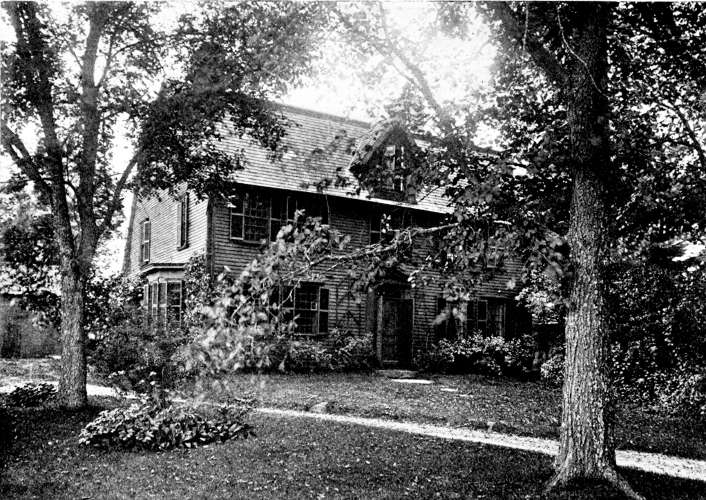
THE OLD MANSE, CONCORD, MASS.
In furtherance of my design, and as if to leave me no pretext for not fulfilling it, there was in the rear of the house the most delightful little nook of a study that ever afforded its snug seclusion to a scholar. It was here that Emerson wrote Nature; for he was then an inhabitant of the Manse, and used to watch the Assyrian dawn and Paphian sunset and moonrise from the summit of our eastern hill. When I first saw the room its walls were blackened with the smoke of unnumbered years, and made still blacker by the grim prints of Puritan ministers that hung around. These worthies looked strangely like bad angels, or at least like men who had wrestled so continually and so sternly with the devil that somewhat of his sooty fierceness had been imparted to their own visages. They had all vanished now; a cheerful coat of paint and golden-tinted paper-hangings lighted up the small apartment; while the shadow of a willow-tree that swept against the overhanging eaves attempered the cheery western sunshine. In place of the grim prints there was the sweet and lovely head of one of Raphael’s Madonnas and two pleasant little pictures of the Lake of Como. The only other decorations were a purple vase of flowers, always fresh, and a bronze one containing graceful ferns. My books (few, and by no means choice; for they were chiefly such waifs as chance had thrown in my way) stood in order about the room, seldom to be disturbed.
The study had three windows, set with little, old-fashioned panes of glass, each with a crack across it. The two on the western side looked, or rather peeped, between the willow branches down into the orchard, with glimpses of the river through the trees. The third, facing northward, commanded a broader view of the river at a spot where its hitherto obscure waters gleam forth into the light of history. It was at this window that the clergyman who then dwelt in the Manse stood watching the outbreak of a long and deadly struggle between two nations; he saw the irregular array of his parishioners on the farther side of the river and the glittering line of the British on the hither bank. He awaited in an agony of suspense the rattle of the musketry. It came, and there needed but a gentle wind to sweep the battle smoke around this quiet house.
I never grew quite acquainted with my habitation till a long spell of sulky rain had confined me beneath its roof. There could not be a more sombre aspect of external nature than as then seen from the windows of my study. The great willow-tree had caught and retained among its leaves a whole cataract of water, to be shaken down at intervals by the frequent gusts of wind. All day long, and for a week together, the rain was drip—drip—dripping and splash—splash—splashing from the eaves, and bubbling and foaming into the tubs beneath the spouts. The old unpainted shingles of the house and out-buildings were black with moisture; and the mosses of ancient growth upon the walls looked green and fresh, as if they were the newest things and afterthought of Time. The usually mirrored surface of the river was blurred by an infinity of raindrops; the whole landscape had a completely water-soaked appearance, conveying the impression that the earth was wet through like a sponge; while the summit of a wooded hill, about a mile distant, was enveloped in a dense mist, where the demon of the tempest seemed to have his abiding-place and to be plotting still direr inclemencies.
Happy the man who in a rainy day can betake himself to a huge garret, stored, like that of the Manse, with lumber that each generation has left behind it from a period before the Revolution. Our garret was an arched hall, dimly illuminated through small and dusty windows; it was but a twilight at the best; and there were nooks, or rather caverns, of deep obscurity, the secrets of which I never learned, being too reverent of their dust and cobwebs. The beams and rafters, roughly hewn and with strips of bark still on them, and the rude masonry of the chimneys, made the garret look wild and uncivilized,—an aspect unlike what was seen elsewhere in the quiet and decorous old house. But on one side there was a little whitewashed apartment which bore the traditionary title of the Saint’s Chamber, because holy men in their youth had slept and studied and prayed there. With its elevated retirement, its one window, its small fireplace, and its closet, convenient for an oratory, it was the very spot where a young man might inspire himself with solemn enthusiasm and cherish saintly dreams. The occupants, at various epochs, had left brief records and ejaculations inscribed upon the walls. There, too, hung a tattered and shrivelled roll of canvas, which on inspection proved to be the forcibly wrought picture of a clergyman in wig, band and gown, holding a Bible in his hand. As I turned his face towards the light he eyed me with an air of authority such as men of his profession seldom assume in our days. The original had been pastor of the parish more than a century ago, a friend of Whitefield, and almost his equal in fervid eloquence. I bowed before the effigy of the dignified divine, and felt as if I had now met face to face with the ghost by whom, as there was reason to apprehend, the Manse was haunted.
Houses of any antiquity in New England are so invariably possessed with spirits that the matter seems hardly worth alluding to. Our ghost used to heave deep sighs in a particular corner of the parlour, as if he were turning over a sermon in the long upper entry,—where, nevertheless, he was invisible in spite of the brilliant moonshine that fell through the eastern window. Not improbably he wished me to edit and publish a selection from a chest full of manuscript discourses that stood in the garret. Once, while Hilliard and other friends sat talking with us in the twilight, there came a rustling noise as of a minister’s silk gown, sweeping through the very midst of the company so closely as almost to brush against the chairs. Still there was nothing visible. A yet stranger business was that of a ghostly servant maid, who used to be heard in the kitchen at deepest midnight, grinding coffee, cooking, ironing,—performing, in short, all kinds of domestic labour,—although no traces of anything accomplished could be detected the next morning. Some neglected duty of her servitude—some ill-starched ministerial band—disturbed the poor damsel in her grave and kept her at work without any wages.
But to return from this digression. A part of my predecessor’s library was stored in the garret—no unfit receptacle indeed for such dreary trash as comprised the greater number of volumes. The old books would have been worth nothing at an auction. In this venerable garret, however, they possessed an interest, quite apart from their literary value, as heirlooms, many of which had been transmitted down through a series of consecrated hands from the days of the mighty Puritan divines. Autographs of famous names were to be seen in faded ink on some of their fly-leaves; and there were marginal observations or interpolated pages closely covered with manuscript in illegible shorthand, perhaps concealing matter of profound truth and wisdom. The world will never be the better for it. A few of the books were Latin folios, written by Catholic authors; others demolished Papistry, as with a sledge-hammer, in plain English. A dissertation on the Book of Job—which only Job himself could have had patience to read—filled at least a score of small thickset quartos, at the rate of two or three volumes to a chapter. Then there was a vast folio body of divinity—too corpulent a body, it might be feared, to comprehend the spiritual element of religion. Volumes of this form dated back two hundred years or more, and were generally bound in black leather, exhibiting precisely such an appearance as we should attribute to books of enchantment. Others equally antique were of a size proper to be carried in the large waistcoat pockets of old times,—diminutive, but as black as their bulkier brethren, and abundantly infused with Greek and Latin quotations. These little old volumes impressed me as if they had been intended for very large ones, but had been unfortunately blighted at an early stage of their growth. The rain pattered upon the roof and the sky gloomed through the dusty garret windows, while I burrowed among these venerable books in search of any living thought which should burn like a coal of fire, or glow like an inextinguishable gem, beneath the dead trumpery that had long hidden it.
By and by, in a little time, the outward world puts on a drear austerity. On some October morning there is a heavy hoar-frost on the grass and along the tops of the fences; and at sunrise the leaves fall from the trees of our avenue without a breath of wind, quietly descending by their own weight. All summer long they have murmured like the noise of waters; they have roared loudly while the branches were wrestling with the thunder gust; they have made music both glad and solemn; they have attuned my thoughts by their quiet sound as I paced to and fro beneath the arch of intermingling boughs. Now they can only rustle under my feet. Henceforth the grey parsonage begins to assume a larger importance, and draws to its fireside,—for the abomination of the air-tight stove is reserved till wintry weather,—draws closer and closer to its fireside the vagrant impulses that had gone wandering about during the summer.
When summer was dead and buried the Old Manse became as lonely as a hermitage. Not that ever—in my time at least—it had been thronged with company; but, at no rare intervals, we welcomed some friend out of the dusty glare and tumult of the world, and rejoiced to share with him the transparent obscurity that was floating over us. In one respect our precincts were like the Enchanted Ground through which the pilgrim travelled on his way to the Celestial City! The guests, each and all, felt a slumberous influence upon them; they fell asleep in chairs, or took a more deliberate siesta on the sofa, or were seen stretched among the shadows of the orchard, looking up dreamily through the boughs. They could not have paid a more acceptable compliment to my abode, nor to my own qualities as a host. I held it as a proof that they left their cares behind them as they passed between the stone gateposts at the entrance of our avenue, and that the so powerful opiate was the abundance of peace and quiet within and all around us. Others could give them pleasure and amusement or instruction—these could be picked up anywhere; but it was for me to give them rest—rest in a life of trouble.[13]