CASTLE ST. LOUIS, QUEBEC J. M. LE MOINE, F. R. S. C.
Reading edition
“Such dusky grandeur clothed the height Where the huge castle holds its state, And all the steep slope, down Whose ridgy back heaves to the sky, Piled deep and massy, close and high, Mine own romantic town.” —Marmion.
In describing the antique castle, several writers have mixed up dates and incidents referring to the Fort St. Louis begun in 1620, with those relating to the Château St. Louis, which, after several changes and transformations, assumed that name only in 1647, under Governor de Montmagny. Hawkins is quite correct in saying that: “The Castle of St. Louis was in early times rather a stronghold of defence than an embellished ornament of royalty. Seated on a tremendous precipice:
“On a rock whose haughty brow Frown’d o’er St. Lawrence’s foaming tide,”
and looking defiance to the utmost boldness of the assailant, nature lent her aid to the security of the position. The cliff on which it stood rises nearly two hundred feet in perpendicular height above the river. The castle thus commanded on every side a most extensive prospect, and until the occupation of the higher ground to the south-west, afterwards called Cape Diamond, must have been the principal object among the buildings of the city.
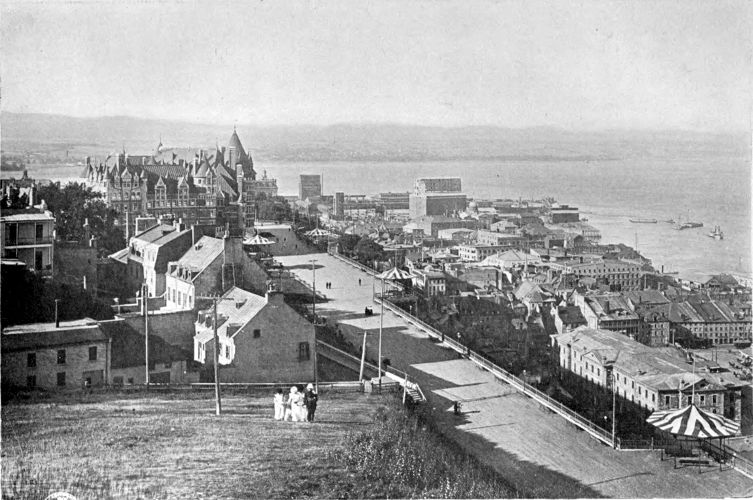
Copyright, 1901, by Detroit Photographic Co.
CASTLE ST. LOUIS, QUEBEC
“When Champlain first laid the foundation of the Fort, in 1620, to which he gave the name of St. Louis, it is evident he was actuated by views of a political, not of a commercial character. His mind was in better keeping with warlike enterprises than the acquirement of wealth. He was perfectly disinterested in all his proceedings. Foreseeing that Quebec would become the seat of dominion and invite a struggle for its future possession, he knew the necessity of a stronghold, and determined to erect one in opposition to the wishes of the Company of Merchants.” The building was commenced in July, 1620.
Champlain, at first, styled his fort “demeure, corps-de-logis”—that is, a dwelling-place. In 1621, he put in charge of it, one M. Du Mai, with a few men. In 1622, he pushed on the work, “insisting on the importance of completing it, having it equipped with an armament, stores and a suitable garrison.” On the 29th November, 1623, the ruggedness of the ascent from the Abitation to the fort, induced him to establish a road or path (since known as Mountain Hill) to Fort St. Louis. The walls of the fort later on covered about four acres. On the 18th April, 1624, his artificers were busy putting in their place the timber conveyed there by his Indian allies on sledges over the snow on the 10th December, 1623. Two years later, a violent wind storm carried away over the cliff the roof of the building.
On his departure for France in August, 1624, though Champlain had left orders to continue the work on his fort, he found on his return that no progress worth mentioning had been made. In anticipation of the time not far distant when he expected the French King would be sending colonists to Quebec, as well as soldiers for their protection, the founder of Quebec decided on razing the small fort begun in 1620. With the materials, he set to work to lay the foundations of the larger one, which he may have occupied as a residence previous to the surrender of the fort to the Kertks in 1629, but where he certainly made his home when he returned from France in 1633, until his death there on Christmas Day, 1635.
Louis Kertk held it from 1629 to 1632, Emery de Caen and Duplessis Bochart took possession of it in 1632, until Champlain’s return, 23d May, 1633.
The first Château, a one-story building commenced in 1647 by Governor de Montmagny, and which is styled “Corps de Logis au Fort,” after some repairs was finally demolished by Count de Frontenac in 1694 and rebuilt by him. The second Château, begun in 1694–5, to which a wing was added was completed in 1700. It is described by La Potherie, and later on, in 1749 by the Swedish botanist and traveller, Herr Peter Kalm, the friend of Linnæus. Capt. John Knox of the 43d, a companion-in-arms of Wolfe, also alludes to it in his voluminous diary of the great siege of 1759, when the bombardment inflicted on Quebec by Admiral Saunders, left it in ruins. It so remained until Gov. Murray had it repaired in 1764, and occupied it in 1765.
On the 5th May, 1784, General Haldimand set to work to construct an addition to St. Louis Castle for public balls and official dinners, whilst the state levees continued to take place in the old Château. A portion of the walls of Fort St. Louis were used in constructing the first story of the building, which took the name of Château Haldimand. It was inaugurated with éclat more than two years after the Governor’s departure, on the 18th January, 1787, by a splendid ball on Queen Charlotte’s birthday when Lady Dorchester-Maria, the accomplished daughter of the Earl of Iffingham—presided. On August 15th, 1787, Prince William, a middy on board the frigate Pegasus, then in port, afterwards Duke of Clarence, and later on, William IV., King of England, paid his respects to the Governor-General at Government House, the old Château and inspected the new building.
On the 21st September of the same year, and on the 4th of October, 1787, the overseer of Military Works, Sergeant James Thompson records in his diary the extensive preparations made to welcome to Quebec the King’s son, without forgetting the platform erected for the occasion on the roof of the old powder magazine (razed in 1892), in the rear of Château Haldimand, in order to witness the fireworks set off in his honour. In December of that year, the Governor removed his household goods to the new building, leaving the old Château to be used as public offices, and about this time the castle was allowed to get out of repair. The Governor for the time being inhabited the new building, the Château Haldimand, it being more modern and roomy, in its internal arrangements.
In 1808, at the request of His Excellency, General Sir James Henry Craig, the provincial legislature voted and spent £10,000 in rebuilding two stories higher the antique castle; and a short time before his departure, in 1811, he removed to it from his summer retreat, Spencer Wood, and his winter quarters at Château Haldimand. On the 23d January, 1834, it was entirely consumed by fire; but its dependency, Haldimand Castle escaped. Lord and Lady Aylmer, the previous occupants of Château St. Louis, instead of inhabiting General Haldimand’s structure, took their abode on the Cape with Col. Craig, until they could rent a house. Four years later, in 1838, the pompous but able Governor and Grand Commissioner, the Earl of Durham, having declined to accept from the authorities any remuneration for his short time of office, it is said, directed this fund to be donated to the razing of the ruins of the old Château, and to the erection on their foundations, of a terrace (Durham Terrace until 1879), 160 feet in length. This the Minister of Public Works, in 1854, the Hon. P. Chabot, M. P. P. for Quebec, increased to 270 feet. Under Lord Dufferin’s Plans of City Embellishments, it was extended, at Government and Municipal cost, to 1,420 feet in length. The corner-stone to this incomparable promenade was laid on the 18th October, 1878, by the Earl of Dufferin, and was named and inaugurated by their Excellencies, the Marquis of Lorne and H. R. H. the Princess Louise, as Dufferin Terrace on the 19th June, 1879, at the request of the Mayor, City Council and Citizens of Quebec.
On the 12th June, 1846, an awful fire, attended by the loss of forty lives, obliterated the remaining walls of the old Château and its stables, transformed first into a riding-school and next into a theatre.
From 1852 to 1855, and from 1860 to 1865, the remaining modern building, Château Haldimand, was used by the Provincial Board of Works, the Crown Lands, King’s Domain and Registrar. In 1857, it became the seat of the Normal School, and again until 1860 and later on.
With the old French powder-magazine in rear, it was razed in 1892 to the ground to make room for the stately pile, the Hotel Château Frontenac, planned by an eminent New York architect, Mr. Bruce Price, for the Château Frontenac Co., of which Thos. G. Shaughnessy is the president. It was built at a cost of $500,000 on a site purchased from the Provincial Government of Quebec, covering 57,000 feet.
Montmagny, Chevalier de Malte, had pushed forward colonization, among other measures drawing on Normandy, Brittany, Perche, Poitou, Aunis, and set to work to inspire respect to the Indians hutted around his fort. The latter styled Montmagny Ononthio, which means “Great Mountain”—playing on his name (Mons Magnus). The surname was borne by the succeeding French Governors.
His next care was to lay out streets, widen and straighten the footpaths which intersected Stadacona. But a chevalier sans cheval, as Mr. E. Gagnon well observes, could not be the correct thing. So a horse as a mount—the first seen in the colony—was imported from France by the inhabitants on the 20th June, 1647, a very suitable present to the worthy Knight. What became of it history does not say. Matters were evidently looking up at the Fort and Château when M. d’Ailleboust, the new Governor took possession of Government House at Quebec in 1648. He was replaced by M. de Lauzon, 1651–56. Lauzon reoccupied it as administrator in 1657, and his successors under Viscount d’Argenson in 1658; Baron d’Avougour, in 1661, and Chevalier Saffrey de Mesy in 1663.
Governor de Courcelles arrived at Quebec in 1665, with the magnificent Marquis de Tracy, the King’s Lieutenant-General in America. Tracy was accompanied by several companies of the dashing Carignan-Salières regiment, and made his début with extraordinary pomp. His advent was quite a social event in Quebec, which had just been granted a Royal Government, and for the first time was styled a town. De Courcelles’s administration lasted until 1672, when Count de Frontenac was named Governor. His first administration lasted until 1682. He was followed by Labarre, 1682–85, and by the Marquis De Nonville, 1685–89, when the stern old warrior was recalled to his former position, which he occupied until the year of his death, in 1698. Callières followed, 1699–1703, when Philippe de Rigaud, Marquis de Vaudreuil, was named and governed the country until 1725.
Charles Le Moine, Baron de Longueuil, administered the colony, 1625–26; he was succeeded by the Marquis de Beauharnois. Count de la Galissonnière was next sent out to govern, from 1746 to 1749, during the captivity of the Marquis de la Jonquière, who, on his way to Quebec, had been taken prisoner by an English fleet. The Marquis, however, at his release ruled here, in 1752, when Charles Le Moine, the second Baron de Longueuil, administered the Government from May to July, 1752. That year the Marquis Duquesne de Menneville replaced him, and the last Governor under French rule was Pierre Rigaud, Marquis de Vaudreuil Cavagnal until 1760.
History tells of one distinguished guest Herr Peter Kalm, the Swedish savant and botanist, who was dined and wined there for forty days by another savant Count de la Galissonnière, Governor of Quebec, in the summer of 1749. Hark to his description of the Château:
“The Palace (Château Saint Louis), is situated on the west or steepest side of the mountain, just above the lower city. It is not properly a palace, but a large building of stone, two stories high, extending north and south. On the west side of it is a courtyard, surrounded partly with a wall and partly with houses. On the east side, or towards the river, is a gallery as long as the whole building, and about two fathoms broad paved with smooth flags and included on the outside by iron rails, from whence the city and river exhibit a charming prospect. This gallery serves as a very agreeable walk after dinner, and those who come to speak with the Governor-General wait here till he is at leisure. The place is the lodging of the Governor-General of Canada, and a number of soldiers mount the guard before it, both at the gate and in the courtyard; and when the Governor, or the Bishop comes in or goes out, they must all appear in arms and beat the drum. The Governor-General has his own chapel where he hears prayers; however, he often goes to Mass at the church of the Recollets, which is very near the palace.”
The Castle and Fort St. Louis under England’s domination has had its sunshine and its shadows; its dark as well as its bright, radiant memories; its anxious hours of siege and alarm—nay, even of blockade, followed by the welcome roar of artillery, proclaiming British victories; more than once social pageants and many festive displays.
Facing the site of the fort, long since vanished, a few yards to the west, lies the well-known area, La Grande Place du Fort (since 1862, the Ring), mantled in foliage and trees, planted when Mayor Thomas Pope held out at the City Hall. Our warlike ancestors knew it as the Place d’Armes. In days gone by, have met, not for military drill, but for annual roll-call, on St. Peter and St. Paul’s Day, June the 29th, the city militia—an important though a very pacific body. It was continued for years until dropped about 1850.
Hark! to the rousing cheer of the British soldiery, as they plant on the Grande Parade, facing the historic Château, on the 18th of September, 1759, on the day of the capitulation of Quebec, the solitary gun, drawn from the Heights of Abraham through St. Louis gate. Captain John Knox, of the 43d Regiment, tells us how his brave commander hoisted the English flag, after taking possession of the keys of Quebec from de Ramsay, its late Governor.
But the lordly castle of other days, riddled by the shot and shell of the English fleet, tenantless, uninhabitable, was not thoroughly repaired until 1764–5, when General James Murray, first Governor of Quebec, had his Royal Commission read on the adjoining square, prior to his taking possession of the Castle as his official residence. A decade later, and the occupant (Sir) Guy Carleton, so appropriately named the “saviour of Quebec,” might notice, from the Château windows, the arrival on the Levis shore, on the 5th of November, 1775, of Benedict Arnold’s hungry and worn-out continentals, eager to cross the St. Lawrence, and land at Wolfe’s cove above. But a wise precaution had induced Lt.-Governor Cramahe to remove to the Quebec side the Levis canoes and water conveyances before the arrival of the invading host. The wave of invasion, triumphant at Montreal, Sorel, Chambly, Three Rivers, St. John and elsewhere, was hurled back by the granite rock of Quebec. On the 31st December, 1775, at 9 A. M., the intrepid chieftain, Guy Carleton, could from his parlour windows look down triumphantly, but not scornfully, on the New England soldiery, escorted to the Grande Parade—426 rank and file—marched up prisoners of war, from the Sault-au-Matelot assault, to await crestfallen, the orders of His Excellency before being detailed to their respective prisons.
Might one not unreasonably infer, from the official etiquette that has ever prevailed among naval commanders frequenting our port, that the youthful captain of the sloop of war, Albemarle, Horatio Nelson, present here in 1782 paid his devoirs at the Castle to the distinguished Governor-General Sir Frederick Haldimand, and partook of the hospitalities usually shown to visitors of distinction? At his romantic time of life did Nelson, like many subsequent lovers, indulge in a sentimental promenade on the famed Castle terrace? Did he ever, at the witching-hour when the citadel evening-gun calls to barrack military beaux, meet there the adorable Mary Simpson, the girl for whose sake he was, he said, ready to quit the service? Southey, as well as Lamartine, in their biographies of the hero of Trafalgar, state that violence had to be used to tear the smitten Horatio from his Quebec charmer. Miss Simpson after marrying Major Matthews, Secretary to the Governor, removed to London with her husband who became Governor of Chelsea Hospital.
A titled visitor of no ordinary rank entered the portals of the Castle in 1787, Prince William Henry, Duke of Clarence, subsequently William IV., King of England. He was then a roystering middy on board H. M. frigate Pegasus, anchored in the port below the Château. A grand ball was given there in his honour by Lord and Lady Dorchester.
A volume would not suffice to detail the brilliant receptions and state balls given at the Castle during Lord Dorchester’s administration—the lively discussions, the formal protests originating out of points of precedence, burning questions de jupons between the touchy magnates of the old and those of the new régime; whether La Baronne de St. Laurent would be admitted at the Château or not; whether a de Longueuil or a de Lotbinière’s place was on the right of Lady Maria, the charming consort of His Excellency Lord Dorchester, a daughter of the great English Earl of Effingham; whether dancing ought to cease when their Lordships the Bishops entered and made their bow to the representative of royalty. Unfortunately, Quebec had then no Court Journal, so that the generations following can have but faint ideas of all the witchery, the stunning head-dresses, the décolletées, and high-waisted robes of their stately grandmothers, whirled around in the giddy waltz by whiskered, epauletted cavaliers, or else courtesying in the demure minuet de la cour.
We are now nearing the stormy era of “Little King Craig.” Troublous times are looming out portentously for the earnest, hospitable, but stern Laird of the Castle, Sir James Henry Craig. The lightning cloud, however, will burst over his successor, Sir George Prevost. As oft before, the trumpet of Bellona has sounded; this time at Washington, on the 18th of June, 1812. “Prepare for the Invader,” is repeated with bated breath in the streets of Quebec.
“Five cannon taken at Detroit, are now lying in the Château Court,” says the Quebec Mercury of 27th October, 1813, whilst the prisoners taken at Detroit, brought down to Quebec, await embarkation for Boston for purposes of exchange. Quebec was martial with United States uniforms—American prisoners—the Yankee Generals Winder, Chandler and Winchester; Colonel Winfield Scott, later on General Winfield Scott, who culled laurels in the Mexican War, and so many other officers and privates, that the Governor of Canada scarcely knew how to dispose of them. Colonel Scott remained in Canada from the date of his surrender, 23d October, 1812, to the period of his departure from Quebec, say May, 1813. But he was on parole all the time.
In bringing to a close this brief sketch, may we not recall how many representatives of royalty, under French and under English rule, Viceroys, proud Dukes, distinguished Earls, martial Counts and Barons, occasionally held there their Court, in quasi-regal style, in order to keep up the prestige of France’s Grand Monarque (Louis XIV.) and thereby impress, the surrounding Indian tribes with his might; or as worthy representatives of the British Crown in the New World: Champlain, de Montmagny, D’Ailleboust, Lauzon, D’Argenson, de Mesy, de Courcelles, stern old Frontenac, La Barre, Callières, de Vaudreuil, de Ramsay, de Longueuil, de Beauharnois, de la Galissonnière, de la Jonquière, Duquesne, General Murray, Sir Guy Carleton, Sir F. Haldimand, Lord Dorchester, General Prescott, Sir James H. Craig, Sir George Prevost, Sir James Kempt, Sir John Coape Sherbrooke, the Duke of Richmond, Earl Dalhousie, Lord Aylmer?