THE CRADOCK HOUSE, MEDFORD[2] SAMUEL ADAMS DRAKE
Reading edition
THE CRADOCK HOUSE, MEDFORD[2] SAMUEL ADAMS DRAKE
The object of paramount interest which Medford contains is the plantation house of Governor Cradock, or “Mathias Charterparty,” as the malcontent Morton styled him. This house is the monarch of all those now existing in North America. As we trace a family back generation after generation until we bring all collateral branches to one common source in the first Colonist, so we go from one old house to another until we finally come to a pause before this patriarch of the sea. It is the handiwork of the first planters in the vicinity of Boston, and it is one of the first, if not the very first, of the brick houses erected within the government of John Winthrop.
Every man, woman and child in Medford knows the “Old Fort,” as the older inhabitants love to call it, and will point you to the site with visible pride that their pleasant town contains so interesting a relic. Turning your back upon the village and your face to the east, a brisk walk of ten minutes along the banks of the Mystic, and you are in presence of the object of your search.
A very brief survey establishes the fact that this was one of those houses of refuge scattered through the New England settlements, into which the inhabitants might fly for safety upon any sudden alarm of danger from the savages.
The situation was well chosen for security. It has the river in front, marshes to the eastward and a considerable extent of level meadow behind it. As it was from this latter quarter that an attack was most to be apprehended, greater precautions were taken to secure that side. The house itself is placed a little above the general level. Standing for a century and a half in the midst of an extensive and open field, enclosed by palisades and guarded with gates, a foe could not approach unseen by day, nor find a vantage-ground from which to assail the inmates. Here, then, the agents of Matthew Cradock, first Governor of the Massachusetts Company in England, built the house we are now describing.
In the office of the Secretary of the Commonwealth, at Boston, hangs the charter of “The Governor and Company of the Massachusetts Bay in New England,” brought over by Winthrop in 1630. The great seal of England, a most ponderous and convincing symbol of authority, is appended to it.
It is well known that the settlement at Salem, two years earlier, under the leadership of Endicott, was begun by a commercial company in England, of which Matthew Cradock was Governor. In order to secure the emigration of such men as Winthrop, Dudley, Sir R. Saltonstall, Johnson, and others, Cradock proposed in July, 1629, to transfer the government from the company in England to the inhabitants here. As he was the wealthiest and most influential person in the association, his proposal was acceded to.
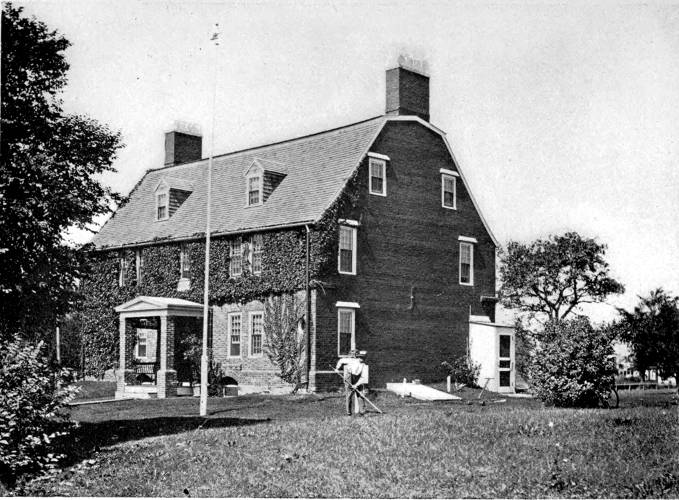
THE CRADOCK HOUSE, MEDFORD, MASS.
We cannot enter here, into the political aspects of this coup d’état. It must ever arrest the attention and challenge the admiration of the student of American history. In defiance of the crown, which had merely organized them into a mercantile corporation, like the East India Company, with officers resident in England, they proceeded to nullify the clear intent of their charter by removing the government to America. The project was first mooted by Cradock, and secrecy enjoined upon the members of the Company. That he was the avowed author of it must be our apology for introducing the incident. This circumstance renders Matthew Cradock’s name conspicuous in the annals of New England.
Cradock never came to America, but there is little doubt that he entertained the purpose of doing so. He sent over, however, agents, or “servants,” as they were styled, who established the plantation at Mystic Side. He also had houses at Ipswich and at Marblehead for fishery and traffic.
For a shrewd man of business Cradock seems to have been singularly unfortunate in some of his servants. One of these, Philip Ratcliff, being convicted “ore tenus of most foul and slanderous invectives” against the churches and government, was sentenced to be whipped, lose his ears, and be banished the plantation. Winthrop was complained of by Dudley because he stayed the execution of the sentence of banishment, but answered that it was on the score of humanity, as it was winter and the man must have perished. Ratcliff afterwards, in conjunction with Thomas Morton and Sir Christopher Gardiner, procured a petition to the Lords of the Privy Council, before whom Cradock was summoned.
Wood, one of the early chroniclers, tells us that Master Cradock had a park impaled at Mystic, where his cattle were kept until it could be stocked with deer; and that he also was engaged in ship-building, a vessel of a “hundred tunne” having been built the previous year (1632). It may be, too, that Cradock’s artisans built here for Winthrop the little “Blessing of the Bay,” launched upon the Mystic tide, July 4, 1631,—an event usually located at the Governor’s farm, at Ten Hills.
This house, a unique specimen of the architecture of the early settlers, must be considered a gem of its kind. It is not disguised by modern alterations in any essential feature, but bears its credentials on its face. Two hundred and sixty odd New England winters have searched every cranny of the old fortress, whistled down the big chimney-stacks, rattled the window-panes in impotent rage, and, departing, certified to us the staunch and trusty handiwork of Cradock’s English craftsmen.
Time has dealt gently with this venerable relic. Like a veteran of many campaigns, it shows a few honourable scars. The roof has swerved a little from its true outline. It has been denuded of a chimney and has parted reluctantly with a dormer-window. The loopholes, seen in the front, were long since closed; the race they were to defend against has hardly an existence to-day. The windows have been enlarged, with an effect on the ensemble, as Hawthorne says in a similar case, of rouging the cheeks of one’s grandmother. Hoary with age, it is yet no ruin, but a comfortable habitation.
How many generations of men—and our old house has seldom if ever been untenanted—have lived and died within those walls! When it was built Charles I. reigned in Old England and Cromwell had not begun his great career. Peter the Great was not then born, and the house was waxing in years when Frederick the Great appeared on the stage. We seem to be speaking of recent events when Louis XVI. suffered by the axe of the guillotine and Napoleon’s sun rose in splendour to set in obscurity.
The Indian, who witnessed its slowly ascending walls with wonder and misgiving; the Englishman, whose axe wakened new echoes in the primeval forest; the Colonist native to the soil, who battled and died within view to found a new nation,—all have passed away. But here, in this old mansion, is the silent evidence of those great epochs of history.
It is not clear at what time the house was erected, but it has usually been fixed at 1634, when a large grant of land was made to Cradock by the General Court. The bricks are said to have been burned near by. There was some attempt at ornament, the lower course of the belt being laid with moulded bricks so as to form a cornice. The loopholes were for defence. The walls were half a yard in thickness. Heavy iron bars secured the arched windows at the back, and the entrance door was encased in iron. The fire-proof closets, huge chimney-stacks, and massive hewn timbers told of strength and durability. A single pane of glass, set in iron and placed in the back wall of the western chimney, overlooked the approach from the town.
The builders were Englishmen, and, of course, followed their English types. They named their towns and villages after the sounding nomenclature of Old England; and what more natural than that they should wish their homes to resemble those they had left behind? Such a house might have served an inhabitant of the Scottish border, with its loopholes, narrow windows and doors sheathed in iron. Against an Indian foray it was impregnable.
Cradock was about the only man connected with the settlement in Massachusetts Bay whose means admitted of such a house. Both Winthrop and Dudley built of wood, and the former rebuked the deputy for what he thought an unreasonable expense in finishing his own house. Many brick buildings were erected in Boston during the first decade of the settlement, but we have found none that can claim such an ancient pedigree as this of which we are writing. It is far from improbable that, having in view a future residence in New England, Cradock may have given directions for or prescribed the plan of this house, and that it may have been the counterpart of his own in St. Swithen’s Lane, near London Stone.
“Then went I forth by London Stone Throughout all Canwick Street.”
The plantation, with its green meadows and its stately forest-trees, was a manor of which Cradock was lord and master. His grant extended a mile into the country from the river-side in all places. Though absent, he was considered nominally present, and is constantly alluded to by name in the early records. Cradock was a member of the Long Parliament, dying in 1641. The euphonious name of Mystic has been supplanted by Medford, the Meadford of Dudley and the rest.
It is not to be expected that a structure belonging to so remote a period for New England, should be without its legendary lore. It is related that the old fort was at one time beleaguered for several days by an Indian war party, who at length retired baffled from the strong walls and death-shots of the garrison. As a veracious historian, we are compelled to add that we know of no authentic data of such an occurrence.