A GLIMPSE AT NEW ORLEANS HOUSES LADY HARDY
Reading edition
We start in the early morning on a pedestrian excursion through this “Paris of the South.” We almost fancy that we have gone to sleep in the New World, and woke up in the old fair and familiar city across the sea. It is the same, yet not the same; there is a similarity in the general features especially in the vicinity of Canal Street, to which I shall allude more fully by and by, and an insouciant gaiety in the aspect of the people, which pervades the very air they breathe; an electric current seems always playing upon their spirits; moving their emotional nature, sometimes to laughter, sometimes to tears. It seems as though the two cities had been built on the same model, only differently draped and garnished, decorated with different orders and stamped with a different die. Coming down a narrow lane, we met a Frenchwoman, her mahogany coloured face scored like the bark of an old tree scarcely visible beneath her flapping sunbonnet. She wore short petticoats, and came clattering along over the rough stones in her wooden sabots, while her tall blue-bloused grandson carrying her well-filled basket strode beside her; and a meek-eyed Sister of Charity bent on her errand of mercy passed in at a creeking doorway. These were the only signs of life we saw as we first turned on our way to the French quarter of the town, which still bears the impress of the old Colonial days. This is the most ancient portion of the city, and full of romantic traditions of the days that are dead and gone. The long narrow crooked streets, running on all sides in a spidery fashion, with rows of shabby-looking houses, remain exactly as they were a hundred years ago. Strict conservatism obtains here; nothing has been done in the way of improvement; the old wooden houses are bruised and battered as though they had been engaged in a battle with time and been worsted; they are covered with discolourations and patches, naked and languishing for a new coat of paint. There are no dainty green sun blinds here, but heavy worm-eaten wooden shutters and queer timber-doors hung on clumsy iron hinges; here and there we get a glimpse of the dingy interiors while a few bearded men are lounging smoking in the doorways, and a few children, clattering like French magpies, are playing on the threshold. Everything is quiet and dull—a sort of Rip Van Winkle-ish sleep seems drooping its drowsy wings and brooding everywhere, till a lumbering dray comes clattering over the cobble stones, and sends a thousand echoes flying through the lonely streets.
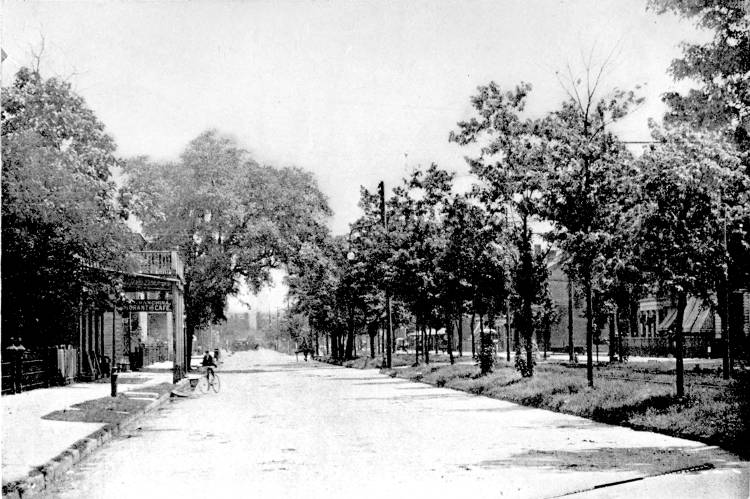
ST. CHARLES AVENUE, NEW ORLEANS
From these stony regions, past the little old-fashioned church where the good Catholics worshipped a century ago and we emerge upon Canal Street, the principal business thoroughfare of the city; it is thronged with people at this time of day, busy crowds are passing to and fro, the shop windows are dressed in their most attractive wares, temptingly exposed to view. Confectioners, fruit and fancy stores overflow into open stalls in front and spread along the sidewalk; huge bunches of green bananas, strawberries, peas, pines, cocoa-nuts and mangoes, mingled with dainty vegetables, are lying in heaps. We are tempted to try a mango, the favourite southern fruit, of whose luscious quality we have so often heard, but the first taste of its sickening sweetness satisfies our desires. The street is very wide, and the jingle-jangle of the car-bells, the rattling of wheels and the spasmodic shriek and whistle of the steam engine—all mingle together in a not unsweet confusion. Lumbering vehicles, elegant carriages, street-cars and a fussy little railway, all run in parallel lines along the wide roadway. This is the great backbone of the city, whence all lines of vehicular traffic branch off on their diverse tracks into all the highways and byways of the land. Here we get on to a car which carries us through the handsomest quarter of the city. Quaint old-fashioned houses, surrounded by gardens of growing flowers, and magnificent magnolias, now in full bloom, stand here and there in solitary grandeur, or sometimes in groups like a conclave of green limbed giants, clothed in white raiment, and perfumed with the breath of paradise. Past lines of elegant residences, where the élite of the city have their abode, and we soon reach a rough wooden shed yclept a “depot.”
The architectural beauty of New Orleans is unique, and wholly unlike any other Southern city; the avenues are wide and beautifully planted, a generous shade spreads every way you turn. The dwelling-houses which line St. Charles’s Avenue are graceful, classical structures, no blending together of ancient and modern ideas, and running wild into fancy chimney-pots, arches, points and angles like a Twelfth Cake ornament. Some are fashioned like Greek temples, most impressive in their chaste outline and simplicity of form; others straight and square, with tall Corinthian columns or fluted pillars, sometimes of marble, sometimes of stone. The severe architectural simplicity, the pure white buildings shaded by beautiful magnolias and surrounded by brilliant shrubs and flowers, form a vista charming to the eye and soothing to the senses, and all stands silhouetted against the brightest of blue skies—a blue before which the bluest of Italian skies would seem pale.
The aspect of the city changes on every side; we leave the fashionable residential regions and enter broad avenues lined with grand old forest trees, sometimes in double rows, the thick-leaved branches meeting and forming a canopy overhead. The ground is carpeted with soft green turf, and bare-legged urchins, black and white, are playing merry games; a broken down horse is quietly grazing, and a cow is being milked under the trees, while a company of pretty white goats, with a fierce-looking Billie at their head, are careering about close by. Pretty pastoral bits of landscape on every side cling to the skirts and fringe the sides of this quaint city. As we get farther away from St. Charles’s Avenue, the better class of residences get fewer and fewer, till they cease altogether, and we come upon pretty greenshuttered cottages, with their porches covered with blossoms and rows of the old-fashioned straw bee-hives in front. Here and there are tall tenement houses built of cherry-red bricks, which are let out in flats to the labouring classes.