THE CHÂTEAU DE RAMEZAY, MONTREAL MAJOR A. C. YATE
Reading edition
The history of Canada that is destined to live is that of its earliest explorers and colonists, amongst whom the French rank first and the English second. One of the most interesting monuments of that history is the Château de Ramezay in Montreal, of which I propose to record here what little I have been able to learn during a short visit to Canada. It was built about 1705 by Claude de Ramezay, “a distinguished soldier of noble birth,” who was Governor of Montreal from 1703 to 1724. In some books I find the name spelt Ramsay or Ramesay, but Ramezay is the spelling adopted by the Numismatic and Antiquarian Society of Montreal. It is practically certain that the Governor of Montreal who bore the name was of Scotch extraction. In the Seventeenth Century the cadets of many families of the French nobility emigrated to Canada (“La Nouvelle France,” as it was then called), while the nominal Vice-royalty was held by several of the highest nobles of the land, viz., the Prince de Condé, Duc de Montmorenci, and Duc de Ventadour. The emigrant nobles were granted seigneuries in various parts of New France, and in some cases these seigneuries have remained in their families to the present day. The Château de Ramezay is the town mansion of one of these seigneurial families. Very little, however, seems to be known of Claude de Ramezay. An autograph letter of his, presented by Judge Baby, is in the museum. In 1703, the Marquis de Vaudreuil, Commandant of Montreal, succeeded the Chevalier de Callière (who had also in his day been Governor or Commandant of Montreal) as Governor of Canada. Claude de Ramezay apparently succeeded De Vaudreuil as Military Governor of Montreal. He appears to have been a man of capacity and to have interested himself keenly in the pioneering and exploring work to which so many men at that time devoted themselves. In 1702, during his Governorship, a French post was established at Detroit, and in 1717, another at the mouth of the Kaministiquia River, on Lake Superior, where Fort William now is. Nor was M. de Ramezay backward in organizing military expeditions against the English settlements in the New England States. During the whole of De Ramezay’s Governorship the English and French colonies in America were at war, as indeed they almost always were, whether the mother-countries were at peace or not.
The Governorship of Claude de Ramezay is said to have ended in 1724, whether owing to his death or retirement we are not told. In 1745, the Château passed into the hands of “La Compagnie des Indes,” and remained with them till September, 1760, when Montreal surrendered to the united forces of Amherst, Haviland and Murray. We are not told what use was made of the Château from 1724 to 1745. Tradition associates with the Château the name of De Vaudreuil, one celebrated in the annals of “La Nouvelle France,” but it is not explicit as to date, or indeed any detail. The first Marquis de Vaudreuil, after having been for some years Commandant of Montreal, became Governor of Canada in 1703, and retained that post until he died, respected and regretted in 1725.
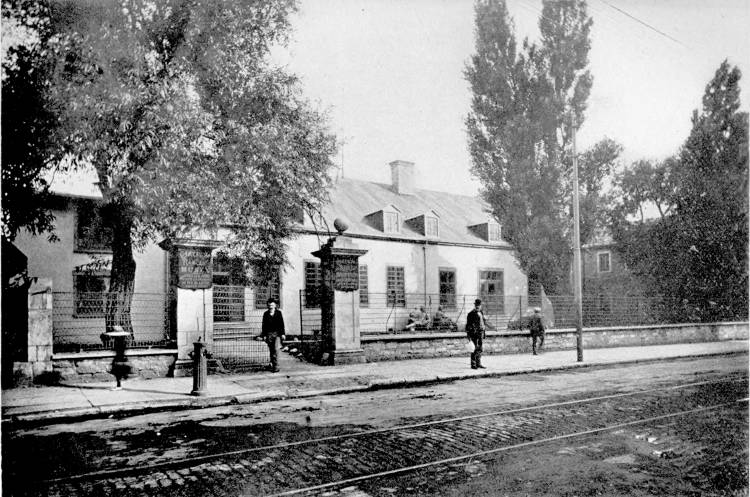
Copyright, 1900, by Detroit Photographic Co.
THE CHÂTEAU DE RAMEZAY, MONTREAL
It is said that when Claude de Ramezay died (no date given), his heirs found themselves unable to bear the expense of keeping up so large a residence, and sold it to “La Compagnie des Indes.” From 1745 to 1760, it was thus the headquarters of a great French trading-company, the resort of Indian voyageurs and coureurs de bois, coming in from the north and west with their loads of furs, and selling or bartering them to the agents of the company, by whom they were shipped to France. This company also held by charter a monopoly in the purchase and sale of all imports and exports in the Colony. When Canada passed into the possession of Great Britain, in 1760, the Château de Ramezay became General Amherst’s headquarters, and subsequently for a short time those of General Gage. We find from Withrow’s History that it was a De Ramsay (as Withrow spells it), who surrendered Quebec to General Townshend after Wolfe’s victory on the Heights of Abraham.
When Canada was ceded to the British, the Château de Ramezay was not at first annexed as the residence of the Governor of Montreal. It was purchased from the “Compagnie des Indes” by William Grant, Baron de Longueuil.[22] It is doubtful if the Grants ever occupied the Château, for it continued to be known for some ten years after the cession by the name of the “Indian House.” The Governor of Canada then, finding it necessary to provide the Lieutenant-Governor with a suitable residence, leased it. The first Lieutenant-Governor who attended it was Mr. Cramahé. He had scarcely settled there when the approach of General Montgomery, in November, 1775, with a force of New England Revolutionists compelled him to vacate it and retire to Quebec. There, pending the arrival of General Sir Guy Carleton, he made energetic preparations for the defence of Quebec, and declined to give any answer to Benedict Arnold’s summons to surrender, which was made on the 14th of October. On the 19th Sir Guy Carleton arrived, and assumed command of the defence. It was on the 12th of November, 1775, that General Montgomery entered Montreal, and on the 4th of December his forces and those of Arnold, about 1,200 men in all, appeared before Quebec. Montgomery was slain in a vain attempt to capture the town on the night of the 31st of December, 1775. Finally, early in May, 1776, the Americans were driven from before Quebec, leaving guns, stores, provisions, and even their sick behind. Meanwhile three American Commissioners, Benjamin Franklin, Samuel Chase and Charles Carroll, came to Montreal to urge the Canadians to join the revolted colonies against Great Britain. Benjamin Franklin, certainly, if not the other two Commissioners, resided when in Montreal in the Château de Ramezay, and here a certain M. Mesplet, under the orders of Benjamin Franklin, set up the first printing-press in Montreal.
The first printing-press in Canada was set up in Quebec in 1764, and on the 21st of June of that year the first number of the Quebec Gazette, a journal which till recently was still published, made its appearance. Benedict Arnold, after his failure at Quebec, went to Montreal and took command of the Revolutionary troops there. He resided in the Château de Ramezay.
After the withdrawal of the Americans, the Château de Ramezay remained untenanted until the government bought it from the Grants, and made it the official residence of the Governors of Lower Canada temporarily resident in Montreal. Their permanent residence was at Quebec, and for years the Governors, when they visited Montreal, had to bring their own furniture with them. At last, however, a grant of money was voted to them for the purchase of permanent furniture for their Montreal residence. For half a century it was occupied by successive Governors, who made many alterations and additions. Lord Metcalfe (1843–1844) was the last resident Governor, the seat of Government between the years 1841 to 1858, being fixed successively at Quebec, Kingston, Montreal, then at Toronto and Quebec alternately, and finally, by Her Majesty’s decision, at Ottawa, where it has since remained.
The union of the Provinces of Upper and Lower Canada was formerly proclaimed on the 10th of February, 1841. After the establishment of the Governor-General in a new Government House, and again, when the headquarters of the provincial government of the Lower Province was transferred to Quebec, the Château de Ramezay was used for various governmental purposes. Among others, the Law Courts sat there, and afterwards certain rooms were used for classes of the Normal School and of the Medical Faculty of Laval. The extensive vaults and cellars below the house had in the Eighteenth Century been used by the French as store-houses for the large quantities of supplies which, owing to the hostility of the Indians it was necessary to maintain there. So incessant were at times the raids of the Iroquois, whether instigated by the New England Government or not, that cultivation was almost an impossibility, and all food supplies had to be imported from France and stored in Montreal. Some of the vaults also were used as dungeons, and at times refractory Indian chiefs were probably incarcerated there to give them time to see reason; while in some cases they were detained as hostages for the good faith of their tribe. There was also a deep well in one vault, now boarded over. Under the English Governors, these vaults were used as wine-cellars, servants’ offices and quarters for the Governor’s guard, for the preservation of the old French and English official and other records, and for the storage of fuel and supplies. In one vault we still find the kitchen. The huge fireplace was fitted up above with an arrangement for smoking ham and bacon, while on one side opened a large oven, about five feet in diameter, for baking bread. In a recess close by was hung a drum, in which worked, like a squirrel in a cage, the turnspit-dog that roasted the joints. In a corner of another vault still lies a portion of the first system of water-pipes used in Montreal. It is the trunk of a tree, ten or twelve feet long, by nine or ten inches in diameter, hollowed out. The walls of the vaults are in some places of great thickness; ranging from five to eight feet. In the early part of the Eighteenth Century, when a good house was built, it was solidly built. It is stated that some fifty years ago, soon after the Château ceased to be the residence of the Governors, the City Council authorized the demolition of a portion of it, in order to open up a thoroughfare. The building was thus cut in two. The portion which is now used as the museum was retained by the civic authorities. The remainder was turned into a hotel in which Jenny Lind and Charles Dickens, amongst others, are said to have stayed. Between 1880 and 1890 the City Magistrates of Montreal meted out justice for petty misdemeanours in this building. Rooms which had been tenanted by a Governor-General, and which for a hundred and forty years had been the centre of the French and British rule in Montreal thus gradually sank to the level of a police magistrate’s court. About this time, however, public attention was drawn to this building (largely owing to the exertions of the Numismatic and Antiquarian Society of Montreal), and to its antiquarian and historical interest. When, in 1893, the Provincial Government offered it for sale by public auction, it was bought by the Corporation of the City of Montreal with the view of preserving the building and establishing in it a free public, archæological, scientific and historical museum. In 1895, the custody of the Château, on behalf of the people of the city, was vested in the Numismatic and Antiquarian Society.
It was in the Château de Ramezay that met from 1838 to 1840, the Special Council (half English and half French), which was appointed by the Home Government to act in place of the legislature of Lower Canada during the Rebellion and so-called “Patriotic War” of 1837–1838. The Constitution was for the time suspended. The Special Council paved the way for the Act of Union of 1840, which was a step towards the present Constitution of the Dominion. The confederation of 1866 was the final step.
Two of the principal rooms in the Château are now known as the Salle du Conseil and the Library. With the former, tradition associates many names (already mentioned), well-known to history, and on whom the varying fortunes of Canada have depended. Its walls are now hung with engravings and documents that commemorate those names and those fortunes. The old fireplace in the Library has only recently been discovered, having been walled up for many years. The treasures that have already been collected in this, the first Canadian Museum of Antiquities, are most interesting and valuable, and some are unique. There are 113 portraits, 82 historical pictures and 74 old prints, which illustrate the most celebrated names and the most famous scenes and events of Canadian history, from Jacques Cartier to Sir John Macdonald. Early explorers, Jesuit missionaries, governors and generals, both French and English; old maps and prints of Canada, Quebec and Montreal, etc., are the subjects. In addition, there is a collection of scarce books, papers, documents and magazines connected with Canada, weapons of the Seventeenth and Eighteenth Centuries, and many quaint and curious relics both of war and peace.