PARLIAMENT BUILDINGS, OTTAWA LADY HARDY
Reading edition
The approach to this city, the capital of the Dominion of Canada, is by no means imposing; the face of the river is covered and its mouth filled with sawdust; it is stifled, and has scarcely strength to flow, it could not burst into a smile, or ripple, under the most tempting of summer suns. Immense booms of timber which have been floated down from the “forest primeval” hundreds of miles away, float still on the river surface till they are hauled up to feed the hungry mills, mechanical giants, whose rasping jaws work day and night crushing these sturdy “sons of the forest,” cutting them in slices and casting them forth to be stacked in huge piles along the river-banks miles before we reach the town. There is no bustle or confusion on our arrival there. On the quiet little landing-stage two or three lumbering vehicles are waiting; we are escorted to one of these by our chivalrous captain, who carries our hand baggage and superintends the removal of the rest.
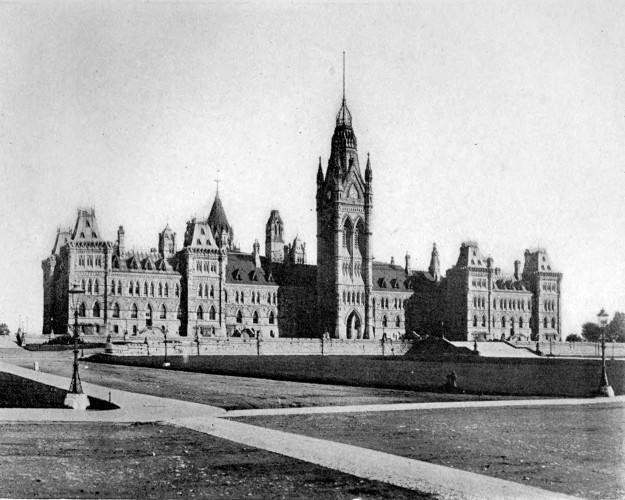
PARLIAMENT BUILDING, OTTAWA, CANADA
Our first day in Ottawa was spent in visiting the Parliament buildings, which occupy a plateau of about thirty acres on the loftiest point of the city, and nearly two hundred feet above the Ottawa River; they are surrounded by beautifully laid out gardens, and seem to be growing out of a bed of soft greensward of velvet smoothness. They are composed of cream-coloured Potsdam stone, the ornamental part being of Ohio and Arupois marble; they are built in the Italian-Gothic style of the Thirteenth Century, and I am told they are the most beautiful specimens thereof in all America, perhaps in the world. Their elevated position, with their long lines of pointed windows, massive buttresses, and numerous pinnacles and towers, silhouetted against the bright blue sky, are objects of imposing and majestic beauty for miles around. In the front centre stands Victoria Tower, one hundred and eighty feet high, and surmounted by an iron crown. The chief entrance to the building is through the broad-pointed arches beneath this tower; the royal arms are above the doorway; in the grand Senate Hall, there is a very beautiful statue of the Queen and the vice-regal throne is flanked by busts of the Prince of Wales and the Princess Alexandra.
In the most remote, as well as in the most populous districts, the features of the royal family are duly represented. The Canadians are the most loyal of British subjects; they lower their voices with solemn reverence when they speak of “Her Majesty the Queen,” to whom they never refer as “the Queen,” pure and simple; they give her a whole string of titles and adjectives, like the tail of a paper kite, and set her sailing in the heaven of their imagination, as though she were beyond the range of humanity altogether.
Much has been said, much has been written on the subject of Canada; we have learned its geographical position, the length and breadth of its lakes and rivers, the extent of its vast forest lands, the height of its mountains, etc., but the figures dazzle the mind, and bring no realization of the fact. Nothing less than a personal visit will enable us to comprehend the wonders of this luxuriant land, which is surrounded and encompassed with its own loveliness. The primeval forest still holds its own in the vast solitudes, sacred as yet from the increasing encroachments of man, its immense inland seas and fruitful rivers winding through scenery the most picturesque, the most sublime; to say nothing of its vast unexplored lands and mineral resources, and the wide tracts of rich uncultivated country, watered by springs and rivulets which have been flowing in their living liquid beauty since the days of Paradise.
We had heard much of the extremes of temperature, of heat and cold, especially in Ottawa, and prepared ourselves for broiling; well, it was warm, the sun blazed, the hot winds blew, and the dust of this most dusty city whirled and swirled around us, got into our eyes, our ears, crept insidiously down our throats, and seemed struggling to turn us inside out; but we clutched our mantles around us, and butted against the wind, screening ourselves from the sun’s fierce rays as best we could. It is not often that the sun and wind have such a tussle together. However, we reached home at last in an uncooked state, feeling not much warmer than we should do on a summer day at home, though the temperature is much higher and the hours are marching to the tune of 90° in the shade.
We had spent the whole day in wandering and driving about the streets of Ottawa, till we gained a very good idea of its external appearance. It has numerous fine churches, and its town hall, post office and all the municipal buildings are substantially and massively built in an attractive and fanciful style of architecture. As for the rest of the city, it is in a perfectly unfinished state; it is as yet only a thing of promise, though it has the making of a very fine town in the future; but however fast it marches, it will have to keep growing, and work hard too for another century at least, before it reaches the level of its magnificent Parliament buildings. The streets are wide and long, stretching away out of sight; they are cobble-stoned and roughly wood-paved for the most part. After passing the principal lines of shops in Sparkes Street, the houses seem to have been built for temporary convenience only, and crop up here and there in a direct line, leaving wide spaces of waste land between, as though they were in a hurry to see which should reach the end of the long street first, the end that seems to be creeping back to the primeval forest, which civilization and time have left far behind.
Ottawa itself is neither picturesque nor attractive, being built on perfectly flat ground. It looks like a timber yard and smells of sawdust. The Ottawa River has as many long thin arms as an octopus, and they run meandering inland by a hundred different ways; here they meet in a vast tumbling mass, falling over huge boulders and broken stony ground till they are dignified by the name of the “Chaudière Falls”; lower down their headlong course is stopped, and they are utilized and made to turn a huge saw-mill where a thousand steel teeth are biting through the grand old trees, tearing them into chips, digesting and disgorging them on the other side; in vain the water foams and groans, crashing its rebellious waves together—man is its master and will have his way.
Rideau Hall, the home of our Princess, lies on the outskirts of the town, and is by no means a regal-looking mansion; it is a long low building of gray stone, standing on rather elevated ground, and has a pleasant view of the town and river from the lawn and flower garden, which encloses two sides of it; the approach is through tolerably well timbered grounds, not of sufficient importance to be called a “park.” The Governor and Princess Louise were away, and the house was undergoing repair—it looked as though it needed it. There was nothing to distinguish this from any second or third-rate country house at home, except the one solitary and rather seedy looking sentinel who paraded before the door. The people of Ottawa speak most enthusiastically of our Princess; every one has some kind memory or pleasant anecdote to tell of her. It is said that when Her Royal Highness held her first reception, she appeared in a plain high dress, expecting, perhaps, to find fashion “out of joint” in this far-away place; but the Canadian ladies came trooping “en grand toilette,” with fans and diamonds, trains and laces, like living importations from Worth himself. At the next reception matters changed, and the royal lady appeared in all the splendour of the British Court.