ST. ANNE DE BEAUPRÉ, QUEBEC[19] ANNA T. SADLIER
Reading edition
ST. ANNE DE BEAUPRÉ, QUEBEC[19] ANNA T. SADLIER
Long ago, in some far away time too distant for actual history to have recorded the fact, a few Breton sailors, coming up the great river were surprised by a terrific storm. In all the terror of the moment, the blackness of the night, the howling of the winds and the rushing of the waters, their hearts went back to distant Brittany. In childhood and in youth they had been taught to have recourse to the beloved patroness of their chère Bretagne. Never had St. Anne d’Auray failed to hear a simple and heartfelt prayer. They registered a vow: if the good saint brought them once more to land, there where their feet touched they would build her a shrine. A morning came blue and cloudless. These brave men were ashore and where? They looked about them. To the northward rose the Laurentian hills, to the southward the wide-rolling St. Lawrence, to the eastward a little stream, now the St. Anne, dividing the settlement from the neighbouring parish of St. Joachim. In such surroundings they built a simple wooden chapel and laid the foundation of a shrine now famous throughout America.
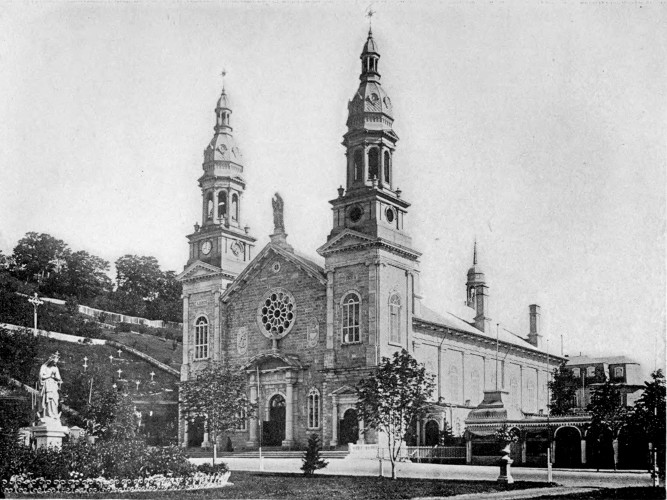
ST. ANNE DE BEAUPRÉ, QUEBEC, CANADA
The years went on; these hardy voyageurs passed on their way and were heard of no more in the village they had founded. But habitations soon grew up, and the settlement of Petit-Cap began to be known by the little temple which stood in its very heart. Meanwhile in the passing years, the springtime floods and the winter storms, and even the hand of time itself, began to tell upon the sturdy wooden frame of the good saint’s shrine. The project of rebuilding it was first seriously entertained somewhere about 1660. A prosperous farmer of the village, named Etienne Lessard, made a generous donation of land sufficient for the erection of a church, provided only that the work was begun at once. A discussion now arose as to the propriety of changing the site; but the matter was finally decided and M. Vignal, a priest from Quebec, went down to Petit-Cap to bless the foundations. He was accompanied by M. d’Aillebout, Governor of New France, who went thither expressly to lay the corner-stone.
This second church, which remained in use till 1876, was built of stone and stood just at the foot of the hill, where the present chapel for processions now is. During the years following its erection multitudes of pilgrims flocked thither.
Amongst those whose interest in the welfare of the church and the propagation of the devotion have woven a halo round this village shrine is that immortal Bishop of Quebec—he who coming of the ancient and knightly race, the Barons Montmorenci de Laval, forsook the splendours of a luxurious court and the softness of a southern climate to devote his wonderful intellect to the service of the primitive Canadian Church.
Rich gifts began to pour in and the attention of royalty itself was drawn to the spot; for a gleam from the magnificence of that traditionally splendid court of Louis le Grand fell upon that humble sanctuary hard by the blue stream, which still bore the Indian voyageur upon his way. It is part of the romance which antiquity has lent to the place, this offering made by the queen-mother of Louis XIV. Anne of Austria’s own royal hands worked a handsome chasuble as a gift to the good St. Anne. The ornaments upon it are red, white and black arrows and the whole is richly wrought in gold and silver. Now, though that splendid pageant of a dream, that gorgeous phantom of a dead royalty, has passed into tradition, the vestment worked by the royal mother’s hands is still seen at the altar of St. Anne’s upon great occasions.
A costly silver reliquary adorned with precious stones and two pictures painted by the Franciscan friar, Luc Lafrançois, are the gifts of Mgr. de Laval; while there is a crucifix of solid silver presented by the hero of Iberville in 1706 in return for favours obtained. So does the past intermingle everywhere with the present, and such tokens speak like the voices of the dead, giving testimony of answered prayers. Kneeling there before that beloved mother of the Mother of Christ, we can see in fancy, as humble suppliants by our side, the great and good prelate whose name shines out from the early Canadian annals with an unsurpassed lustre, or the valiant soldiers, proud and warlike viceroys, gay and gallant barons of France, who have bent the knee here, humble, believing, hopeful as the poor fisher whose boat rocked the while upon the surging waters without. In 1875, a magnificent banner, seven feet and a half high by four and a half broad, was presented to the Curé by his Excellency Lieutenant-Governor Caron, of Quebec. On one side of it is St. Anne teaching the Blessed Virgin, the two figures encircled by a silver shower. Above and below is inscribed: “St. Anne, Consolation of the Afflicted, pray for us.” The reverse of the banner represents St. Joachim as a pilgrim, proceeding to the temple with his simple gift of two white doves. The work thereupon was done by the Sisters of Charity.
The walls and sanctuary are fairly covered with crutches, hearts of gold and silver, and the like, each one telling of a belief in some cure obtained, or petition heard.
The year of 1876, the year of the building of the new church was crowned by a rescript of His Holiness Pius IX., bearing date the 7th of May, by which he declared St. Anne patroness of the Province of Quebec, as long ago St. Joseph had been declared patron of all Canada.
The interior of the church is adorned with eight altars, the high altar being the gift of his Grace Mgr. Taschereau, of Quebec; the Blessed Virgin’s, that of the Bishop of Montreal; one to the Sacred Heart of Jesus, that of the Bishop of St. Hyacinth; while St. Joseph is donated by the Bishop of Ottawa, the Holy Angels by the clerks of St. Viator.
Two really beautiful stained windows which adorn the chancel are the gift of four parishioners. Various pictures upon the walls commemorate remarkable deliverances from shipwreck and the like. Such is Le Père Pierre and the crew of the ship Saint Esprit making a vow to St. Anne; or the King’s vessel, Le Héros, on the point or foundering; or yet another caught in the ice and saved through the intercession of St. Anne. Of the artistic excellence of many of these pictures we say nothing.
Besides the relics of St. Anne, the Church of Beaupré can boast many others, such as the one of St. Francis Xavier, of St. Deodatus, St. Benedict, St. Valentine, St. Remi, St. Eulalie, St. Amantis, Pontianus, St. Cæsarius, and others. The Rev. M. Gauvreau, Curé from 1875 to 1878, almost completely finished the exterior of the new church. In 1876, he likewise built a school chapel for the children of the neighbouring concessions. He also conceived the idea of building the Chapel of the Processions out of the material of the old church. It was consecrated October 2, 1878, and is intended to perpetuate the ancient edifice, being erected after the same fashion and surmounted by the same bell-tower, whence the same sweet-toned voice calls the people to prayer that called the dead and gone generations ago. Situated upon an eminence, and being used especially when the concourse of pilgrims is very great, it is an imitation of the altar of the Scala Sancta at St. Anne d’Auray. There is a fountain just before the entrance to the new church, where crowds of pilgrims are seen using the water. It is surmounted by a statue of St. Anne.
The one principal street of St. Anne’s runs along the slope of a hill which in the summer-time is thickly covered with fruit-laden trees. Canadian homesteads of comfort and of plenty line it on either side. The population consists of some hundred and fifty families, who, experiencing little of “life’s long and fitful fever,” spin out their days in a primitive and rural simplicity which belonged to the golden epoch of la Nouvelle France. The traveller fresh from the restless bustle of a modern Babylon seems to find himself suddenly transported to some far-away Utopia of simple content which has slept for centuries an enchanted sleep, and awakes isolated indeed from the Juggernaut of progress. The handsome church, sole token of modern enterprise, arises like a new Aladdin’s tower from amid the group of quaint, almost mediæval dwellings. In the spring and summer-time St. Anne’s awakes from a lethargy in which it has been plunged during the long winter, and, as the city of some Arabian Nights’ tale, is suddenly aglow with life and animation. Pilgrims of every rank and condition of life fill its street; matron and maiden, priest and layman, the young and the old, the grave and the gay, come thither, an eager but silent and recollected throng, to the feet of the good St. Anne. Prayers go up, hymns ring out on the stilly evening, or at tranquil morn, and the pilgrims take their homeward way, with a vision of the calm, restful loveliness of nature there in that favoured spot to haunt them for many days. They remember Nature at St. Anne’s, with her dim and night-empurpled hills, amongst which linger the memories of hundreds of years, with her flowing sunlit streams, the waving of trees and grass, the dreamy village life, and above all a something indescribable. The chant and the organ-tone and the murmur of pilgrim voices fade into a distant memory, but the voyager down that sapphire stream, the St. Lawrence, to that hill-shadowed sanctuary, keeps for a lifetime the impression of what he has seen and heard.