FORT MARION, ST. AUGUSTINE IZA DUFFUS HARDY
Reading edition
From Jacksonville to St. Augustine is like a going back from the Nineteenth Century into the Sixteenth. This, the oldest city in the United States—with its history that should be printed in red letters, being one volume of war and siege and bloodshed—is to all appearance the old Spanish settlement still. The world seems to have gone on and left it behind; the march of modern improvement has passed it by; the tourist has found it out, and the hotel-keeper, of course, keeps him company; but they have failed to spoil, or modernize and mar the quaint old town. Step outside your hotel, and you at once step into a bygone age. The old Spanish city lies wrapt in a dreamy peace; it seems asleep in the sunshine. Narrow, unpaved, sandy streets; quaint wooden houses breaking out into balconies and piazzas; untidy yards with ragged banana-trees and palms and oleanders and climbing roses; “coquina” houses, relics of old days, massive of wall and scant of window, built of the curious material “coquina,” found only hereabouts (formed of masses of crushed shell dug out of Anastasia Island, just across the river)—this is St. Augustine at a first glance!
The oldest inhabitant is sitting at his door under his own vine and figtree, smoking the pipe of peace in his shirt sleeves. He bids us good evening; we stop and chat awhile with the old man, who is like a picture, his snow-white hair and beard framing a rugged brown face. He is a Spaniard, he tells us, born here, and nearly grown to manhood when the Spanish flag was hauled down to give place to the Stars and Stripes. He points out one of the oldest Spanish houses, a pink house, built of “coquina,” and plastered over with a delicious soft pink like the flush of sunset. Its little lattice windows are broken, so that we can see the thickness of its massive “coquina” walls; it is empty and falling rapidly to ruin. Down the narrow, sunny, sandy, almost deserted street comes a riderless horse, trotting at a brisk pace. He knows his home, and turns in under his own archway smartly. Next comes a solitary cow, and presently a mare, also unencumbered by rider or saddle, followed by a pretty little foal. They are all returning to their respective homes in a quiet, business-like way.
We walk on to the Plaza, the central spot in which the sluggish currents of life in St. Augustine seem to meet and eddy and make a little stir in the sleepy old place. Facing on the Plaza is the old Catholic church, with its high quaint belfry, to which the guide-books and residents invariably call the attention of the tourist. Here is the old market, under whose arched roof, men, women and children were bought and sold once upon a time, and not so long ago, before the slave traffic (which brought its curse with it, and pulled down the pillars of the temple, and drew ruin, at least for a season, on these fair lands of the South), gave place to the innocent bargaining for fish, flesh, fowl and fruit, which is all these old walls look down upon to-day.
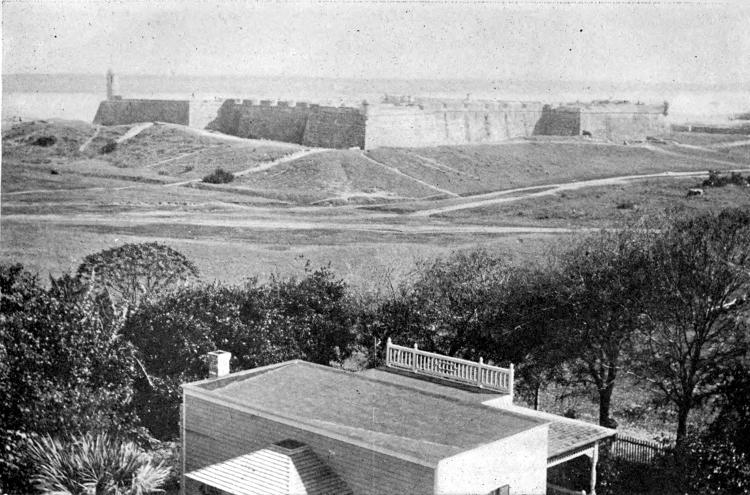
FORT MARION, ST. AUGUSTINE, FLORIDA
Beyond the Plaza we come upon the “sea-wall,” which our little guide-book has led us to anticipate as a “promenade.” When we behold it, however, our dreams of promenading vanish. It runs along the shore, from the modern barracks at one end of the town to the ancient fort at the other. It is simply a low, massive stone wall, the top of which, unprotected by any rail or parapet, is described as the favourite “Lover’s Walk”; but, if it is so, St. Augustine lovers must be slender as well as affectionate. We find it quite enough to walk singly upon it with a steady head. The tourist is “promenading himself” there, of course, with his wife in her palmetto-hat; and we perceive, on observation of the various couples, that lovers, when young and slim, may walk double, though more frequently he walks behind her. A soft, fresh breeze blows up from the unseen Atlantic, which is shut from our view by the long slip of Anastasia Island, running parallel with the sea-wall, between the ocean, whose salt fragrance floats faintly to us, and the river lapping the base of the wall. The sea-wall walk leads us to the old Fort Marion, which is, perhaps the sight to be seen here.
The first stone was laid in 1592, the last, as the inscription over the gateway tells us, in 1756. The great fortress is in excellent preservation. Its massive “coquina” walls stand almost untouched by time or siege, though the wild grass waves under our feet in the barbican and blue flowers blossom from the chinks in the “coquina” blocks. A grim silence broods over the ancient walls, as we explore turret and drawbridge, casement and bastion. There is an old sergeant whose mission is to show visitors over the place, but he is apparently off duty, for we seek and find him not. A fellow-tourist, however, gives us all the information we require. We sit on damp blocks of stone on a mud floor under a vaulted roof, while he tells us of the “locked dungeon,” into which admission can only be gained through the absent sergeant. He pioneers us into the “bakehouse,” a huge, dimly-lit stone room, also with mud floor and vaulted roof, with a recess which served as oven, and one aperture which combined the offices of chimney and window. It was here that, during the siege of St. Augustine, all the townsfolk collected for shelter; and a wretched community they must have been! From this bakehouse a gloomy archway leads into a pitch-dark dungeon. Our escort lights matches, which only serve to make the darkness visible. By their feeble glimmer we can see neither roof nor walls, nothing but the thick blackness which closes round us like a pall. We are told, however, that the obscurity here is nothing to the inky darkness of the “locked dungeon,” wherein, the story goes, skeletons were found in iron cages,—but this is, by the best authorities, denied.
We next inspect a comparatively light and airy cell, with a narrow grating high up, to our eyes unattainable and impassable, but through which the Indian chief, “Wild Cat,” is said to have effected his escape. The great Osceola, his companion in obscurity, nobly refused to avail himself of the same means. It strikes me as possible that the “Cat” was the slenderer and more agile of the two. From the fort we cross a rough and pathless stretch of sand and turf to another relic of the past—to the old city gates. They are built of “coquina,” of course. We inspect the barred and grated sentinel-boxes, the high towers flanking the gateway and dutifully resist the temptation to chip off a piece of “coquina” as a souvenir.
The next day is Easter Sunday; the quaint old streets are crowded with gaily-dressed people; the Plaza is swarming with happy pairs. This is truly the “Land of Flowers.” As we saunter in the shade of the great trees that make King Street rather a forest-glade than a street, and linger to gaze into the groves and gardens which surround almost every residence, we drink in the fragrant breeze, heavy with perfumes of myriad blossoms, and revel in the luxuriance of tropical bloom and foliage all around us. Here is the lance-leaved palmetto, and here the beautiful feathery date-palm; here the oleanders droop their pink and pearl, starred and scented boughs high out of reach above our heads; here climbing roses straggle up to the housetops; here are great forest-like trees covered with the sweet yellow flowers of the apoppinac; here the giant magnolia, tall as a poplar and sturdy as an oak, is opening the great white petals of its mammoth flower. Now and then we come upon the bridal blossoms of the orange and again upon branches weighed down under their globes of ruddy gold.
We take a farewell stroll down St. George’s Street—where the oldest inhabitant still sits smoking under his figtree, and the ragged bananas and spiky palms in the gardens stand out against the deepening glow in the west—as evening draws on. We wander down to the sea-wall, which is nearly deserted now. There are one or two wild-looking men on horseback, their saddles mere mats of crimson or blue embroidered cloth, their feet thrust into the unsightly bags known as Mexican stirrups. There are several dogs, one large yellow mastiff taking his siesta on the sea-wall, occupying the entire width of the “promenade”; a canine friend, coming to interview him, stands on his hind legs, with his fore-paws on the top of the wall. This somehow makes the “Lover’s Walk” look a very small affair. One of the riders spurs his horse up on to the wall, and, like the successful admirer of “the Lady Kunigonde of the Kynast,” he “rides along the battlemented parapet,” breaking up the canine tête-à-tête. Fortunately, there are no lovers on the wall to be startled from off their own particular domain, only the yellow mastiff scuttles down in a hurry as horse and rider gallop by.
The sun is setting behind the town, and the eastern sky before us catches a tender reflected blush just on the horizon. Beyond the sea-wall lies a stretch of water, blue as heaven and calm as a dream; it scarcely laps against the old stones; the little boats on its surface “float double” boat and shadow; an indescribable softness, like a sleep, broods over its waveless tide. Beyond this entranced water lies the long dark shade of Anastasia Island; beyond that, the pale reflected rose of the eastern sky fades slowly with the dying day. The one or two stragglers on the sea-wall stand out in vivid silhouette against the blue water and blushing sky; the clatter of the horse’s hoofs, as the equestrian Blondin dashes along the top of the wall, seems to shatter the silence like the breaking of a spell.