INDEPENDENCE HALL, PHILADELPHIA D. W. BELISLE
Reading edition
This venerable edifice, which excites so much patriotic veneration from the American people and is regarded with profound esteem abroad, was known until the year 1776 as the State House. From that memorable period—when the representatives of the nation resolved to be free—the room on the east side of the main entrance has been designated by the appellation of Independence Hall. For wise and patriotic reasons it has never been altered. By that designation it will remain hallowed to all time. So long as a single genuine spark of freedom remains in the human heart, so long will Independence Hall be regarded as the birthplace of liberty—the immortal spot where the manacles of oppression were sundered and despotism received its most formidable rebuke. The State House, originally constructed for the purpose of accommodating legal business, the dispensation of Colonial statutes for Pennsylvania, and the transaction of various other matters, was commenced in the year 1729 and completed in 1734. Its dimensions and architectural plan—the design being furnished by an amateur architect, named John Kearsley, Sr.,—were regarded by many as too large and expensive; and the erection of the building was, therefore, quite strenuously opposed. Had the men who first conceived the noble enterprise of building it foreseen the exalted character which their contemplated edifice would assume in future, there would not probably have been a single dissenting voice in the liberal plan projected by its founders. It is a singular historical fact, that most of those who opposed the plan of the edifice in the commencement and who were still living at the time, were opposed to the adoption of the “Declaration of Independence,” which occurred within its very walls about a quarter of a century afterwards. According to bills and papers kept by Andrew Hamilton, one of the three Commissioners who had the superintendence of the financial matters connected with its construction, it appears that the edifice cost originally $16,250. The two wings which now form important addenda to the building, however, were not erected until the years 1739–40, and increased the total amount to $28,000—but their cost cannot be counted in the original bill.
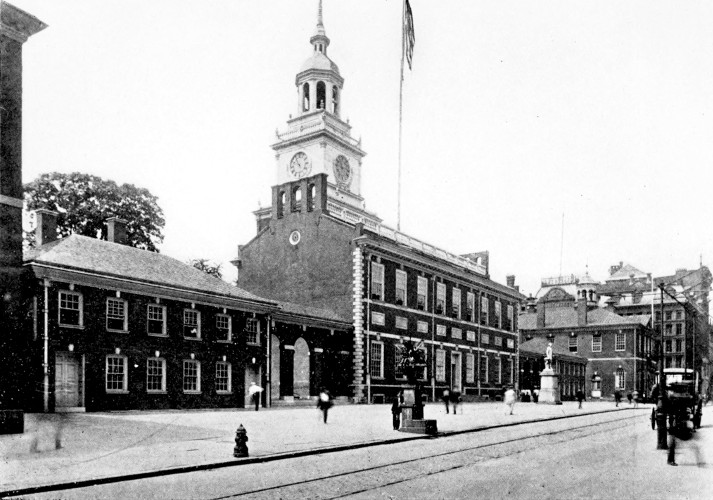
INDEPENDENCE HALL, PHILADELPHIA, PA.
Watson in his Annals says: “Edmund Woolley did the carpenter work, John Harrison the joiner work, Thomas Boude was the brick mason, William Holland did the marble work, Thomas Kerr, plaster, Benjamin Fairman and James Stoopes made the bricks; the lime was from the kilns of the Tysons. [These kilns were situated in Manship Township, Montgomery County, about one mile west from Willow Grove and fifteen miles from the Hall of Independence.] The glass and lead cost £170 and the glazing in leaden frames was done by Thomas Godfrey, the celebrated. I may here usefully add, for the sake of comparison, the costs of sundry items, to wit: carpenter’s work at 4s. per day; boy’s, 1s.; master carpenter, E. Woolley, 4s. 6d.; brick-laying by Thomas Boude, John Palmer and Thomas Redman, at 10s. 6d. per M.; stone work in the foundation at 4s. per perch; digging ground and carting away, 9d. per yard; bricks, 31s. 8d. per M.; lime per 100 bushels, £4; boards, 20s. per M.; lath-wood, 18s. per cord; laths, 3s. per C.; shingles, 20s. per M.; scantling, 1½d. per foot; stone, 3s. per perch, and 5s. 5d. per load. Labourers receive 2s. 6d. per day; 2,100 loads of earth are hauled away at 9d. per load.” These items are only given as specimens of curiosity, and will serve to amuse, if not to instruct.
The woodwork of the steeple by which the building was first surmounted, on examination in 1774, was found to be so much decayed, that it was decided to remove it, and it was accordingly taken down, leaving only a small belfry to cover the bell for the use of the town-clock,—which had but one dial face, at the west end of the building. In that condition it remained until 1829, when the steeple which now crowns the building, was erected on the plan of the original one. Some years ago the interior woodwork to the room in which the “Declaration of Independence” was signed was removed for the purpose of modernizing the plans, but public sentiment soon demanded its restoration, and it now presents the same appearance it did on that memorable occasion. In 1854, the City Councils of Philadelphia very patriotically resolved to place in this sacred room—where they properly belong—all the relics associated with the brilliant history of the Hall and the times contemporaneous with the American Revolution, which they could obtain. With commendable zeal and enterprise they have obtained and arranged in their appropriate places portraits of nearly all the distinguished “Signers of the Declaration of Independence,” as well as many other valuable relics, all of which are sacred mementoes uniting the present and the past with ligaments of inseverable affection.
“When the regular sessions of the Assembly were held in the State House,” says Watson, “the Senate occupied upstairs and the Lower House the same chamber since called Independence Hall. In the former, Anthony Morris is remembered as Speaker, occupying an elevated chair facing north—himself a man of amiable mien, contemplative aspect, dressed in a suit of drab cloth, flaxen hair slightly powdered, and his eyes fronted with spectacles. The Representative Chamber had George Latimer for Speaker, seated with his face to the west,—a well-formed manly person, his fair large front and eyes sublime declared absolute rule.”
For many years previous to 1855, the upper apartment of Independence Hall was divided into rooms which were occupied by the Supreme Courts of the United States, and was rented for offices of various kinds.
Grave and deliberate as were the general purposes, during the early period of the Revolution, to which the “State House” was appropriated in the Colonial days of Pennsylvania, it was on several occasions used as a hall for banqueting. In the long gallery, upstairs, the feasting tables were spread, around which hilarity and mirthfulness prevailed, while the tables themselves were loaded with every desirable luxury which the appetite or inclination might fancy or desire. Soon after the edifice was completed, in 1736, William Allen, Esq., then Mayor of Philadelphia, made a feast at his own expense. This entertainment, which was of a sumptuous and costly character, was spread in the “State House,” and the Mayor extended his invitations to all distinguished strangers in the city. The number of invited guests exceeded any at the feasts given in the city on previous occasions, while those who partook of his hospitality expressed their unanimous consent that, “for excellency of fare, it was a most elegant entertainment.” On the arrival of their new Colonial Governor, Denny, in 1756, while the Assembly was in session, that body gave him a reception dinner, and this feast was likewise spread at the “State House,” at which the “civil and military officers and clergy of the city” were present. This entertainment occurred in August, and was an important event during that session of the Assembly. It had a tendency to harmonize various antagonistical personal feelings, which were looked upon as boding no peculiar good to the new administration. Again, when Lord Loudon, commander-in-chief of the King’s forces in the several colonies, visited the city in the year 1757, the corporation received him at the “State House” by a great banquet. General Forbes, who was then commander at Philadelphia and of the southern settlements, was also present on that occasion. Various guests were invited, among whom were officers of rank, gentlemen strangers, clergy and private citizens, who partook of those municipal hospitalities. It was remarked by some uninvited guests at the time, that the expenditure for this entertainment was greater than had ever before been made by the authorities for public receptions, which indicated a very early hospitality to such feasts—especially when given at the expense of the public treasury. When in 1774, the first Congress met in Philadelphia, a sumptuous collation was prepared by the gentlemen of the city, for the entertainment of its representatives, the “State House” was selected as the building in which the festive ceremonies should be performed. The members and invited guests congregated first at the City Tavern,[10] and thence marched in an imposing procession to the “State House,” in the dining-hall of which the repast was spread. About five hundred persons partook of the dinner, and when the toasts were given they were rendered patriotic by the “firing of cannon and martial music.” These festive occasions exerted salutary influence upon public sentiment, and had a tendency to develop, in no small degree, political feelings which actuated the people. No doubt the principles promulgated and advocated around the brimful goblet and board, were regarded in a patriotic or disloyal sense, according to the dominant characteristics of leading men, with their adherence to Parliamentary laws, or Republican sympathy.
Notwithstanding the fact that Independence Hall is regarded as a most sacred shrine of Liberty, in days of yore it was used for various purposes—some of which illy comported with the true character of the building. Mr. Watson says: “For many years the public papers of the Colony, and afterwards of the City and State, were kept in the east and west wings of the State House, without any fire-proof security as they now possess. From their manifest insecurity, it was deemed, about the year 1809, to pull down those former two-story brick wings and to supply their places by those which are now there. In former times such important papers as rest with the Prothonotaries were kept in their offices at their family residences.” When workmen were superintending the removal of the former wings of the “State House,” Mr. Grove, who was the master mason, made several interesting discoveries of relics. These were mostly found under the foundations of the walls, as the workmen excavated the ground considerably deeper for the present cellars. At the depth of some five feet, and close to the western wall, was dug up a keg of Indian flints. Nothing appears upon record to give the faintest idea as to who performed the deed, or for what purpose they were buried there. The impression of the keg was distinct, but the wood had decayed and become assimilated with the loamy soil. At about the same depth, and in close proximity to it, were uncovered the complete equipments of a sergeant, consisting of a musket, cartouche-box, sword, buckles, etc. “The wood being decayed left the impression of what they had been.” These discoveries excited considerable curiosity, and attracted a large multitude of people to see and examine them. But a greater and more general excitement was created, a day or two subsequently, at the announcement that a lot of bomb-shells, filled with powder, had been exhumed by the diggers. This circumstance led to various conjectures, relative to the object for which they had been buried beneath the building, but a satisfactory solution of the mystery has not, as yet, been given. Some entertained the belief that it was intended for another Guy Fawkes plot, to destroy the edifice on a particular occasion. Most probably, however, they had been placed there for safe keeping, or to prevent their falling into unfriendly hands. Subsequently, when the present foundation was built two of these bombs were walled in with the stones and now form a portion of the stonework.
We have remarked that Independence Hall was used for various purposes. In the year 1802, the Legislature of Pennsylvania granted to Charles Wilson Peale the use of the upper rooms in which the public banquets were formerly given for the exhibition of curiosities which he had collected and arranged under the title of the Philadelphia Museum.
As a place of literary entertainment, Independence Hall assumes a conspicuous reputation. In 1771, the Rev. Jacob Duché, assistant minister of Christ Church and St. Peter’s, Philadelphia, wrote as follows:—“The ‘State House,’ as it is called, is a large plain building, two stories high. The lower story is divided into two large rooms, in one of which the Provincial Assembly meet and in the other the Supreme Court of Judicature is held. The upper story consists of a long gallery, which is generally used for public entertainments, and two rooms adjoining it, one of which is appropriated for the Governor and his Council; the other, I believe, is yet unoccupied. In one of the wings, which join the main building by means of a brick arcade, is deposited a valuable collection of books, belonging to a number of the citizens, who are incorporated by the name of ‘The Library Company of Philadelphia.’ You would be astonished, my Lord, at the general taste for books which prevails among all orders and ranks of people in this city. The librarian assured me that, for one person of distinction and fortune, there were twenty tradesmen that frequented this library.” The Library Company of Philadelphia, to which the above reverend writer so sneeringly alludes (and who, during the Revolutionary struggle for Independence, turned Tory to the cause of Freedom), was first started by Benjamin Franklin in 1731, and was called “The City Library,” in consequence of a union which was made on the first of July of that year, of several libraries. In October, 1732, their first importation of books from England arrived, amounting in cost to £45 15s., sterling. The Library was located in Pewter-platter Alley, but in 1740 it was transferred to the State House. Thence in 1773 it was placed in the Carpenters’ Hall, where it remained until the year 1790. It received its incorporation in 1742, under the title of the “Library Company of Philadelphia.” In 1792, this Company, the Loganian and the Union, were merged into one,—making a tria juncta in una.
During the progress of the struggle for Freedom, the State House was signalized for many scenes which transpired within it, and was, at one time, used as a hospital for wounded soldiers. A “lobby” extended the whole length of the building, then eastward from the head of the stairs, and in this “lobby” the American officers who were captured at the Battle of Germantown were retained as prisoners. It was used as a hospital after the Battle of the Brandywine, where many a noble patriot breathed his last. Such were some of the sad purposes for which this sacred structure has been used. This building is also rendered immortal from the fact that here Washington “bade farewell to public life, and delivered that memorable address which will ever be cherished as a sacred legacy by his grateful countrymen.” In 1824, Lafayette received his friends in Independence Hall. It has been subsequently used as the audience-chamber of several distinguished visitors, and a reception room for the Presidents of the United States. The body of the venerable John Adams here lay in state on its way to his final resting-place.
After the completion of the State House in 1734, measures were set on foot to secure means and funds sufficient to place in the dome a bell appropriate for the building. As they had already supplied a great public necessity by placing a clock in the west end—not in the steeple, as Harper’s Magazine represents it—many influential citizens opposed the measure, on the ground of extravagance, arguing that the “great cost of the State House had imposed a heavy tax upon the citizens, and further expenditure was useless.” The better judgment of the people, however, after several years prevailed, and it was decided to have a bell. But another great and discouraging difficulty met the speedy accomplishment of their purposes. There had been but little moulding and casting effected in the Colonies, in consequence of the home government monopolizing almost exclusively every department of manufacturing, thereby subjecting their subjects in the New World to depend upon the mills, looms and furnaces of England for a supply of such articles as Parliament might think proper for them to have. It became necessary, therefore, to submit to the inconvenience, trouble and delay, of sending to London for a bell. This was done. The size, peculiar shape, weight,[11] motto and thickness, were accurately mentioned, as directions for casting it, and the order was sent in the latter part of the year 1750. About a year would elapse before they could reasonably expect the bell to reach this country. It came at last in 1752, and before it was landed from the ship, hundreds of citizens repaired to the vessel to examine it and congratulate the city on its safe arrival.
The tone was clear, distinct and forcible, well calculated to inspire feelings of pride in those enterprising citizens, who had been chiefly instrumental in procuring it. But their high anticipations were doomed to meet a sad disappointment. A day or two after its arrival, while removing it from the vessel to the place for which it was intended, it met with an accident by which its tones were rendered discordant, the beauty of its appearance mutilated and its uses almost destroyed. In fact, the bell had to be recast, and it was decided that an experiment should be made in the city.
Accordingly the task was assigned to Messrs. Pass & Stow, who were to perform the operation under the superintendence of Isaac Norris, Esq., Speaker of the Colonial Assembly. To that gentleman is ascribed the honour of having originally suggested the motto “Proclaim Liberty throughout the land and to all the inhabitants thereof,” which the bell contains, and which proved so prophetic of its future use. In regard to the new bell cast by Messrs. Pass & Stow, Mr. Norris remarked that “they have made a good bell, which pleases me much that we should first venture upon and succeed in the greatest bell, for aught I know, in English America—surpassing, too, the imported one, which was too high and brittle.” No doubt such were the facts, especially in reference to the last part of Mr. Norris’s remarks, and in that respect, also, the bell was significantly emblematical. Efforts were made to restore the bell to its original sound by boring holes into it, but the attempt proved unavailing.
Such is the brief history of the origin of the “Old State House Bell”; and it is to be regretted that no more definite reminiscences connected with it have been preserved. During the struggle for that Independence and Freedom which was proclaimed by this bell, while the British threatened to take and occupy Philadelphia, this bell, together with that belonging to Christ Church, was taken down, and conveyed to the river, near Trenton, where they were buried in the water in order to prevent them from falling into the hands of their enemies. In this condition they remained from 1777 to the close of the American Revolution, when they were brought back to the city and placed in their former situations.